
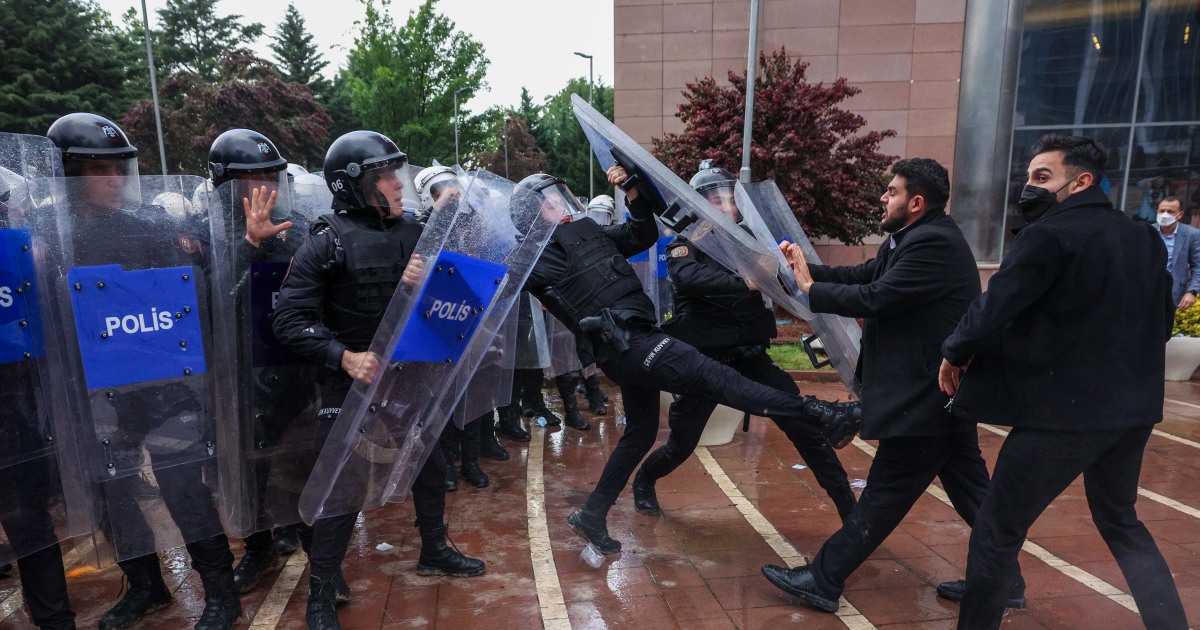
On Sunday, police forces seized the headquarters of Turkey’s leading opposition party, the Republican People’s Party (CHP). This operation came amid rising tensions, resulting in the use of tear gas and rubber bullets against supporters and officials who had gathered outside the building.
Police Action and Aftermath
The police action marked the conclusion of a lengthy standoff that lasted several hours, aimed at pushing out party leader Ozgur Ozel and his supporters. Eyewitness reports and local media footage showcased the chaotic scenes as riot police stormed the building. The visuals depicted substantial clouds of tear gas and widely scattered debris, with correspondents claiming that doors and furniture were notably damaged during the incident. The forceful police response has drawn widespread condemnation and raised numerous questions about the state of political freedom in Turkey.
Legal Disputes and Political Tensions
The confrontation followed an appeals court ruling that annulled Ozel’s election as CHP chairperson held in November 2023. According to the court’s decision, Ozel was to be replaced by Kemal Kilicdaroglu, who previously led the party for over a decade without securing a national election victory. The legality of such an abrupt change has been intensely scrutinized, given that Ozel’s leadership had recently guided the CHP to significant electoral successes, including a remarkable performance against President Recep Tayyip Erdoğan’s ruling party in the 2024 municipal elections.
The opposition argues that this judicial decision aims to undermine the CHP, already struggling against a wave of legal challenges targeting its members and elected officials. Many observers view the motives behind these court actions as politically charged, serving to blunt the influence of the party ahead of upcoming elections.
Implications for Future Elections
Looking forward, the next presidential election in Turkey is slated for 2028. However, President Erdoğan possesses the authority to call for early elections. A critical challenger to his rule is Istanbul Mayor Ekrem Imamoglu, a CHP member, who has been imprisoned since March and is currently facing corruption charges. This situation further complicates the political landscape, reinforcing the CHP’s claims of systemic targeting and suppression orchestrated by the ruling party.
Support for Ozel remains robust among CHP members, as they overwhelmingly rallied behind him during the standoff, leading to the new administration’s inability to exert control over the headquarters. Authorities had been gradually increasing police presence throughout the day, with a legal request from Kilicdaroglu’s team for police assistance to vacate the premises.
Conclusion: Erosion of Democratic Principles
Erdoğan’s administration has faced scrutiny for alleged political maneuvering against the opposition, emphasizing a trend toward authoritarianism. Since taking power first as prime minister and then president in 2003, Erdoğan has maintained a strong hold over the political landscape, despite setbacks faced in the 2019 elections when several major cities fell under CHP control. However, the recent developments at the CHP headquarters have escalated concerns regarding the viability of democratic norms in Turkey amidst increasing political repression.