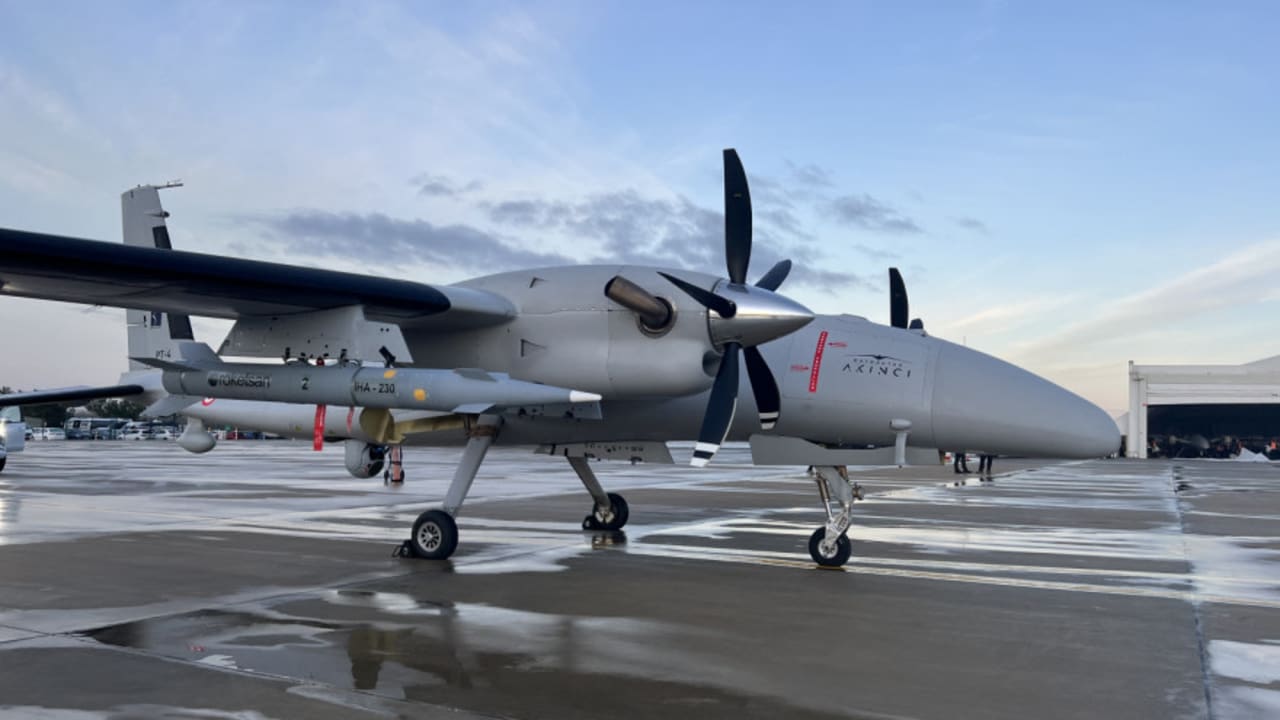
Turkey’s Roketsan UAV-230 Missile Enters Service
Turkey has marked a significant advancement in its military capabilities with the introduction of the Roketsan UAV-230 missile into the Turkish Land Forces Command’s arsenal. The revelation was made by Rear Admiral Zeki Akturk during a briefing from the National Defense Ministry. This new addition is expected to provide a substantial upgrade to Turkey’s firepower.
### Key Specifications of the UAV-230 Missile
According to information on Roketsan’s official website, the UAV-230 is an air-to-surface ballistic missile designed for supersonic flight, boasting a range exceeding 150 kilometers. Its versatility allows it to strike various targets, including mobile and stationary air defense systems, radar installations, communication infrastructures, command centers, and lightly armored vehicles. Weighing 225 kg and measuring 3.4 meters in length, the missile features a 42 kg warhead with options such as fragment, armor-piercing, or thermobaric types.
The UAV-230 operates as a fire-and-forget missile, utilizing an inertial guidance system supplemented by Global Navigation Satellite System (GNSS) capabilities. This design aids in countering adversarial jamming attempts, enabling operators to engage targets deep within enemy territory while maintaining a safe distance from the frontline.
### Performance and Launch Platforms
The missile is primarily launched from unmanned aerial vehicles (UAVs) like the Bayraktar AKINCI and AKSUNGUR, with aspirations for integration with other advanced UAV designs in the future. Initial successful tests of the UAV-230 date back to December 2022 when it hit a target 100 km away. Subsequent trials pushed that distance to 140 km by March 2023, and eventually to 155 km by November 2024. The Bayraktar AKINCI itself can reach altitudes of up to 12 km and carry diverse payloads, including air-to-air missiles and bunker-busting bombs.
### Enhancing Turkey’s Defense Autonomy
In alignment with its goal to achieve defense autonomy, Turkey aims to fulfill nearly all of its military requirements domestically by 2030. Following its exclusion from the F-35 program, the nation has diversified its defense projects, which now prominently feature the KAAN fifth-generation fighter jet, currently in development, and the Altay main battle tank, with expected deliveries starting in 2025. The Turkish Navy is also undergoing a modernization push with new submarines and air-defense destroyers.
In terms of missile technology, Turkey is advancing into long-range and hypersonic systems, exemplified by the Tayfun Block-4 ballistic missile, which is projected to exceed Mach 5 speeds with an 800-km range. Mass production of this missile is anticipated by 2026.
### Turkey’s Ascendance in Global UAV Markets
Turkey is home to a diverse and influential UAV and Unmanned Combat Aerial Vehicle (UCAV) arsenal, anchored by models such as the Bayraktar TB2, Akinci, and Anka series. These drones are characterized by their endurance, cutting-edge sensors, enhanced autonomy enabled by artificial intelligence, and versatile precision munitions.
The Baykar company, spearheaded by Selcuk Bayraktar, has become synonymous with Turkey’s drone advancements. Their UAVs have notably altered the dynamics of various conflicts globally, including those in Syria, Libya, Ethiopia, Nagorno-Karabakh, and Ukraine. As of now, Turkey reportedly controls approximately 65% of the world market for medium-altitude combat drones, outpacing both the U.S. and China.
With a rapidly expanding footprint in over 30 countries across Africa, Central Asia, and the Middle East, Turkey’s defense industry is shifting focus towards European and NATO markets. In fiscal year 2024, Baykar’s drone exports reached an impressive $1.8 billion, highlighting the international demand for its advanced UAV technology.