
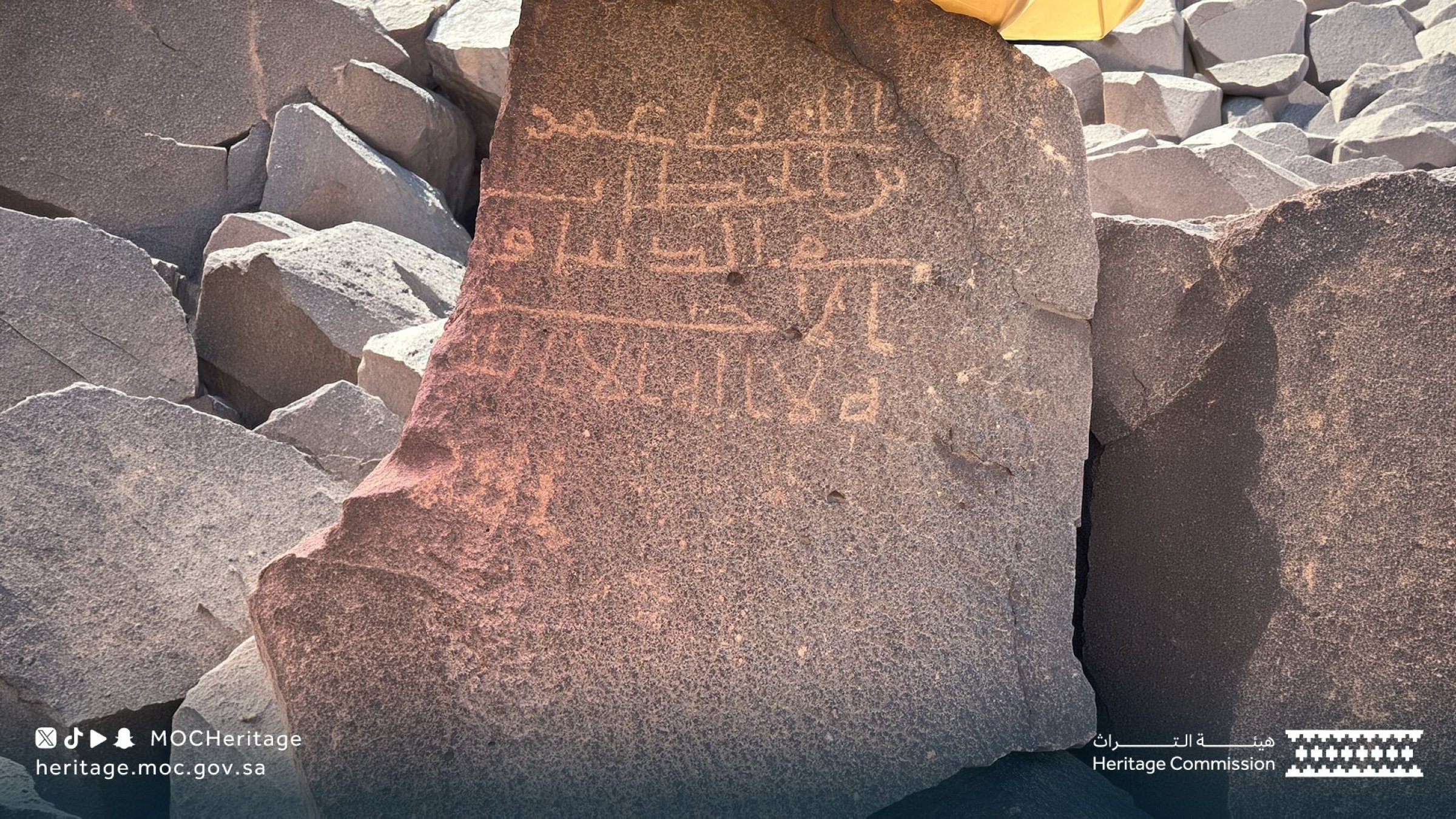
Saudi Arabia’s Heritage Commission recently unveiled a remarkable rock inscription featuring the name of Caliph Umar ibn al-Khattab. This discovery, made during extensive archaeological surveys in the Medina region, significantly enriches the nation’s expanding documentation of early Islamic heritage.
Significant Archaeological Findings
On Tuesday, the Heritage Commission announced that the inscription was one of 1,774 archaeological discoveries identified during the first and second seasons of a large-scale survey in the Al Mahd Governorate. These findings not only highlight the historical importance of the area but also reveal its vibrant and diverse past. The survey teams documented a total of 173 previously unknown archaeological sites, underlining the region’s wealth of historical significance.
Among these notable discoveries, teams unearthed 173 rock carvings that feature the name of Umar ibn al-Khattab—a significant figure in Islamic history—and ancient Arabic poetic inscriptions carved into stone, marking a connection to the rich literary heritage of the area.
Comprehensive Survey Results
According to the data shared by the Heritage Commission, the comprehensive survey yielded 1,259 rock art drawings, as well as 461 Islamic inscriptions, and 34 inscriptions in the Thamudic language. Additionally, findings included 11 stone structures, three palatial sites, two milestones indicating caravan routes, and four ancient wells. This extensive array of archaeological evidence is indicative of a flourishing culture in the region that thrived in various aspects, including governance, trade, and the arts.
The Legacy of Umar ibn al-Khattab
Umar ibn al-Khattab, who served as the second caliph of Islam from 634 to 644 CE, is celebrated as a close companion of Prophet Muhammad. His leadership was instrumental in the early expansion of the Islamic state, and his legacy continues to influence Islamic governance and jurisprudence. The rock inscription bearing his name not only highlights his historical importance but also serves as a testament to the enduring impact of early Islamic figures on the broader historical narrative of the region.
This discovery in Saudi Arabia represents a pivotal moment in the study of Islamic history, showcasing the importance of archaeological endeavors in uncovering the past. The findings from this survey remind us that historical narratives are often layered and complex, urging us to continually explore and understand the diverse cultures that have shaped our world. As more discoveries arise, there is sure to be a deeper appreciation for the rich heritage embedded within the landscapes of Saudi Arabia.