
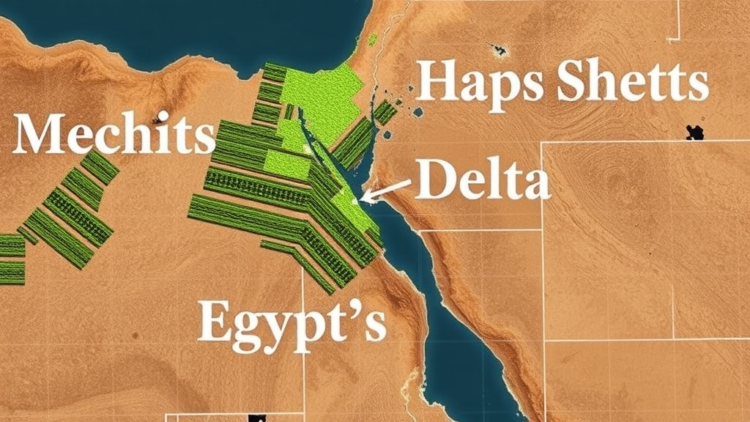
In Egypt’s Nile Delta, timely insights into crop water stress can significantly impact agricultural output. A groundbreaking study featured in Smart Agricultural Technology introduces an advanced artificial intelligence framework designed to accurately assess vegetation water stress utilizing satellite imagery. This innovative tool serves as a critical resource for water managers grappling with the challenges of agricultural sustainability in an area known for its intense water limitations. Led by researchers Ahmed Elbeltagi, Aman Srivastava, and Abdullah A. Alsumaiei, the study zeroes in on the Dakahliyah Governorate, a vital agricultural zone increasingly affected by water scarcity.
The Complexity of Water Stress in Agriculture
Understanding vegetation water stress is inherently complex. It encompasses changes in various factors such as canopy greenness, leaf area, surface temperature, and evaporation rates, all observable through satellite data. Tools like the Normalized Difference Vegetation Index (NDVI), Enhanced Vegetation Index (EVI), and others provide crucial insights into crop health across large areas. However, synthesizing this multifaceted data into a coherent estimate of water stress has historically posed challenges, particularly in irrigated regions where human intervention complicates natural plant responses to climate variables.
Utilizing Satellite Data for Improved Accuracy
The researchers leveraged MODIS satellite products from 2018 to 2025, employing data sets such as NDVI and EVI at a resolution of 250 meters. They also included metrics like Leaf Area Index (LAI), Fraction of Photosynthetically Active Radiation (Fpar), Evaporative Stress Index (ESI), and Land Surface Temperature (LST) to enhance their analytical depth. Special care was taken to ensure data quality by excluding unreliable satellite pixels affected by factors like clouds or shadows. This comprehensive approach allowed for robust model training, backed by a testing period to validate results.
Innovative Methodologies in Data Analysis
A key aspect of the study is the innovative integration of Best Subset Regression (BSR) with machine learning techniques. Instead of using every available parameter, the researchers focused on the most impactful indicators—LAI, Fpar, ESI, NDVI, and LST—by assessing which combinations offered the best predictive accuracy. This tailored approach was combined with various machine-learning models, including Random Forest and multilayer perceptron networks, revealing significant efficiency improvements in model performance.
Impact and Future Application
The outcomes of this feature-optimized framework were noteworthy. After implementing BSR, the Random Forest model emerged as the top performer, achieving a correlation of 0.9943 with minimal error rates. Cross-validation reinforced these findings, affirming the model’s reliability across varied data sets. The research highlights the potential of this artificial intelligence approach to facilitate real-time vegetation monitoring at the governorate level. While it currently assesses the existing conditions rather than forecasting future needs, the application of this technology could revolutionize irrigation management.
The research underscores the growing need for scalable, efficient solutions in agricultural sectors facing water scarcity. By identifying the most informative satellite indicators of crop water stress and streamlining the analytical process, the study demonstrates how technology can enhance agricultural resilience, especially in semi-arid zones of the world. As climate change intensifies, strategies like those developed in Dakahliyah could serve as critical components in safeguarding food security and optimizing resource allocation in agricultural systems.