
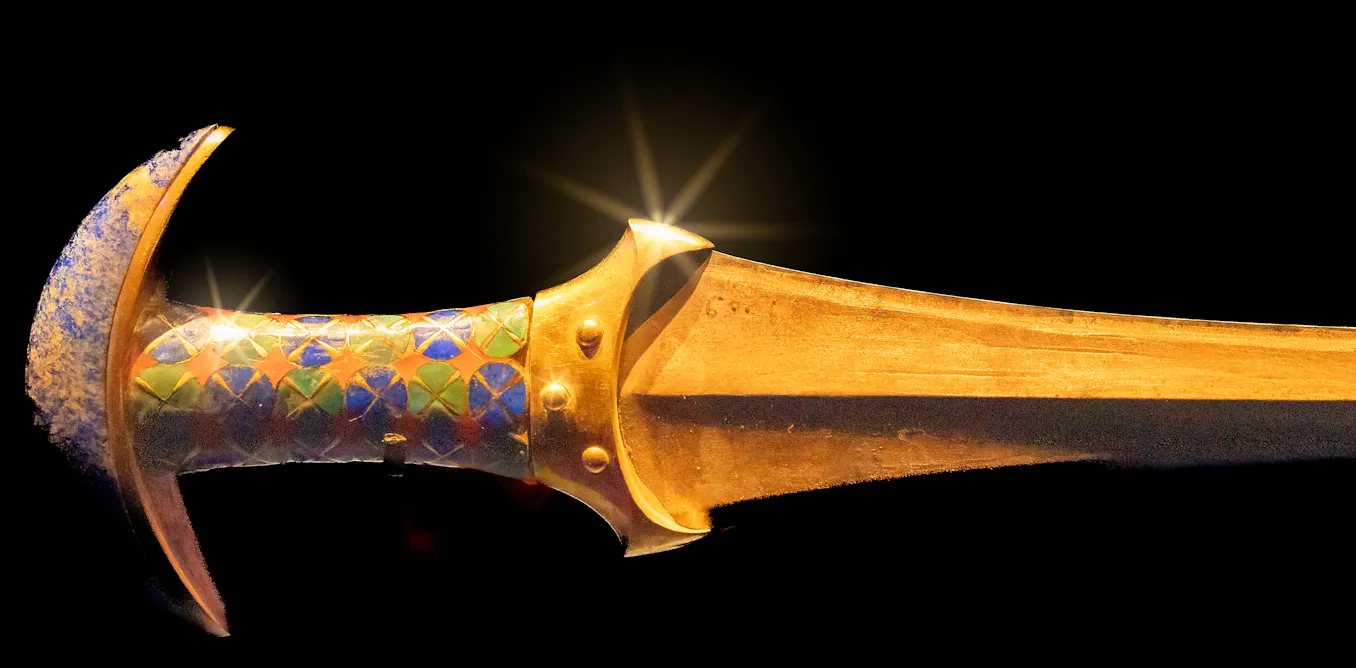
For many years, the perception of ancient Egyptian princesses has revolved around ideals of beauty, ceremony, and royal status. However, recent research is reshaping this narrative, suggesting that princesses from the Middle Kingdom were not just symbols of privilege, but skilled and trained individuals capable of wielding weapons, including bows and maces. This surprising revelation invites a reevaluation of gender roles in ancient Egypt and highlights the active participation of women in a male-dominated society.
New Insights from Scientific Research
A groundbreaking study published in Frontiers in Environmental Archaeology has revealed intriguing details about a select group of royal princesses. Researchers focused on the skeletal remains of six mummies unearthed in the late 19th century at Dahshur, a royal burial site located on the west bank of the Nile. Among these remains were four daughters of King Amenemhat II, identified as Ita, Itaweret, Sathathormeryt, and Khenmet, while the sixth belonged to King Hor. The weapons and items buried with these princesses provide compelling evidence that they were active participants in their society, rather than mere bystanders in the power structures of their time.
The skeletal analysis indicated significant physical fitness, particularly in the upper body, suggesting that these women engaged in repetitive activities like archery. The presence of bows, arrows, and maces in their graves strongly indicates that they were not just ceremonial objects; these weapons were likely utilized during their lifetimes. Such findings challenge historical assumptions about the roles of women, revealing that they played crucial parts in various aspects of statecraft.
Understanding Women’s Roles in Ancient Egyptian Society
Women in ancient Egypt held more active roles than previously thought. They were not confined to the background, supporting male leadership; many women governed the nation and contributed to its development. This newfound evidence sheds light on how royal women, such as the princesses from Dahshur, were deeply intertwined with the affairs of the state, highlighting the extensive capabilities of women beyond traditional roles.
The study emphasized the need to reconsider how archaeology interprets gender roles across history. Traditional narratives often misrepresent female presence in power dynamics based on artistic depictions that may not necessarily reflect reality. Egyptian art aimed to convey complex conceptual ideas rather than serve as accurate historical documentation. Therefore, relying solely on artistic representations can lead to misconceptions about women’s influence and agency in ancient societies.
The Broader Implications for Gender Studies
The exploration of “warrior women” extends beyond ancient Egypt, offering insights into the dynamics of gender roles throughout history. The Dahshur princesses serve as a reminder that women were often active and capable figures, defying conventional boundaries of their time. This idea resonates with recent archaeological findings in various cultures, where items typically associated with masculinity—such as weapons—were found in female graves. For instance, the recent reexamination of Viking warrior graves has produced similar findings, revealing that women likely participated in conflicts and held leadership roles.
As modern archaeology continues to evolve, it aims to address historical biases that have overlooked women’s contributions across different cultures and time periods. The burgeoning database of ancient Egyptian women serves as a crucial step in uncovering the histories of women who shaped their societies, prompting further investigation into their lives.
In conclusion, the evidence surrounding the Dahshur princesses compels us to reconsider the roles of women in ancient Egypt not merely as passive figures but as active participants in governance and warfare. These insights enrich our understanding of the complexities of ancient societies and challenge existing narratives about gender, power, and agency. The rest of the world can benefit from this evolving perspective, reminding us that historical lives cannot be neatly categorized into binary roles.