
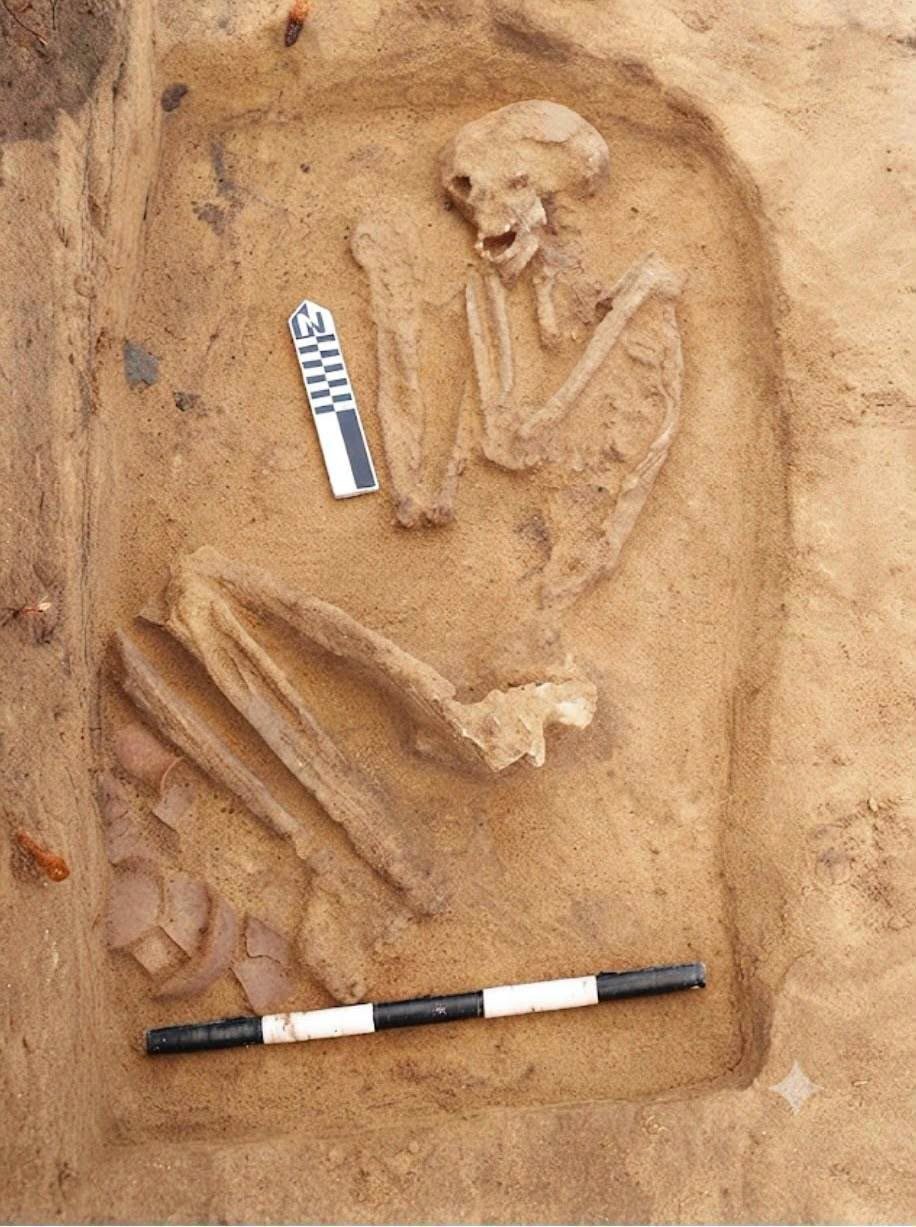
An exciting archaeological discovery in Dakahleya governorate has unveiled an ancient cemetery that spans from the Predynastic Period to the Greco-Roman era, as well as a settlement dating back to the Second Intermediate Period. This revelation, announced by Egypt’s Ministry of Tourism and Antiquities, highlights the historical evolution of settlement patterns and burial customs in the eastern Nile Delta across multiple millennia.
Significance of the Discovery
Tourism and Antiquities Minister Sherif Fathy commended the archaeological team’s efforts, labeling the findings as a significant scientific contribution to understanding the Delta’s historical and cultural progression. He acknowledged the expertise of the Egyptian archaeologists leading the excavation, which underscores the importance of preserving and studying Egypt’s deep-rooted history. Hisham El-Leithy, Secretary-General of the Supreme Council of Antiquities, further emphasized the archaeological importance of Kom Al-Khelgan, calling it one of the most promising sites in the eastern Nile Delta.
El-Leithy noted that these recent findings not only outline the progression of settlement patterns but also reveal variations in funerary traditions and human interactions with the surrounding environment from prehistoric times through the Greco-Roman period. Ongoing excavations are expected to uncover even more valuable insights as researchers continue their work in this historically rich area.
Findings from the Early Periods
The earliest discoveries at the Kom Al-Khelgan site date back to the Lower Egyptian culture, specifically during the Buto I and Buto II phases of the fourth millennium BC. The archaeological team uncovered simple oval-shaped burial pits carved from the sandy soil, showcasing diverse burial positions that reflect the funerary customs of the time. The graves contained modest offerings such as handmade pottery vessels and marine shells, suggesting that a significant population resided in the area during this early period.
Additionally, researchers found remains of a settlement alongside tombs established during the Second Intermediate Period and extending into the New Kingdom. The residential structures unearthed include mud-brick buildings, grain storage silos, ovens, and hearths, each offering crucial insights into the daily lives and economic activities of the community. Distinctive sinusoidal mud-brick walls encircling residential and funerary areas indicate an architectural style prevalent from the Middle Kingdom to the New Kingdom.
Insights into Hyksos-era Occupation
Several tombs were also disclosed, dating between the 15th and 17th Dynasties, indicating that the region remained active during the Hyksos period. Its proximity to Avaris, the capital of the Hyksos in the eastern Delta, adds layers of archaeological significance to this discovery. The varying designs of the tombs—some in the mastaba style and others featuring decorative elements—suggest that burial customs diversified during this time.
Grave goods recovered include jewellery, amulets, scarabs, and tools, along with Tell el-Yahudiya ware, a specific pottery style associated with the Second Intermediate Period. Hisham Hussein, head of the Central Administration of Lower Egypt Antiquities, revealed a mud-brick tomb from the early 18th Dynasty, revealing pottery and bronze tools indicative of the period. The excavation also unveiled the foundations of a robust mud-brick structure with substantial walls, hinting at a bustling community life.
Kom Al-Khelgan continued to serve as an inhabited site throughout the Ptolemaic period, as evidenced by several burial pits, including the intriguing find of a child’s grave situated inside two reused amphorae. This particular burial practice reflects the era’s customs and reinforces the site’s continuous occupation throughout different phases of Egyptian history.
With ongoing excavations, archaeologists at Kom Al-Khelgan anticipate further discoveries that will enhance their understanding of the area’s extensive history and its role in the cultural evolution of the eastern Nile Delta. The findings at this site not only illuminate ancient practices but serve as a window into the lives of communities that thrived in this historically rich environment.