
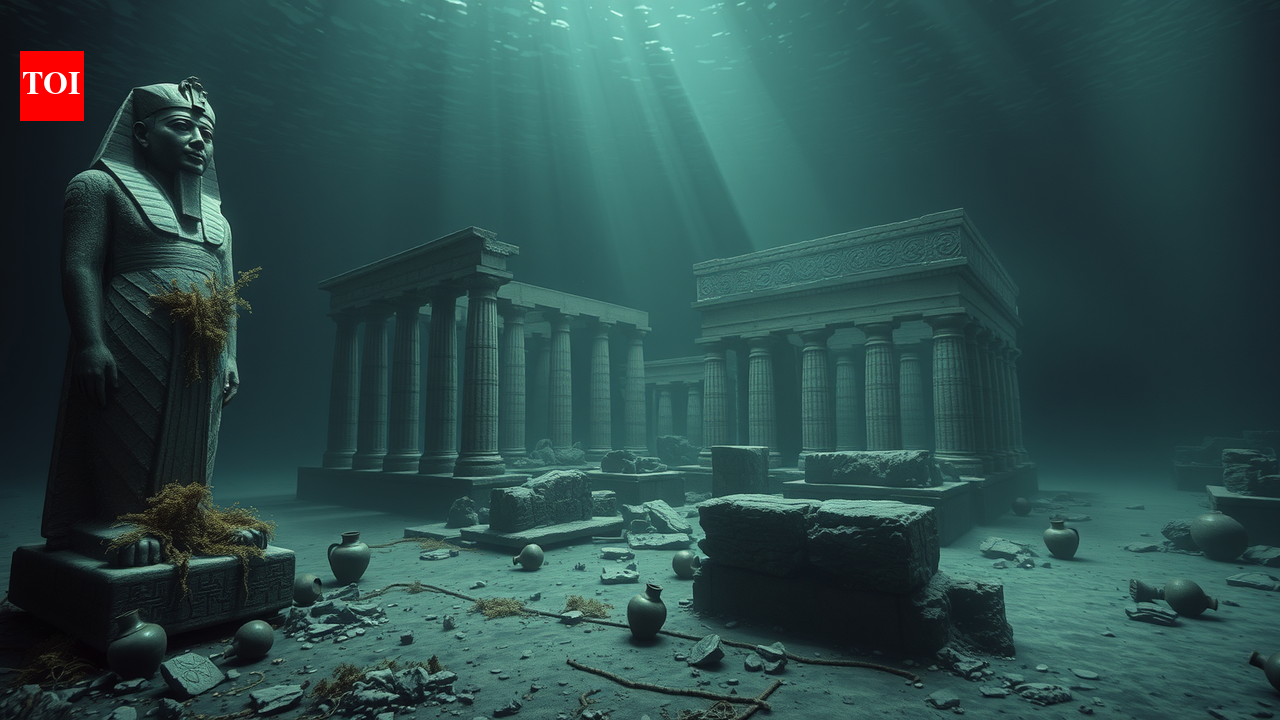
Under the waves of the Bay of Aboukir, approximately 7 kilometers off the coast of modern Egypt, lies Thonis-Heracleion, an ancient city that has long been forgotten by most of the world. Once the largest port on Egypt’s Mediterranean side, it was a bustling gateway for merchants, soldiers, and pilgrims before mysteriously vanishing around the second century BC due to catastrophic events including rising sea levels and earthquakes. Rediscovered in 2000 by French archaeologist Franck Goddio and his team from the European Institute for Underwater Archaeology, recent findings in September 2023 have unveiled a wealth of treasures, including the remains of a grand temple and a trove of ancient artifacts.
The Significance of Thonis-Heracleion in Ancient Egypt
Before Alexandria rose to prominence, Thonis-Heracleion was the critical entry point for all maritime traffic coming from the Mediterranean. Established roughly 2,500 years ago near the Canopic Branch of the Nile—one of Egypt’s main navigable arteries—the city required every incoming vessel to dock, allowing for the flourishing trade of olive oil, wine, silver, and ceramics. It was a strategic commercial hub where not just goods but cultural exchanges occurred until it succumbed to natural calamities, ultimately being buried beneath the waves along with its irreplaceable treasures, statues, and temples.
Excavations since its rediscovery have unearthed multiple remarkable finds, including 64 well-preserved ships and 700 anchors, as well as gold coins and colossal statues that once towered over the city. Among these discoveries is the vast Temple of Amun-Gereb, which played a significant role in the religious and political life of ancient Egypt. This temple served not only as a place of worship but also as a venue where pharaohs received their divine legitimacy from the god Amun.
The Temple of Amun and its Treasures
The most significant discovery in 2023 involved the temple treasury of Amun, a site of major cultural importance. The catastrophic seismic events of the mid-second century BC led to the temple’s collapse into a canal, burying its treasures under layers of hard clay that remarkably preserved them for over two millennia. Among the artefacts retrieved from the site are exquisite silver ritual instruments, gold jewelry, and beautifully crafted alabaster containers for perfumes—symbols of both wealth and craftsmanship in ancient Egyptian society. Notably, among the gold artifacts was a Djed pillar, a symbol of stability, showing the economic significance of the temple during its peak.
Additionally, the excavation revealed wooden structures beneath the temple, supported by well-preserved posts and beams dating back to the 5th century BC. These underground findings suggest earlier phases of construction, indicating that the site held significance long before the temple as we know it was built. The anaerobic clay surrounding these structures allowed for exceptional preservation, presenting opportunities for ongoing analysis and research.
Insights into Greek Influence and the Discovery of Aphrodite’s Sanctuary
One of the more fascinating discoveries was a sanctuary dedicated to the Greek goddess Aphrodite located east of the Temple of Amun. Unearthed bronze and ceramic items from this site highlight the presence of Greek settlers who lived and worked in Thonis-Heracleion during the Saïte dynasty (664–525 BCE). This blend of cultures illustrates the city’s role as a cosmopolitan trading hub—a melting pot where Greek mercenaries and traders coexisted alongside the native Egyptians.
Archaeological finds from the Aphrodite sanctuary include a delicate duck-shaped pourer, indicating the sophistication of the artisans involved. These artifacts add layers to our understanding of the diverse communities that populated Thonis-Heracleion, reshaping historical narratives around the influence of Greek culture in ancient Egypt.
In summary, the remarkable finds from Thonis-Heracleion provide invaluable insights into a vibrant, interconnected world. These discoveries tell the story not just of a lost city but of a crucial trade nexus that shaped cultural and economic exchanges for centuries.