
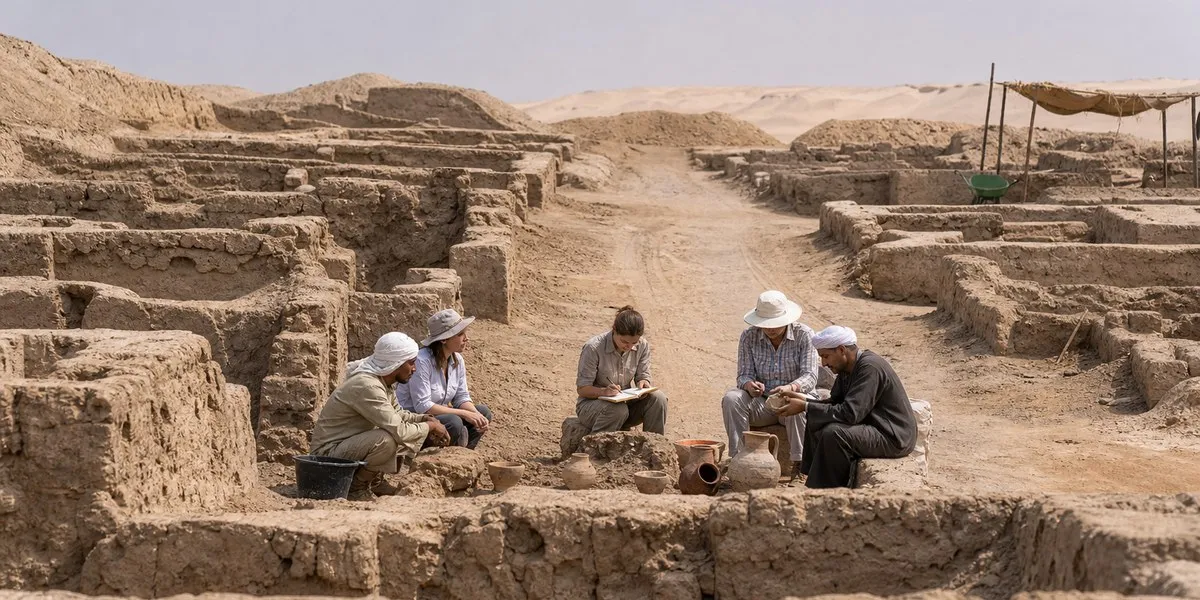
Archaeologists conducting digs at the ancient Egyptian site of Tell el-Abqain, located in the Beheira Governorate, have unveiled significant finds from the New Kingdom period. These discoveries include living quarters of warriors, granaries, royal inscriptions, and the burial site of a young stallion. This revelation highlights the site’s historical importance, particularly in its role as a defensive fortress against Libyan tribal attacks during that era, as reported by the Jerusalem Post and Egypt’s Ministry of Tourism and Antiquities.
Infrastructure and Food Supplies
Among the notable findings is a main thoroughfare, approximately four meters wide, that runs east to west through a large residential complex constructed of mudbrick. This road intersects with a street running north to south, providing a direct route to the fortress’s southern entrance and linking the living quarters to military facilities. The design of these roads suggests a well-planned urban environment aimed at supporting both residential and military needs.
Additionally, the complex features grain silos and ceramic ovens used for food preparation. Rooms located north of the main road served as storage areas for wheat, with archaeologists uncovering large vessels containing charred grains, effectively confirming the presence of agricultural resources at the site. This reinforces the notion that the fortress was not only a military stronghold but also a vital center for food production and supply, critical for sustaining its inhabitants and defending against threats.
Equestrian Discoveries and Royal Inscriptions
One of the standout discoveries is the carefully executed burial of a young male horse, which appears to have belonged to a breed known for its agility and speed. This horse likely served multiple purposes, including training, military uses, or being harnessed for war chariots. The deliberate burial position suggests a ritualistic significance, indicating respect for the animal by its owners.
In proximity to the horse’s burial site, archaeologists have identified fragments of alabaster and limestone that may have decorated the harness of a chariot. Additionally, fragments of a limestone stele inscribed with hieratic characters attributed to Pharaoh Merneptah from the 19th Dynasty were discovered, providing further insight into the hierarchies and beliefs of the time. The inscription parallels the might of the pharaoh with the strength of the god Set, underscoring the intertwining of religion and governance in ancient Egypt.
Artifact Treasures and Cultural Insights
The excavation has also yielded numerous artifacts that contribute to our understanding of ancient Egyptian culture. Notable discoveries include scarabs inscribed with the names of Pharaohs Ramesses II and Seti I, various amulets shaped like fish, lotuses, and cobras, as well as pottery, stone tools, and ornamental objects. Each item serves as a testament to the rich cultural and spiritual life of the New Kingdom society.
Such artifacts signify the importance of both religious and socio-political structures during the period. The presence of diverse items, from functional tools to decorative elements, indicates a complex society engaged in agriculture, warfare, and artistry, providing a window into life during one of Egypt’s most illustrious epochs.
Through these recent excavations, Tell el-Abqain offers valuable insights into the daily lives of ancient Egyptians, their military capabilities, and their beliefs, reinforcing its historical significance as a site of both strategic defense and cultural richness.