
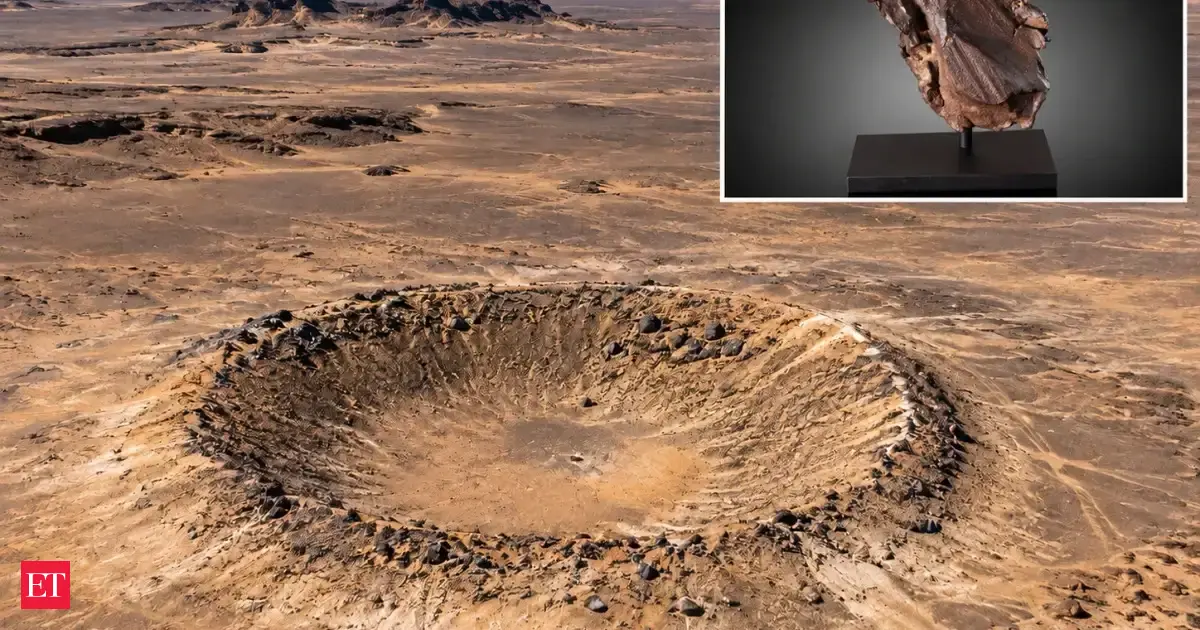
Vincenzo De Michele, an Italian mineralogist previously associated with Milan’s Natural History Museum, embarked on a quest to locate ancient settlements in Egypt’s desert in 2008. While examining satellite images, he stumbled upon a striking circular feature on the landscape, situated near the junction of Egypt, Sudan, and Libya. This feature would later be identified as a remarkable impact crater, which scientific research identified as the Kamil Crater, one of the most pristine impact sites discovered on Earth.
The Formation of Kamil Crater
The Kamil Crater measures 148 feet in diameter and features a raised rim that stands about 10 feet above the surrounding desert terrain. Researchers note that the crater’s true floor lies 52 feet beneath the rim; however, sand accumulation has lowered the visible floor to about 33 feet. Named after Gebel Kamil, a nearby rock formation, this crater is situated in the East Uweinat district, a desolate area characterized by rocky plains that have remained largely unchanged over time.
The Cosmic Visitor: An Iron Meteorite
Scientific investigations revealed that Kamil Crater was formed by the collision of an iron mass approximately 4 feet wide and weighing around 10 tons. Entering Earth’s atmosphere at an average speed of about 18 kilometers per second, the meteorite decelerated to roughly 3.5 kilometers per second by the time it impacted the ground. Notably, this meteorite did not disintegrate in the atmosphere as most do; instead, it maintained its structure upon descent, ultimately exploding upon striking the Earth.
Discoveries and Insights from the Kamil Expedition
In February 2010, a comprehensive geological expedition was launched to explore the crater. Over a year of meticulous planning enabled scientists to recover 5,178 meteorite fragments, totaling around 1.71 tons. The majority of these fragments were small, weighing under 34 kilograms each, but a significant find was an intact piece weighing 83 kilograms. Categorized as an “ungrouped” iron meteorite named Gebel Kamil, it contains an unusually high nickel content, nearly 20%, along with elevated levels of germanium and gallium, providing intriguing clues about its origins.
A Unique Natural Laboratory
The Earth features only 176 verifiable impact craters, and significantly, Kamil Crater has remained remarkably intact. This preservation allows scientists to use it as a real-world laboratory to compare theories and models developed over the years regarding meteorite impacts. Earlier theories posited that iron masses of a specific size would disintegrate during descent; however, Kamil’s findings have prompted a re-evaluation, suggesting that approximately 35% of such iron meteorites survive entry into the atmosphere largely intact, a hypothesis that requires further validation.
Insights into Planetary Science
The Kamil Crater offers a striking visual with residual rays extending from its rim, marking the pathways of rocks ejected during the impact event. Such rayed craters are widely documented on the Moon and Mars, where weathering forces are minimal. The Kamil Crater stands out among Earth’s geological features, providing researchers with a unique opportunity to examine a well-preserved impact site. This exceptional condition makes it an invaluable resource for planetary scientists, granting them the ability to study impact phenomena comparable to those observed on celestial bodies, showcasing the craters’ importance not only in understanding Earth’s geological history but also in broader planetary studies.