
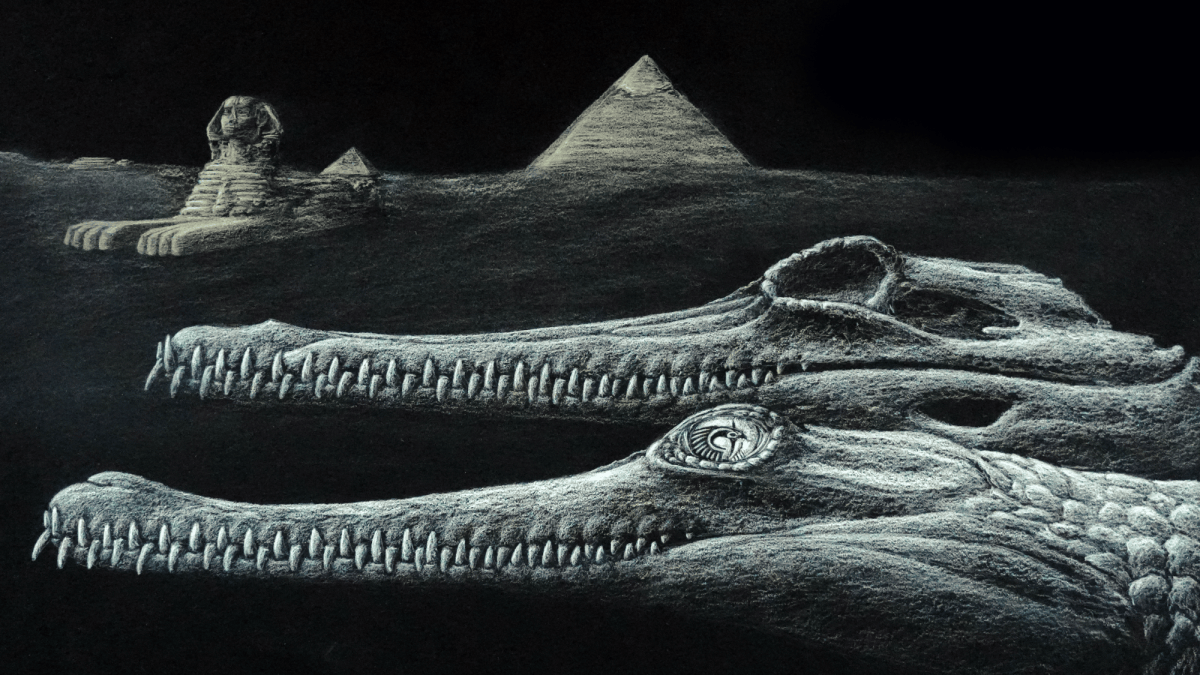
The Great Sphinx of Giza has captured the imagination of historians and archaeologists for over 4,500 years. This enigmatic monument, dating back to Ancient Egypt’s Fourth Dynasty, continues to unveil its secrets, including notable fossil discoveries buried in its vicinity. Among these recent finds is a newly identified species of extinct crocodile named Herugavialis cairensis. This discovery adds another layer to the already rich tapestry of life that once flourished in ancient Egypt.
The Great Sphinx: A Symbol of Power and Mystery
Standing majestically at 66 feet tall, the Great Sphinx features the body of a lion and the head of a man, symbolizing royal power. While the exact identity of its creator remains uncertain, many believe it was sculpted during the reign of Pharaoh Khafre, who is also recognized for constructing one of the famous pyramids in Giza. This iconic structure has fascinated both scholars and the public, sparking countless speculations about its purpose and history.
The Significance of the Crocodile Discovery
Crocodiles, like lions, are prominent figures in Egyptian art, often depicted in tombs and temples. The recently identified species, Herugavialis cairensis, is part of a group known as gavials, recognized for their elongated, slender snouts. Today, these crocodiles primarily inhabit freshwater environments across the Indian subcontinent and Southeast Asia. Presently, only two species of gavials exist: Gavialis gangeticus and Tomistoma schlegelii, also referred to as the ‘false gharial’.
Historically, however, fossils indicate that gavials once thrived across various continents. For over 100 million years, many of these creatures inhabited shallow marine areas. Previous excavations in Egypt’s Mokattam Formation during the 1920s recovered several crocodile fossils, initially attributed to the false gharial due to morphological similarities.
Paleontological Insights and the Naming of *Herugavialis*
Recent advances in paleontological techniques have enhanced scientists’ ability to analyze skull fossils, including the one uncovered in the 1920s. Although Herugavialis is relatively well-preserved, a unique feature drew researchers’ interest: the absence of its snout tip. This peculiar detail led to a fascinating connection with the Sphinx, which is famously known for its own missing nose.
“There is a symbolic tie between the lost tip of the crocodile’s snout and the Great Sphinx’s famously absent nose,” noted Philip Mannion, a co-author of the study. The crocodile is named after the Egyptian deity Heru, who may have inspired the Sphinx’s design. This connection highlights not only the physical, but also the cultural intertwining of ancient Egyptian life.
The Ecological Landscape of Ancient Egypt
When the Great Sphinx was constructed, Herugavialis was not the only crocodile species inhabiting ancient Egypt. The region was characterized by shallow marine areas that supported at least two other types of gavial crocodiles. “For much of the last 50 million years, the Mediterranean region was home to a diverse array of crocodilians, including gavials,” explained co-author Paul Burke. However, environmental changes over time ultimately led to the decline of crocodile populations as the Mediterranean dried up approximately 6 million years ago.
These exciting discoveries continue to shed light on the evolutionary history of crocodiles and their ecological significance during ancient times. As researchers uncover more evidence, the Great Sphinx and its surroundings remain a vital link to understanding the complexity of life in prehistoric Egypt. The revelations serve as a constant reminder of how much we still have to learn about our planet’s history and the creatures that once roamed it.