
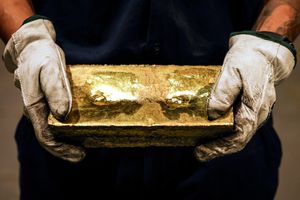
Gold prices surged past $4,100 an ounce on Monday, following a lull in hostilities between the U.S. and Iran. This temporary ceasefire has led to a decrease in oil prices, alleviating inflation concerns ahead of a crucial Federal Reserve meeting scheduled for later this week.
Gold Prices on the Rise
Spot gold saw an increase of up to 1.6%, reaching over $4,100, as reported by Bloomberg. By late morning in London, prices adjusted slightly lower but were still up by 1.1%, sitting at $4,095.16 per ounce. Silver also displayed significant gains, climbing 1.9% to $59.27 an ounce. Meanwhile, Brent crude oil experienced a notable decline, plummeting by as much as 9.5%. In a related trend, the U.S. dollar index slipped by 0.2%, which made dollar-denominated gold more accessible for international buyers.
Ceasefire and Market Reactions
For the third consecutive night, no attacks were launched by either Washington or Tehran. An Iranian official announced that Iran would refrain from further aggression, contingent upon the U.S. establishing a similar halt. This détente followed discussions between Iranian and Omani officials concerning shipping routes through the critical Strait of Hormuz. According to independent analyst Ross Norman, the recent developments have provided a positive backdrop for precious metals, particularly as oil prices have dropped and both the U.S. dollar and Treasury yields have eased.
The significance of falling oil prices cannot be overstated when it comes to monetary policy. High energy costs typically inflate consumer prices, which strengthens the argument for interest rate hikes. Since gold does not yield interest, it often suffers in such environments. Market analysts are now closely watching the Federal Reserve’s announcement on Wednesday, with approximately 66% of investors predicting that rates will remain unchanged. However, a 77% likelihood of a potential rate increase in September has been indicated by market calculations.
The Outlook for Gold
According to Norman, gold is exhibiting cautiously optimistic signals, balancing concerns from the Iranian situation with expectations surrounding the Fed. Should the Fed Chair push back against the market’s current pricing of two rate hikes, it could provide substantial support for gold prices.
Since late June, gold has maintained a relatively stable range, with demand keeping it above the $4,000 threshold. Despite this stability, the yellow metal has lost over 20% of its value since hostilities escalated when the U.S. and Israel initiated strikes against Iran in late February. This intervention interrupted a prolonged rally that had previously driven prices close to $5,600 an ounce.
Market analysts, like Justin Lin from Global X ETFs, emphasize that a significant resolution in U.S.-Iran relations is essential for gold to break its current range of $4,000 to $4,200. They argue that as long as geopolitical tensions persist, rising yields and inflation expectations will act as a barrier to any upward movement in gold prices. As the market awaits more clarity on both the geopolitical stage and the Federal Reserve’s decisions, gold remains in a cautious holding pattern.