
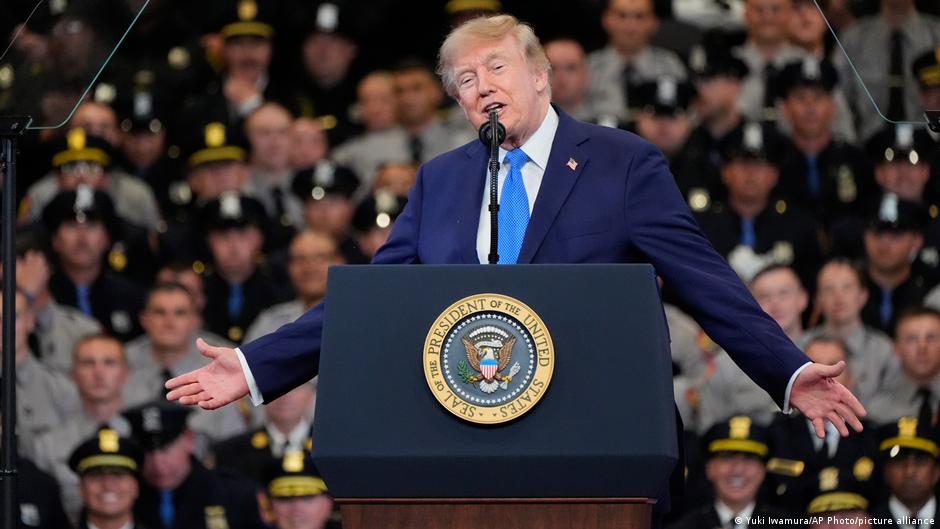
Former President Donald Trump recently suggested that he may soon declare the Strait of Hormuz as a U.S. territory while speaking at a rally in Garden City, New York. This announcement has sparked concern and speculation regarding its implications for U.S.-Iran relations and the ongoing conflict in the region.
Trump’s Assertion on the Hormuz Strait
During the rally, Trump claimed, “After we finish defeating Iran, which is being very badly defeated — pretty soon I’ll be declaring the Hormuz Strait a territory of the United States.” His comments indicated a bold stance, although it remains unclear whether he was expressing a serious policy shift regarding U.S. strategy towards Iran or merely making a provocative statement.
Iran quickly responded to Trump’s remarks. Kazem Gharibabadi, Iran’s Deputy Foreign Minister, firmly dismissed the notion, asserting that the Strait of Hormuz would remain under Iranian control and reiterating that the country would not be intimidated by U.S. threats. This back-and-forth underscores the escalating tensions between the two nations as both parties remain entrenched in their positions.
Current Landscape in the Strait of Hormuz
The Strait of Hormuz is a critical navigational passage, facilitating the transit of about one-fifth of the world’s oil and liquefied natural gas shipments. The conflict between the U.S. and Iran has escalated since the launch of a military campaign against Iran on February 28, with American officials declaring aims to dismantle Iran’s nuclear capabilities and instigate political change within the regime. Since the onset of hostilities, Iran has countered by targeting U.S. allies in the region and imposing a blockade on the Strait, further complicating the dynamics of global energy supply.
In retaliation, the United States has enacted its own naval blockade against Iranian vessels. This ongoing confrontation has led to a stalemate, significantly impacting global energy markets and driving prices higher amid fears of prolonged conflict. As the midterm elections approach in November, these economic repercussions are expected to influence voter sentiment significantly.
Remarks from the Garden City Rally
In addition to his comments on the Hormuz Strait, Trump urged Americans to accept higher gasoline prices as a necessary cost for securing national and global safety from what he termed “a very evil country.” He insisted that the measures being taken by the U.S. were beneficial not only for Americans but also for the wider world.
Moreover, Trump faced questions regarding the living conditions of troops stationed aboard the USS Abraham Lincoln, a U.S. aircraft carrier currently deployed in the Middle East. Reports of deteriorating living conditions and mental health issues among the crew have raised concerns, particularly with the ship being at sea for an extended period. Despite these reports, Trump downplayed the situation and suggested that the deployment length was insufficient, confirming that the carrier would soon be replaced by a similar vessel.
Trump’s provocative statements and the reality on the ground contribute to the complex narrative surrounding U.S. involvement in the Middle East. As the situation continues to evolve, the implications for U.S. foreign policy and international energy markets remain significant.