
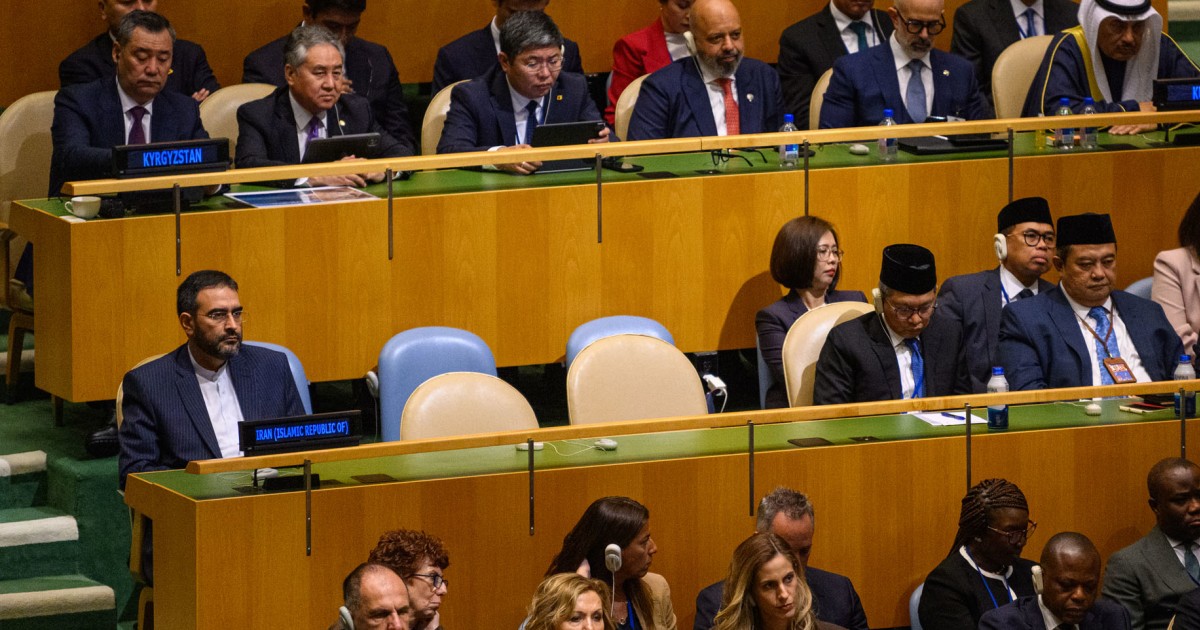
President Trump recently addressed the United Nations General Assembly, delivering a 37-minute speech that highlighted his administration’s domestic achievements while positioning the U.S. as a preeminent global leader. In an unexpected move, he urged for the term “artificial intelligence” to be replaced with “superintelligence.” However, the speech took a more serious turn as Trump issued a direct warning to Iran, with its diplomats seated in the audience. Senior White House correspondent Gabe Gutierrez sheds light on this pivotal moment.
Trump’s Repeated Warnings to Iran
This latest speech reiterates Trump’s longstanding warnings aimed at Iran. While he has previously expressed intentions to take a hardline stance against the nation, this marked a significant moment as the Iranian delegation was present in the chamber. The choice to highlight this threat in such a setting underscored the administration’s resolve in its approach to foreign policy, particularly concerning Iran.
Positioning the U.S. as a Global Leader
Throughout his remarks, Trump strived to present America as a dominant force on the world stage. He championed his domestic policies, aiming to demonstrate how these successes translate to greater international influence. The president’s comments on rebranding AI to “superintelligence” further illustrated his desire to be at the forefront of cutting-edge technology discussions. By doing so, he not only appealed to his domestic audience but also sought to assert America’s role in shaping global innovation.
Implications of Trump’s Threat
The direct threat to Iran amidst their diplomats raised eyebrows and drew attention to the precarious nature of international relations. Such rhetoric can have far-reaching consequences, potentially straining diplomatic dialogue. Observers are assessing how this bold tactic might influence Iran’s future actions and whether it could provoke retaliatory measures. The presence of Iranian officials in the audience during this pointed remark may have been a calculated move by the Trump administration to send an unequivocal message regarding U.S. policies toward Iran.
In a landscape of increasingly complex international relationships, Trump’s statements may also be perceived as an attempt to rally support domestically and demonstrate a show of strength on the world stage. As nations grapple with evolving dynamics, the reactions to Trump’s threats will likely shape diplomatic engagements moving forward.
In conclusion, Trump’s address at the United Nations General Assembly served multiple purposes: showcasing U.S. achievements, advocating for technological advancement, and delivering stern warnings to geopolitical adversaries like Iran. As this speech resonates within the halls of global diplomacy, the implications of the messages conveyed will undoubtedly continue to unfold in the months ahead.