
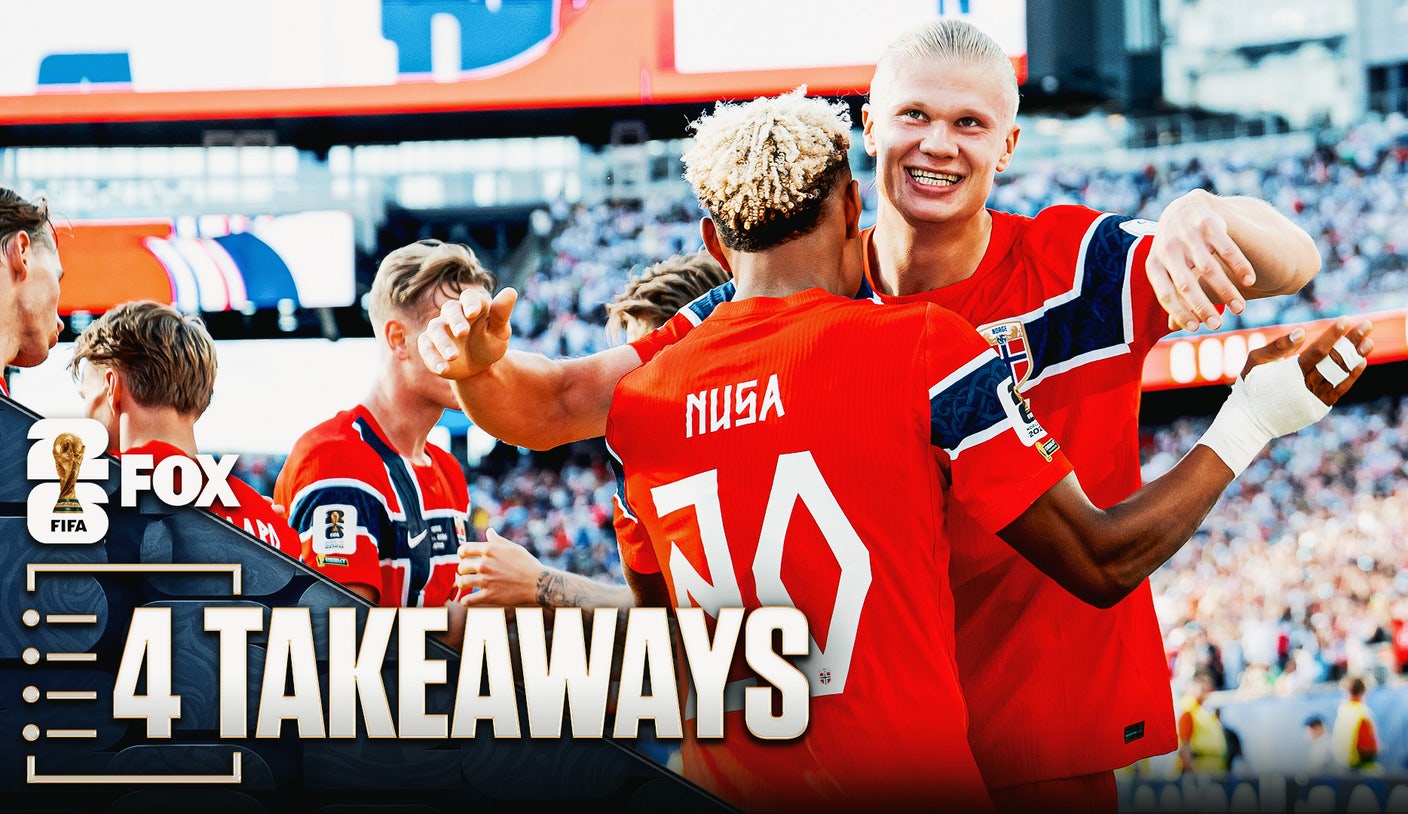
Norway made a triumphant return to the World Cup with an impressive 4-1 victory over Iraq at Boston Stadium. This match showcased Norway’s potential, as they had previously been identified as a possible dark horse for the tournament thanks to a flawless UEFA qualifying campaign. While the Norwegians did not deliver a flawless performance, they clearly earned their win, with credit due to Iraq for their effort, particularly in the first 75 minutes.
1. Haaland’s Long-Awaited World Cup Debut
Erling Haaland was undoubtedly one of the tournament’s most anticipated players. The Manchester City striker has achieved incredible success at the club level, but international competitions present a different set of challenges. This marked Norway’s first World Cup appearance since 1998, having not qualified for the European Championships since 2000—just after which Haaland was born. In this match, he made a significant impact, scoring two goals in the first half and propelling Norway to victory.
Haaland’s first goal showcased his exceptional talent as he made a near-unmatched run into the box, combining speed and precision to evade defensive efforts. His second goal came from relentless effort, capitalizing on a mistake by Iraq’s defense, while his push for a hat trick resulted in a crucial own goal, further cementing his importance to the team. This performance affirmed Haaland’s status as a formidable player on the international stage, making the World Cup even more exciting with his presence.
2. Assessing Norway’s Supporting Players
Norway’s tactical approach was evident as they sought to utilize speedy wingers and fullbacks to deliver the ball to Haaland. This strategy proved effective, with the team showing strong attacking prowess, especially in the first half when they exploited space on the left flank through players like Antonio Nusa and David Møller Wolfe. However, the midfield duo of Martin Ødegaard and Sander Berge struggled to exert control in the center, especially during the first half when Iraq dominated possession.
Despite Norway’s resounding 4-1 win, some aspects of their game raised questions. While Haaland can be relied upon for consistent performance, the effectiveness of the central midfield cannot be overlooked; their performance will need improvement as stronger opponents await in the tournament.
3. Iraq’s Competitive Spirit and Critical Mistake
Iraq’s game plan revolved around limiting Ødegaard’s influence, recognizing that stopping Haaland directly is often impossible. For the first 75 minutes, Iraq put on a commendable performance, demonstrating their ability to compete rather than simply defend. Amir Al-Ammari, a standout player from Cracovia, played an instrumental role in maintaining possession and generating opportunities, including an assist to Ayman Hussein, who leveled the score at 1-1.
However, a critical mistake proved detrimental to Iraq’s chances. Following their equalizer, defender Zaid Tahseen made an ill-advised backward pass to goalkeeper Jalal Hassan while under pressure from Haaland, resulting in a costly own goal. This blunder shifted the momentum firmly in Norway’s favor, and from there, Iraq struggled to recover.
4. Future Prospects for Both Teams
Group I presents a daunting challenge, featuring heavyweight teams like France and a strong Senegal side alongside Norway and Iraq. Norway’s victory was essential for their hopes of advancing, especially with four points typically being the benchmark for progress in the tournament. Their next match against Senegal, fresh from a tough loss to France, is likely to be a competitive fixture.
On the other hand, Iraq faces an uphill battle in a group where they are seen as underdogs. Despite moments of commendable play, their path forward will require sharper execution and consistency to be competitive against stronger teams. Both teams will need to regroup and prepare for their forthcoming matches, with Norway eager to build on their success and Iraq hoping to bounce back from a challenging opening encounter.