
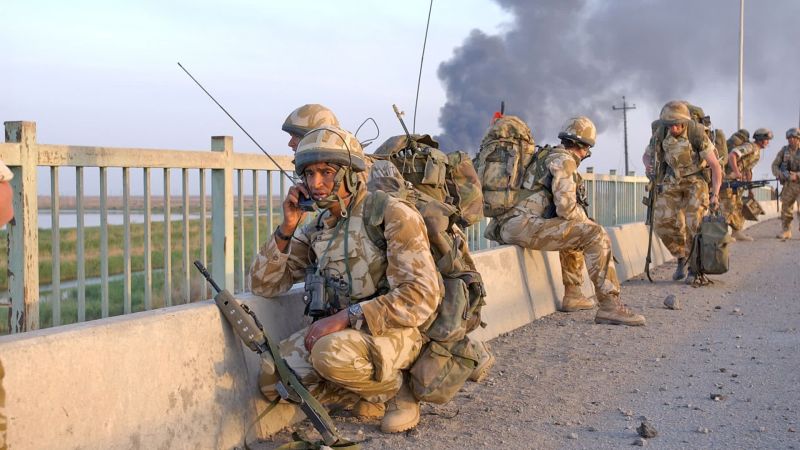
The 2003 invasion of Iraq marked a significant moment in military history, showcasing both rapid deployment capabilities and logistical challenges faced by the British Army. As the UK reflects on the 15-year anniversary of the war, insights from senior officers shed light on how the operation was conducted and the potential difficulties in executing similar missions today.
The Logistics Behind the Invasion
During the invasion, the British Army successfully mobilized 32,000 troops along with over 100,000 tonnes of military equipment in a mere 10 weeks. Major General (Ret’d) Tim Cross and Brigadier (Ret’d) Shaun Cowlam played pivotal roles in managing logistics. In interviews, they addressed issues surrounding the equipment shortages that plagued the campaign, including claims that soldiers deployed without proper desert gear. Cowlam explained these shortages arose from planning assumptions made prior to the conflict, emphasizing that the military’s scale was geared for a smaller operation. He highlighted that unpreparedness stemmed from a shift in deployment strategy that rushed thousands of troops into combat.
The logistical assembly required was complex: it involved numerous ships, aircraft, and vehicles mobilizing into a desert environment. Cowlam recalled a daunting build-up that included 354 aircraft and 15,000 vehicles. The planning and execution were complicated by a lack of established logistical command, which delayed some vital readiness processes. The implication was clear; robust logistics were critical for the invasion’s success.
Challenges in Readiness and Training
Colonel (Ret’d) Tim Collins, famed for his pre-war address to his battalion, recounted the quick transition to a wartime footing after being assigned to lead the Royal Irish Regiment. The limited timeframe for pre-deployment training posed considerable challenges for personnel needing acclimatization. Collins organized intensive training sessions, but logistical issues were compounded by unforeseen incidents, such as a negligent discharge during drills that forced soldiers to adapt quickly to the reality of imminent combat.
Despite these obstacles, the training sessions underscored the determination of the British forces. Collins noted the urgency of ramping up readiness against tight deadlines to ensure that troops could effectively operate in a combat environment only weeks after receiving their deployment orders.
Lessons Learned and Future Implications
As discussions emerge regarding the British Army’s capability to undertake similar large-scale operations today, all three senior military leaders expressed skepticism. They noted that current recruitment and resource limitations would hinder similar rapid deployments, calling attention to an overall reduction in available personnel and equipment. General Cross stated, “We would struggle to deploy more than a brigade-level capability,” highlighting how the military landscape has shifted since 2003.
Moreover, concerns extend to geopolitical tensions that could require UK forces to engage again in regions like the Middle East or Eastern Europe. Retired leaders voiced that if faced with a significant conflict today, the British Army might find itself at a structural disadvantage, further emphasizing that military readiness must evolve to meet contemporary challenges. With ongoing conflicts in Ukraine and elsewhere, the exhortation for substantial troop and equipment enhancements becomes even more pressing.
In conclusion, the reflection on the Iraq War serves not only as a retrospective of military strategy and logistics but also as a cautionary tale regarding the need for sustained readiness in an uncertain world. The insights from experienced commanders illustrate the complexities of modern warfare and the imperative for ongoing investment and adaptation within the British military framework.