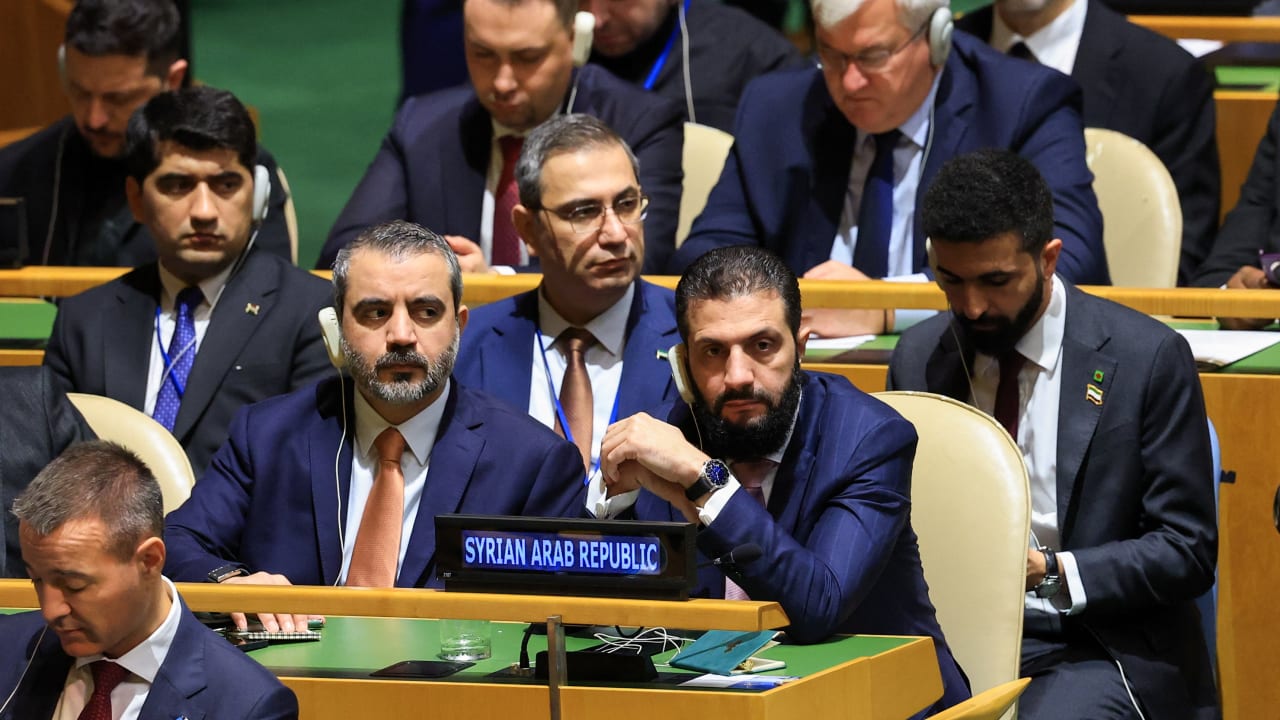
Syrian President Ahmed al-Sharaa provided a significant analysis of the relationship between Syria and Israel during a recent Atlantic Council discussion in New York. He stated that the recent tragic events of October 7 should not dictate Israel’s strategic direction concerning Syria, noting that there had previously been negotiations that nearly reached agreement.
Negotiations and the Golan Heights
Al-Sharaa revealed that direct discussions with Israel had been ongoing for about a year and involved American mediation. He emphasized Syria’s commitment to diplomacy, hoping to resolve issues through negotiations rather than conflict. According to him, the talks had achieved about 90% agreement at one point, but Israel would retract or add new conditions as they neared consensus. Despite setbacks, he affirmed that the dialogue channel remains open, highlighting a phased approach to peace that must prioritize Syrian security and rights.
The future of the Golan Heights emerged as a critical focus during the discussion. Al-Sharaa reiterated Syria’s stance that the territory remains rightful Syrian land, effectively dismissing the idea of negotiations concerning its fate. Addressing questions about former U.S. President Trump’s recognition of Israeli sovereignty over the Golan, he recalled a humorous exchange he had with Trump, while firmly asserting that the Golan Heights belong to Syria and cannot be relinquished by any external party.
Israel’s Security Policies and Regional Stability
Al-Sharaa argued that Israel’s security measures are counterproductive, exacerbating threats in the region instead of alleviating them. He emphasized that genuine security cannot be achieved through aggressive tactics, like daily bombings in Syria. His remarks included a pointed question about the effectiveness of such military actions and suggested that respecting the security of neighboring nations would be a more logical approach for Israel.
Pointing out the tragic loss of life in Gaza, he reminded the audience of the scale of civilian suffering, implying that the trauma should lead to a reevaluation of policies that perpetuate violence. Al-Sharaa advocated for a relationship built on mutual respect and economic cooperation, rather than one characterized by military aggression.
Transforming Syria: A Focus on Institutions
Beyond his remarks on Israel, Al-Sharaa presented a vision for a transformed Syria, emphasizing the need for a system grounded in law and collective governance rather than reliance on a single ruler. He articulated plans for a new constitution that would respect cultural rights, notably for the Kurdish population, and aspire toward a Syria free from foreign military bases.
He stated that ongoing negotiations regarding the status of foreign military presence in Syria are aimed at achieving this objective. Al-Sharaa’s vision depicts a more stable Syria where authority is institutionalized, paving the way for potential cooperation with various global powers while maintaining sovereignty.
In summary, Al-Sharaa’s discussion reflects a complex interplay of regional politics, historical grievances, and aspirations for a balanced future between Syria and Israel. His statements emphasize the importance of addressing underlying issues instead of allowing recent tragedies to shape long-term policy.