
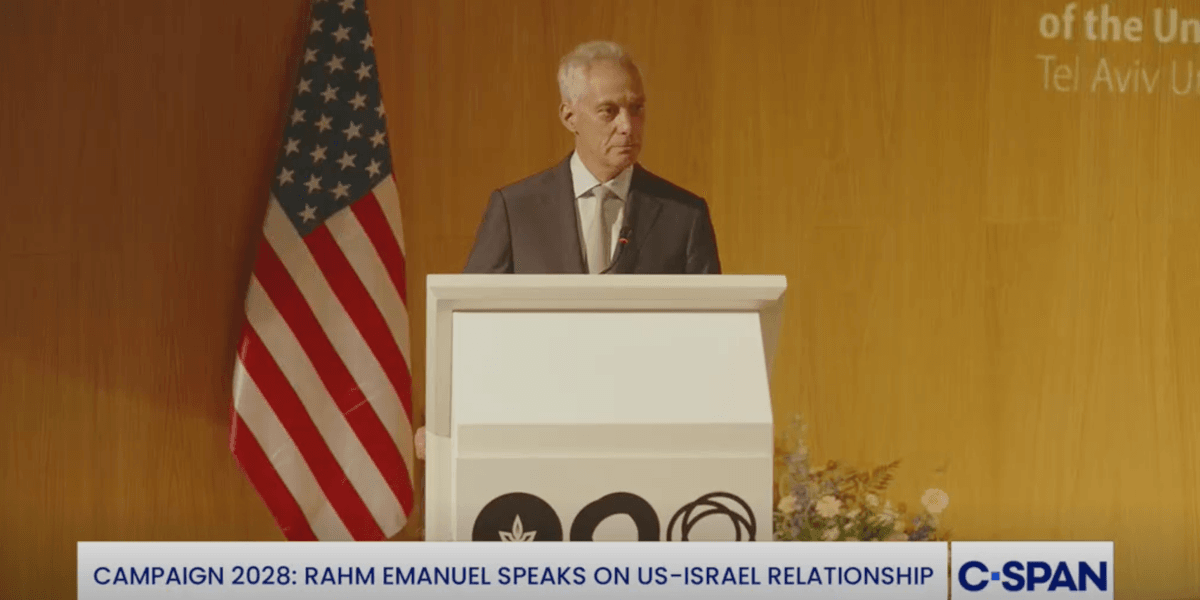
Former Chicago Mayor Rahm Emanuel recently spoke at Tel Aviv University, generating significant attention for his pointed critique of the U.S.-Israel relationship. This speech marked a notable shift in Emanuel’s traditional stance as he prepares potentially to run for president in 2028 as a Democratic candidate. With increasing scrutiny of Israel’s policies from the American left, Emanuel’s commentary underlines the evolving dynamics of Democratic support for Israel.
Shifting Perspectives on U.S.-Israel Relations
Emanuel’s address emphasized that American policy towards Israel has long been rooted in an uncritical alliance, where Washington’s support has been unconditional. He acknowledged this approach as a mistake, asserting it failed both countries. Emanuel’s evolving rhetoric reflects not just personal growth but a broader recognition within the Democratic Party of the need for a reevaluation of U.S.-Israel ties. In light of recent polling indicating that a significant portion of Democrats believe Israel is perpetrating genocide in Gaza, Emanuel’s remarks come at a crucial time of shifting allegiances within the party.
While relaying the historical context of the Israeli-Palestinian conflict, Emanuel placed most blame on the Palestinian side for the lack of peace. Nonetheless, he did not shy away from criticizing Israeli Prime Minister Benjamin Netanyahu, stating that Netanyahu’s leadership has led Israel into a cul-de-sac. Emanuel argued that the current Israeli government’s actions have paradoxically advanced Hamas’s objectives, ultimately obstructing any genuine path towards a two-state solution.
The Democratic Party’s Internal Debate
Within the Democratic Party, responses to Emanuel’s position vary. Some call for a definitive break in relations with Israel, while Emanuel appears to advocate for a strategy that aims to save the relationship through constructive criticism. Critics suggest he represents a faction that seeks to retain pro-Israel supporters by promoting tough rhetoric. Erik Sperling, head of Just Foreign Policy, articulated that established supporters of Israel now realize they must adopt more aggressive criticism to ensure that the U.S. remains a steadfast ally.
Yousef Munayyer, a prominent voice in the Palestinian advocacy community, interpreted Emanuel’s speech as an attempt to appease pro-Israel donors. Notably, the choice to deliver such a message in Israel rather than the U.S. indicates a conscious effort to maintain strong ties, even amid a politically charged environment.
The Future of U.S.-Israel Policy
Emanuel’s policy suggestions align closely with progressive voices within the Democratic Party, advocating for a reassessment of U.S. military aid to Israel. This perspective parallels the views of organizations like J Street, which have consistently pushed for a more balanced approach to U.S.-Israel relations. Nonetheless, Emanuel’s emphasis on constructive criticism reveals his awareness of a significantly altered political landscape, where traditional stances may no longer resonate with the current Democratic base.
The fact that an influential figure like Emanuel is willing to critique the Israeli government underscores a considerable ideological shift within the Democratic establishment. Observers note that positions once considered fringe, such as the implications of aid conditionality, are now entering the mainstream dialogue. This transition is not merely a response to grassroots pressures but reflects a strategic calculation to maintain relevance in an evolving political environment.
In summary, Emanuel’s speech captures the complexities of U.S.-Israel relations as viewed through a shifting Democratic lens. With considerable public sentiment advocating for change, figures like Emanuel illustrate the party’s willingness to confront uncomfortable truths, demonstrating that traditional alliances might need reevaluation in light of new realities.