
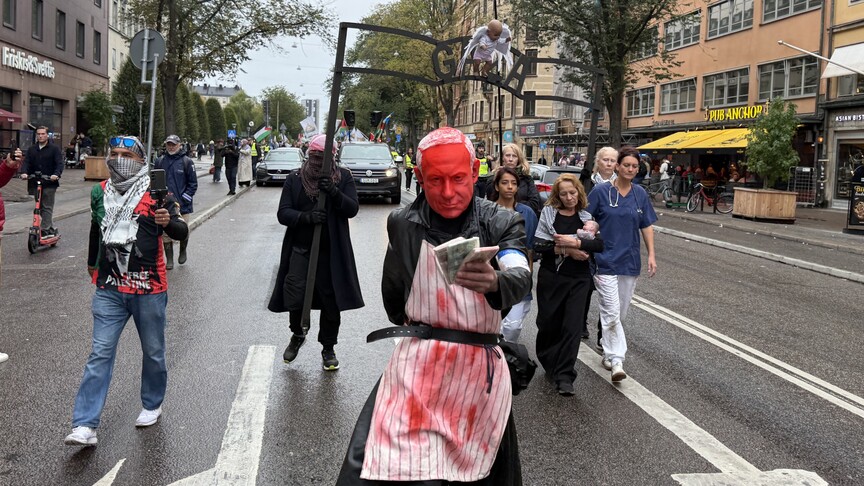
On a recent Saturday, a significant gathering took place in Stockholm, where hundreds demonstrated against Israel’s military actions in the Gaza Strip. This protest, organized by various civil society groups, aimed to call attention to the ongoing humanitarian crisis and demand a halt to violations against civilians in the region.
Gathering for Peace in Stockholm
The march began in the Radmansgatan area as participants displayed banners with messages such as “Free Palestine, Free Gaza,” and “Stop the Genocide.” The demonstrators made their way toward the parliament, passionately chanting slogans highlighting the plight of children in Gaza and advocating for Palestinian freedom. Many waved Palestinian flags, signifying solidarity with those affected by the conflict. Protesters also asserted that the United States shares responsibility for the ongoing injustices in Gaza.
Voices of Activism: A Call to Action
Among the demonstrators was Swedish activist and comedian Kerim Arslanagic, who emphasized the urgency of the situation in Palestine. He described the dire conditions faced by Palestinians, including food scarcity and inadequate infrastructure, as a significant loss for humanity. “The oppression of Palestinians has been ongoing since 1948,” he stated, characterizing the situation as an “ongoing genocide and a colonial project.” Arslanagic went on to draw parallels to colonialism that has historically ended in Europe, asserting that similar injustices persist in Palestine today.
He referenced what Israel describes as its strategy of “mowing the grass,” a tactic aimed at suppressing resistance but criticized the disproportionate escalation of violence since the tragic events on October 7, 2023. According to reports, the Israeli offensive on Gaza has led to staggering casualties, with nearly 74,000 fatalities and 175,000 injuries, causing significant destruction throughout the enclave.
Despite a ceasefire that was established last October, violence has continued unabated, with reports from Gaza’s Health Ministry indicating over 1,400 Palestinian deaths and nearly 5,000 injuries since then. This ongoing conflict has drawn international scrutiny, leading to a UN-commissioned inquiry, which has labeled Israel’s actions as genocidal against the Palestinian population.
Unity and Activism: The Path Forward
Arslanagic urged fellow activists and artists to leverage their platforms for advocacy, believing that collective voices have the power to influence political change. He stated, “If we make our voices heard, we can change things.” This sentiment encapsulates the mantra of many protesters seeking justice for Palestine.
The demonstrations in Stockholm serve as a reminder of the growing international movement advocating for Palestinian rights amid ongoing conflicts. The unity shown in these protests highlights the need for a global response to the humanitarian crisis unfolding in Gaza. Activism, particularly in the face of systemic injustices, can drive awareness and prompt action, potentially leading to meaningful changes in policies affecting the region.
As the world observes the continuing conflict, calls for peace and justice for Palestinians remain pronounced. The voices raised in Stockholm reflect not only a local sentiment but also a broader humanitarian concern that resonates globally, emphasizing the necessity for immediate action and resolution.