
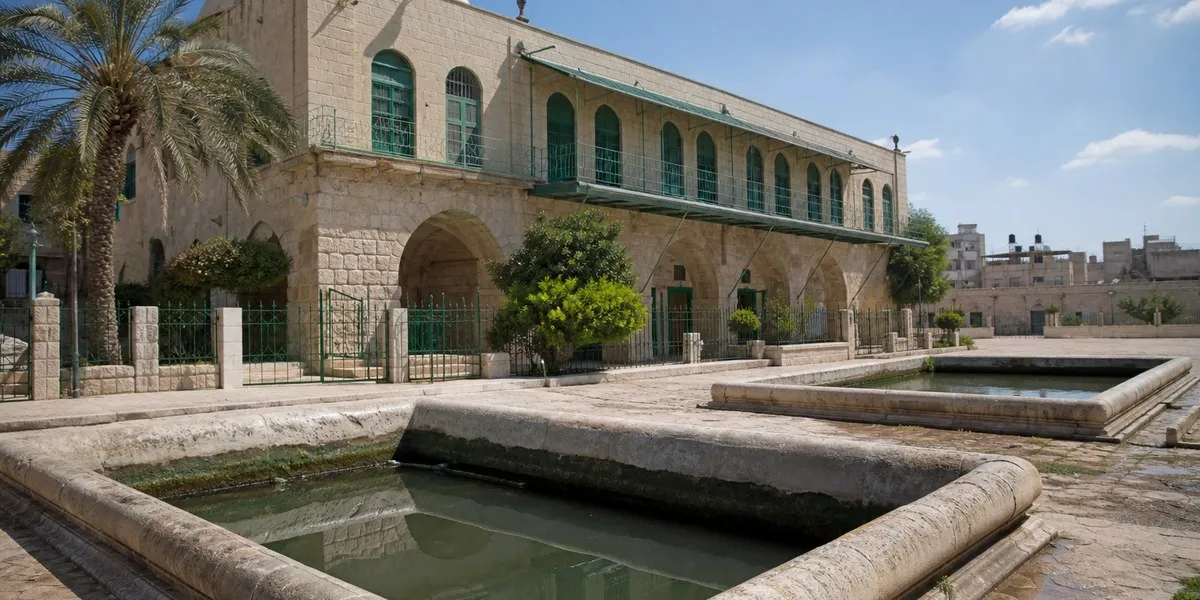
In Tulkarm, located in the occupied West Bank, Israeli authorities have taken significant steps regarding the Bint Yaqub shrine, a site of Islamic heritage. Reports claim that during recent military operations, Israeli forces placed notifications that the site is now under the jurisdiction of the Israel Antiquities Authority. This news was initially reported by Anadolu Agency and corroborated by the Palestinian news agency, Wafa.
Architectural Significance
The Bint Yaqub shrine itself is an architectural marvel with a rich history. The structure stands two stories tall—its lower level originates from the Roman era, while the upper section dates back to the Mamluk period. The shrine features intricate domes, a designated prayer room, and a stairwell leading to the ground floor. Additionally, it is flanked by two stone pools and two other Roman-era constructions that provide further historical context. Close by is the modern Al-Fakhara building, known for its pottery production and equipped with a kiln. Between 2002 and 2004, restoration efforts were undertaken by the Palestinian Ministry of Tourism and Antiquities, collaborating with the Tulkarm municipality, enhancing the site’s cultural significance.
Palestinian Reaction
In response to these developments, the Palestinian Ministry of Awqaf has openly condemned the actions taken by Israeli authorities. They assert that this move to classify the shrine as an archaeological site under Israeli control disregards its status as a site on Islamic waqf land. The ministry warns that this decision exemplifies a broader trend of land seizure aimed at facilitating settlement expansion. Furthermore, they have urged international and human rights organizations to act swiftly to ensconce the sanctity of religious waqf properties.
The tensions extend beyond the Bint Yaqub shrine. Similar notifications regarding archaeological sites have been recorded in areas such as Izbat Abu Yasin in the village of Iktaba and Al-Hafasi, indicating significant land areas affected by these measures due to their historical importance. In a related development, a report by the Israeli organization Emek Shaveh revealed that in February, the Israeli government expanded the authority of the Civil Administration’s archaeology office to include areas under partial Palestinian Authority governance.
Legislative Developments
In May, the Knesset made strides toward altering the management of archaeological sites in the West Bank by approving a bill aimed at creating a civilian body dedicated to overseeing these sites, taking authority away from the Civil Administration’s archaeology unit. However, the bill’s progress has since stalled, raising questions about its future and the implications for sites like the Bint Yaqub shrine.
This ongoing situation highlights the complex socio-political landscape in which historical and cultural sites are embroiled in larger geopolitical conflicts. The Bint Yaqub shrine is not just a significant structure in terms of Islamic history and culture; it has also become a focal point in the struggle over land rights and national identity in the region. As these developments unfold, the importance of international awareness and intervention cannot be understated, especially with so much at stake for the residents and their heritage.