
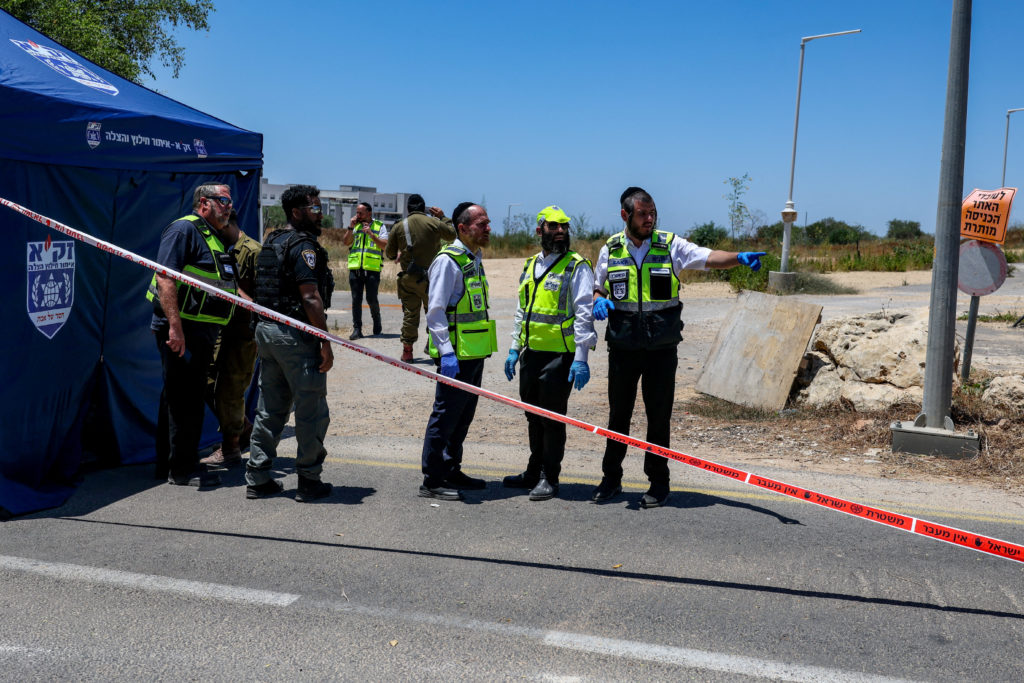
On Sunday, a Palestinian man with Israeli citizenship launched a shocking shooting spree across multiple towns in central Israel, resulting in the death of a reservist and injuring five others, according to reports from local police and military sources. The assailant was subsequently killed by law enforcement officials. This incident has heightened tensions in an already volatile situation, which follows recent violent acts involving Israeli settlers and the tragic death of a Palestinian baby in the West Bank over the weekend.
Details of the Attack
The attack commenced early Sunday morning at a gas station located near Kokhav Yair, close to the demarcation line with the occupied West Bank. Further shootings were also reported in two adjoining Israeli towns and near the Israeli settlement of Salit within the West Bank. Initially, police anticipated a series of coordinated assaults; however, they later concluded that only one gunman and a potential accomplice, who attempted to attack police with a glass bottle, were involved. The assailant, identified as a man in his twenties from the Arab town of Taybeh, remains shrouded in mystery regarding his motives.
Israel’s military reported that a 55-year-old reservist was among the casualties near Tzur Natan. The Magen David Adom rescue service confirmed that five other individuals sustained injuries, two of which were severe. The unprecedented nature of the attack provoked fears among citizens, prompting local authorities to advise residents to remain indoors while schools enforced lockdown measures lasting several hours.
Political Reactions and Implications
Following the attack, Prime Minister Benjamin Netanyahu commended the actions of security forces that neutralized the shooter. However, the hard-line public security minister, Itamar Ben-Gvir, shared a video showcasing the deceased assailant, echoing a controversial stance by stating, “This is the end of every terrorist, this is how it should look.” This aggressive rhetoric aligns with Ben-Gvir’s recent push for a law aimed at imposing the death penalty on Palestinian attackers, a legislative effort currently facing legal challenges.
Critics have voiced concerns over Ben-Gvir’s provocative actions, citing instances where his statements and behavior have raised ethical questions about the treatment of detained individuals engaged in anti-Israel activities. As violence continues to escalate, especially in the West Bank—where numerous military operations have resulted in hundreds of fatalities—community leaders express apprehension about the potential for further attacks that may come from inside Israeli territory itself.
Continued Violence in Gaza
In a related series of events, Israeli airstrikes on Sunday resulted in the deaths of at least five Palestinians in Khan Younis, a city in southern Gaza, where Israeli forces targeted a police station. Additional strikes led to further casualties, including four fatalities resulting from an attack on a vehicle in Gaza City. The Israeli military has thus far refrained from commenting on these recent strikes, although their operational goals have consistently focused on neutralizing perceived threats posed by militants.
Despite a U.S.-brokered ceasefire that brought temporary relief from intensified fighting, violence has resumed, limiting humanitarian efforts and raising the specter of ongoing conflict. Netanyahu has reiterated plans to expand Israel’s territorial control in Gaza, stating that Israeli forces currently occupy over 60% of the region. This entrenched position complicates any potential resolutions, with the head of the U.S.-backed Board of Peace noting that next steps toward sustained stability have stalled over the contentious issue of disarming militant groups like Hamas.
The unfolding crisis not only reflects the immediate and pressing concerns of safety but also highlights the complex layers of political and social ramifications influenced by ongoing military and civilian interactions. As both sides grapple with spiraling tensions and the consequences of ongoing violence, the urgent need for a comprehensive dialogue aimed at sustainable peace becomes increasingly evident.