
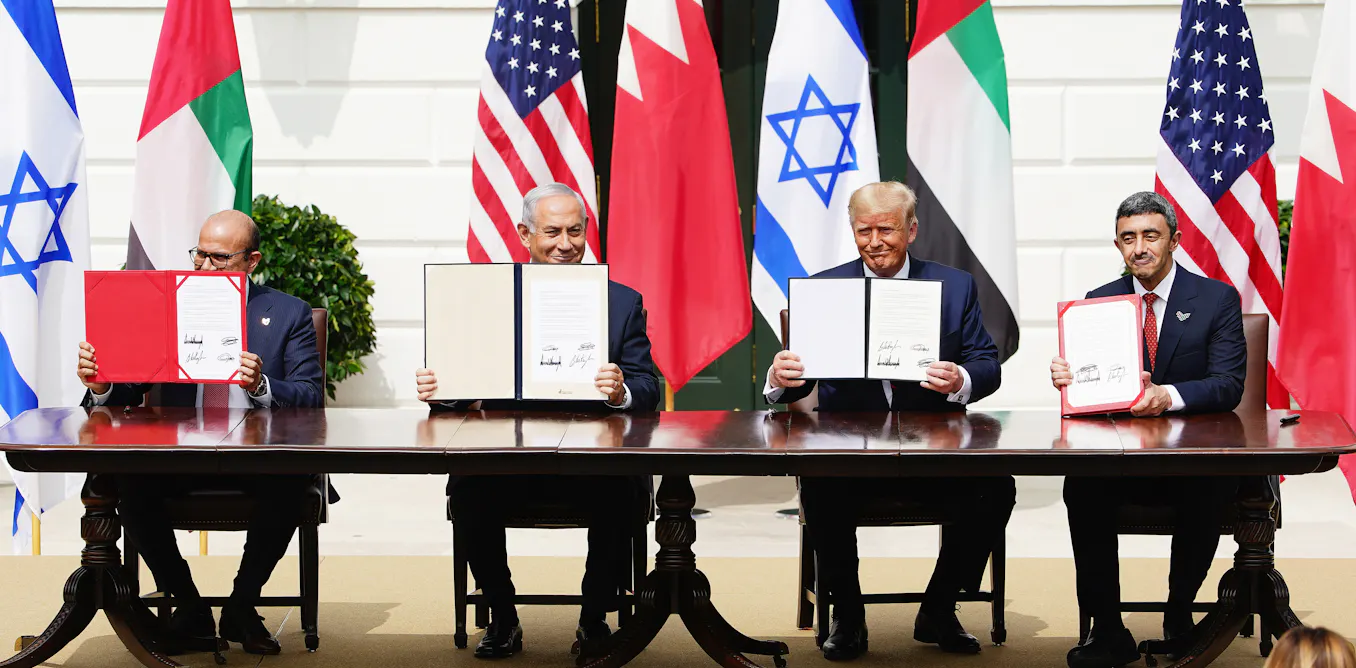
As diplomatic efforts continue between the United States and Iran, President Donald Trump has introduced a new condition: other Middle Eastern nations must join the Abraham Accords, which normalize relations with Israel. This demand arises amidst increased tensions and shifting power dynamics in the region.
The Diminishing Power of the US and Israel
The military and economic strength of both the US and Israel has significantly waned since launching “Operation Epic Fury,” aimed at countering Iran. Recently, alliances that had previously seemed solid with Persian Gulf countries are now being scrutinized. Even with major losses in its leadership, Iran appears more resilient, having effectively challenged Gulf nations. This troubling environment leaves both Trump and Israeli Prime Minister Benjamin Netanyahu seeking an immediate political win to present to their electorates ahead of important elections.
In this troubled context, Trump is reviving the Abraham Accords, which he has long celebrated as a hallmark of his foreign policy achievements. His outreach to regional partners such as Saudi Arabia and the UAE emphasizes that any deal regarding Iran hinges on their acceptance of the accords, aimed at establishing diplomatic ties with Israel.
Understanding the Abraham Accords
The Abraham Accords were devised during Trump’s first term, led by his son-in-law, Jared Kushner. This initiative sought to address not only the Israeli-Palestinian conflict but also broader Arab-Israeli issues. Historically, the question of Palestine has remained a top concern for the Arab populace, even as many leaders have shifted their focus away from it.
Over the decades, Israel has successfully chipped away at Arab opposition to its presence in occupied territories, beginning with peace agreements in the late 20th century. The Trump administration’s actions, including relocating the US embassy to Jerusalem and dismissing the illegality of Israeli settlements, further altered the geopolitical landscape prior to the accords being signed in 2020.
The UAE and Bahrain were early adopters of the accords, with subsequent countries like Morocco and Sudan also signing on. These agreements have been accompanied by various incentives, including military and economic arrangements aimed at bolstering Israel’s standing in the region.
Challenges in Expanding the Abraham Accords
Although the Abraham Accords have made some headway, key players like Saudi Arabia remain hesitant to join. This reluctance has been reinforced by the intensifying conflict following Hamas’ attacks on Israel, which are perceived as efforts to disrupt normalization talks. Saudi Arabia has asserted that any formal agreement with Israel would require assurances for Palestinian statehood, a crucial demand that remains unmet.
Other nations, such as Pakistan and Qatar, are also unlikely to adopt the accords due to domestic pressures favoring Palestinian rights. Pakistani officials have already dismissed Trump’s requirements, and Saudi Arabia is likely to follow suit. The prevailing sentiment across many nations suggests that the accords, in their current form, are politically toxic and not feasible for broader acceptance.
Seeking Regional Solutions
Despite the obstacles, both Trump and Netanyahu remain determined to advance their agenda. Netanyahu may attempt to shape a narrative around strengthened regional ties as a counter to ongoing military engagements, yet such efforts will likely fall short of their aim to neutralize the Iranian threat. The growing opposition to Israel within the region, including among American right-wing supporters, complicates the landscape further.
The Trump administration finds itself at a crossroads, grappling with a multitude of problems, including depleted military resources and eroding trust from its Gulf allies. In this context, the Accords appear increasingly imposed and outdated. Countries like Saudi Arabia are exploring alternative methods for regional stability, such as proposing non-aggression pacts that diverge from the US-led framework.
In conclusion, while the revival of the Abraham Accords may appear strategic for Trump and Netanyahu, the geopolitical landscape suggests that many Middle Eastern nations are actively pursuing their own solutions, independent of US influence. The lack of support for the accords indicates that regional dynamics are shifting, and the traditional methods of persuasion may no longer hold sway.