
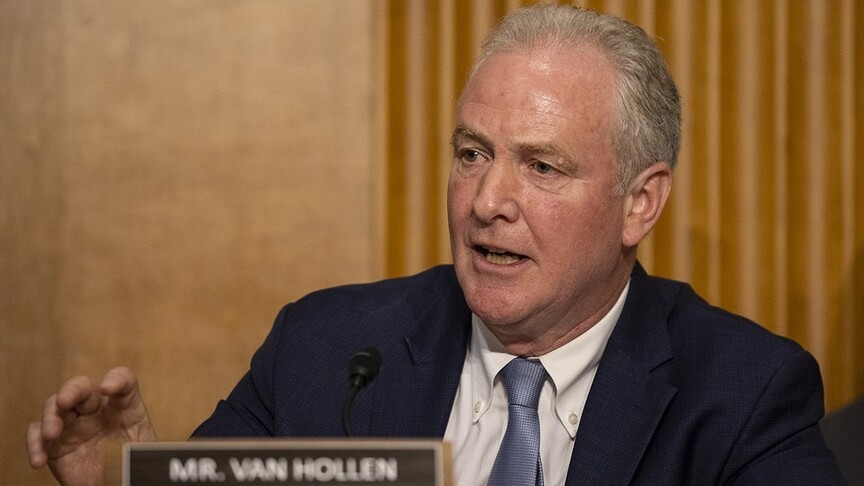
Senator Chris Van Hollen has announced his intention to impede a planned $2.8 billion arms transfer to Israel, expressing concern over the heavy munitions being supplied amidst ongoing bombardments in the Gaza Strip. His remarks have sparked a significant conversation around U.S. military aid and its implications, particularly regarding the actions of the Israeli government.
Concerns Over Military Aid
Van Hollen, a Democrat representing Maryland, took to social media platform X to convey his disapproval of the proposed military assistance. He criticized the Trump administration for channeling funds to a government he describes as led by a “wanted war criminal.” His post not only underscores the humanitarian implications of military support but also raises questions about the moral and ethical responsibilities of U.S. involvement in foreign conflicts, especially when it appears to contradict President Trump’s “America First” initiative.
According to Van Hollen, the escalation of U.S. military aid occurs while Israeli Prime Minister Benjamin Netanyahu continues to conduct military operations in Gaza and has not held accountability for the deaths of U.S. citizens in the region. He emphasized the need for Congress to closely examine how such policies align with national interests and the values that the United States espouses on the global stage.
Details of the Proposed Arms Package
Recent reports suggest that the Trump administration is advancing a substantial arms package, which includes 40,000 bombs, each weighing 2,000 pounds. This arsenal reportedly features 20,000 MK-84 bombs, notable for their use in past conflicts, as well as additional munitions like the BLU-117 and I-2000 Penetrator warheads. The sheer scale and destructive capability of these weapons add urgency to the debate over their deployment and the possible humanitarian impact on the civilian population in Gaza.
It is important to note that shipments of some of these munitions, including the MK-84, were temporarily halted due to concerns about civilian casualties during conflict. However, restrictions were lifted in early 2025 under the Trump administration, allowing for the resumption of these controversial arms transfers. The implications of such actions provoke further scrutiny regarding their congruence with U.S. foreign policy goals.
International Legal Ramifications
Compounding the situation are claims against Netanyahu and former Defense Minister Yoav Gallant, who are reportedly wanted by the International Criminal Court (ICC) for alleged war crimes and crimes against humanity in Gaza. This raises critical questions about the legality and morality of providing military support to a government facing potential war crimes allegations.
As U.S. citizens have increasingly fallen victim to violence in Gaza and the occupied West Bank in recent years, the pressures on lawmakers like Van Hollen to reassess military aid and its ramifications grow stronger. This ongoing conflict has become a focal point not only for domestic political discussions but also for international legal considerations.
The anticipated arms transfer and its potential consequences reflect a growing rift in how military aid should be structured and monitored. With increasing calls for accountability and transparency, the debate surrounding U.S. military aid to Israel is far from over, likely shaping future policy discussions both in Congress and across international platforms.