
The ongoing conflict involving the U.S., Israel, and Iran has had significant repercussions on higher education in the region, particularly in Qatar. The crisis has exposed aspects of vulnerability in Qatar’s educational framework, demonstrating that branch campuses alone cannot uphold the country’s ambition to be a global education center. This situation calls for a reevaluation and enhancement of Qatar’s higher education system to better meet its long-term goals.
The Transformation of Higher Education in Qatar
Over the past ten years, Qatar has witnessed a remarkable evolution in its higher education landscape. Aiming to transition toward a knowledge-based economy as outlined in its National Vision 2030, Qatar has invested heavily in expanding its educational institutions. This growth includes both local universities and international branch campuses (IBCs), reflecting the country’s commitment to elevating academic standards and broadening educational options. From hosting just one public university in the early 2000s, Qatar now boasts a robust collection of higher education institutions that contribute to national initiatives focused on enhancing local knowledge production and workforce capacity.
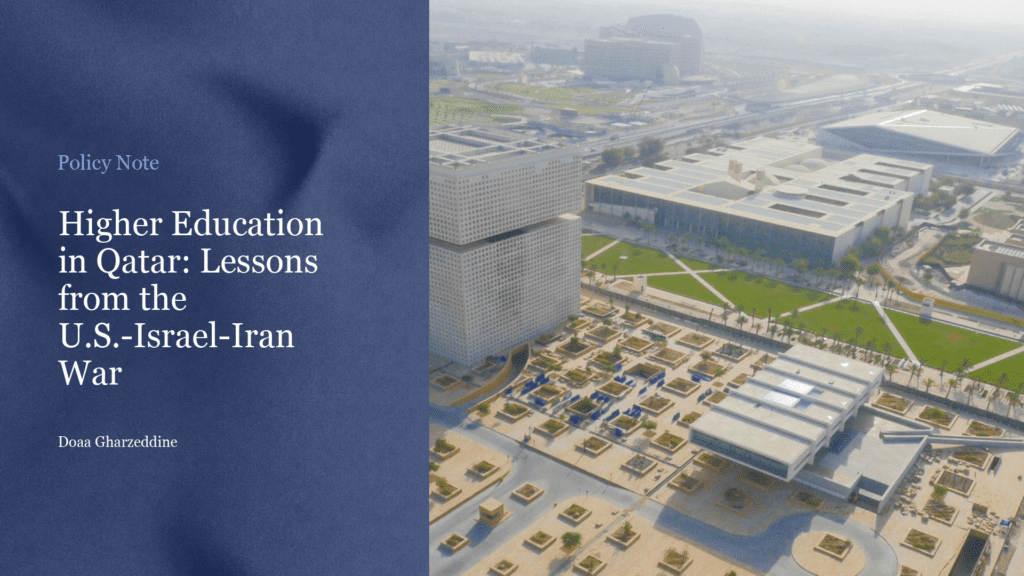
Education City (EC), established in 2003, stands as a cornerstone of Qatar’s educational framework. The hub serves as a collaborative space for various universities and research facilities, promoting a vibrant academic environment. By fostering innovation and research, IBCs based in EC are instrumental in elevating the higher education ecosystem and supporting the workforce demands aligned with Qatar’s strategic goals. Furthermore, these institutions play a crucial role in social development, creating platforms for interaction between local and international students, and thereby enhancing the community’s educational experience.
Challenges Evolving from Regional Conflicts
However, the recent escalation of the U.S.-Israel-Iran conflict has posed new challenges for universities in Qatar. With missile strikes targeting U.S. assets and intensified regional tensions, universities are now grappling with safety concerns and the necessity to adapt swiftly to maintain educational continuity. The conflict’s fallout has disrupted operations at various institutions, forcing them to switch to remote or hybrid learning environments and temporarily shutter physical campuses.
The pressures arising from regional instability have raised alarms among branch campuses, which now face increasing reputational and operational risks. The Ministry of Education and Higher Education (MOEHE) has mandated a shift to remote learning as a precautionary measure, highlighting the lack of preemptive strategies to effectively navigate such crises. Academic institutions, including globally recognized IBCs, had to act quickly to mitigate potential disruptions, illustrating the need for comprehensive contingency protocols that can enhance resilience in times of turmoil.
Addressing Vulnerabilities and Creating a Sustainable Future
While IBCs have undeniably contributed to elevating Qatar’s academic profile, their structural vulnerabilities have become apparent in the wake of the conflict. Decisions related to campus operations often rest with their home institutions, which can leave Qatari branches exposed to broader geopolitical shifts. The closure of Texas A&M University’s Qatar branch, driven by changing political climates and institutional priorities, serves as a poignant example of this challenge. To foster a more resilient higher education system, Qatar must reduce its reliance on IBCs and invest in enhancing local educational institutions that can withstand external pressures.
Long-term strategies should include the establishment of a Gulf-wide student mobility network similar to the ERASMUS program. Creating pathways for students across Gulf Cooperation Council (GCC) universities can help bolster Qatar’s education system while addressing labor market demands. Moreover, developing emergency preparedness guidelines tailored for higher education will empower institutions to maintain academic integrity during crises, ensuring the well-being of students and faculty alike.
Future Prospects for Qatar’s Education Sector
As Qatar emerges from the current conflict, it is crucial to assess and address the vulnerabilities highlighted in its higher education sector. The focus should not solely be on reactive measures but on cultivating a robust educational framework capable of withstanding disruptions. By aiming for greater autonomy in local governance and aligning academic programs with labor market needs, Qatar can solidify its position as a leading education hub in the region.
In summary, while the U.S.-Israel-Iran war poses complex challenges, it also presents an opportunity for Qatar to rethink its approach to higher education. Building a more resilient, interconnected education system will not only enhance Qatar’s international standing but also contribute to the broader stability and development of the Gulf region. By prioritizing local capacity-building initiatives and fostering collaborative frameworks, Qatar’s educational landscape can evolve into a model of resilience and innovation.