
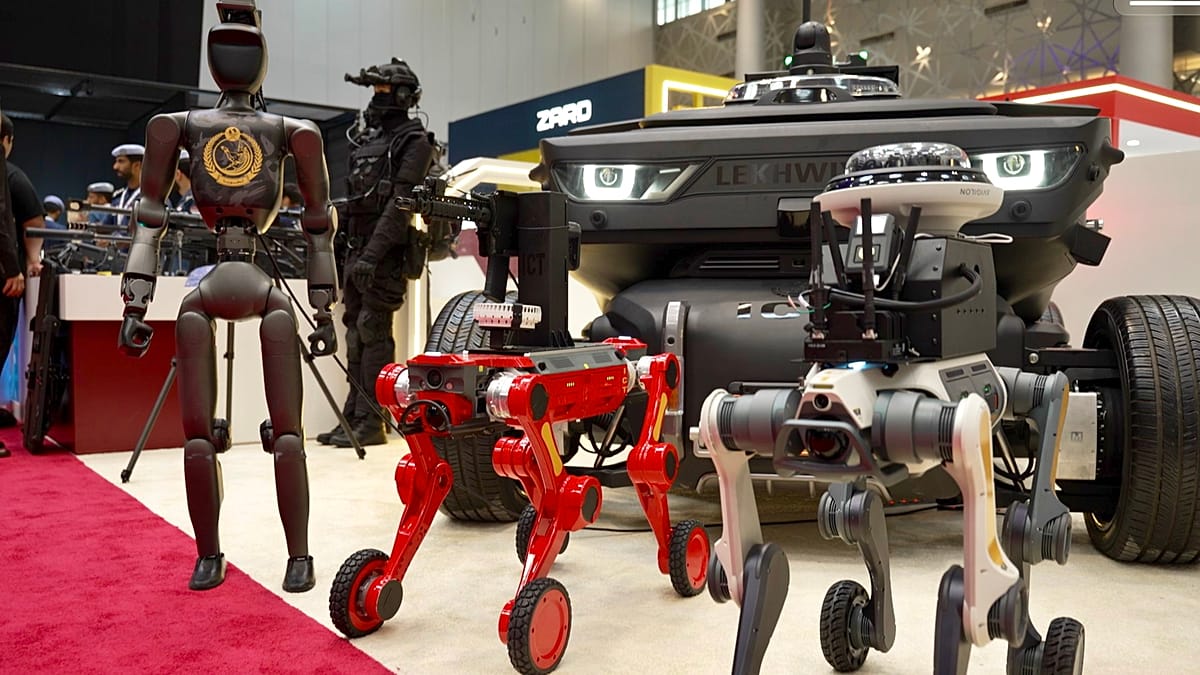
Security companies from 33 nations convened in Doha this week for Milipol Qatar, showcasing advanced technologies such as drones, robotics, and AI systems. This event happens as Qatar reassesses its security measures in response to recent geopolitical tensions, notably from the Iran conflict.
Exhibition Insights and Participation
The three-day exhibition concluded on Thursday and featured a wide array of equipment tailored for law enforcement, emergency response, and industrial safety. Significant discourse also revolved around cybersecurity and the safeguarding of critical services. Alexandros Lakatamitis, the general manager of West Bay Petroleum, emphasized that both governmental and industrial clients are increasingly prioritizing security. “The protective bubble we’ve experienced for so long has burst,” he remarked. This sentiment reflects a growing awareness among stakeholders about the evolving challenges in national and corporate security.
Approximately 280 companies participated in the showcase at the Doha Exhibition and Convention Center, with Major Khalid Saadon Al-Kuwari noting that 70% of these businesses came from outside Qatar. He remarked that the exhibition served as a valuable platform for governments to explore solutions to diverse security issues based on successful implementations in other nations, highlighting the event’s role in fostering international collaboration in security strategies.
Learning from Recent Conflicts
The timing of the exhibition coincided with a series of pertinent discussions on security in Doha. On Monday, Qatar’s Defense Minister, Saoud bin Abdulrahman Al Thani, indicated that the nation was applying lessons learned from the Iran war to bolster defenses against threats such as ballistic missiles, drone incursions, and cyberattacks. Additionally, he articulated plans for establishing a local defense production hub, emphasizing enhanced cooperation with regional and international partners.
The exhibition floor also featured innovative solutions aimed at addressing civilian emergencies and hazardous industrial situations. Lakatamitis illustrated how drones can search vast terrains for missing individuals, with software capable of analyzing aerial images to pinpoint potential signs of those in need, thereby directing rescue efforts more effectively. Moreover, he highlighted the utility of drones equipped with gas detection capabilities, enabling inspections without endangering human lives.
AI Integration and Cybersecurity Focus
The event also marked a broader discussion regarding the integration of AI into security practices. The second Doha International Conference on AI & Security ran parallel to Milipol, featuring presentations on responsible AI deployment, autonomous technologies, and the safeguarding of essential infrastructure. A cybersecurity seminar hosted on Thursday focused on strategies to maintain the functionality of critical services during cyberattacks. Khalid Al Nasr, from Qatar’s National Cyber Security Agency, stressed that responses should go beyond merely restoring IT services; they must ensure that vital governmental functions can be sustained or timely reinstated.
The gathering also resulted in new international security collaborations, with Qatar and France formalizing a cooperation agreement between their interior ministries, slated for 2027–2030. This partnership aims to enhance coordination and the exchange of expertise in the sectors of homeland security and civil protection.
On the final day of Milipol, Qatar’s Prime Minister, Sheikh Mohammed bin Abdulrahman Al Thani, inaugurated the sixth Watan exercise. This initiative unites security, military, and civilian organizations to effectively rehearse emergency response protocols, further highlighting Qatar’s commitment to improving its security landscape in collaboration with global partners.