
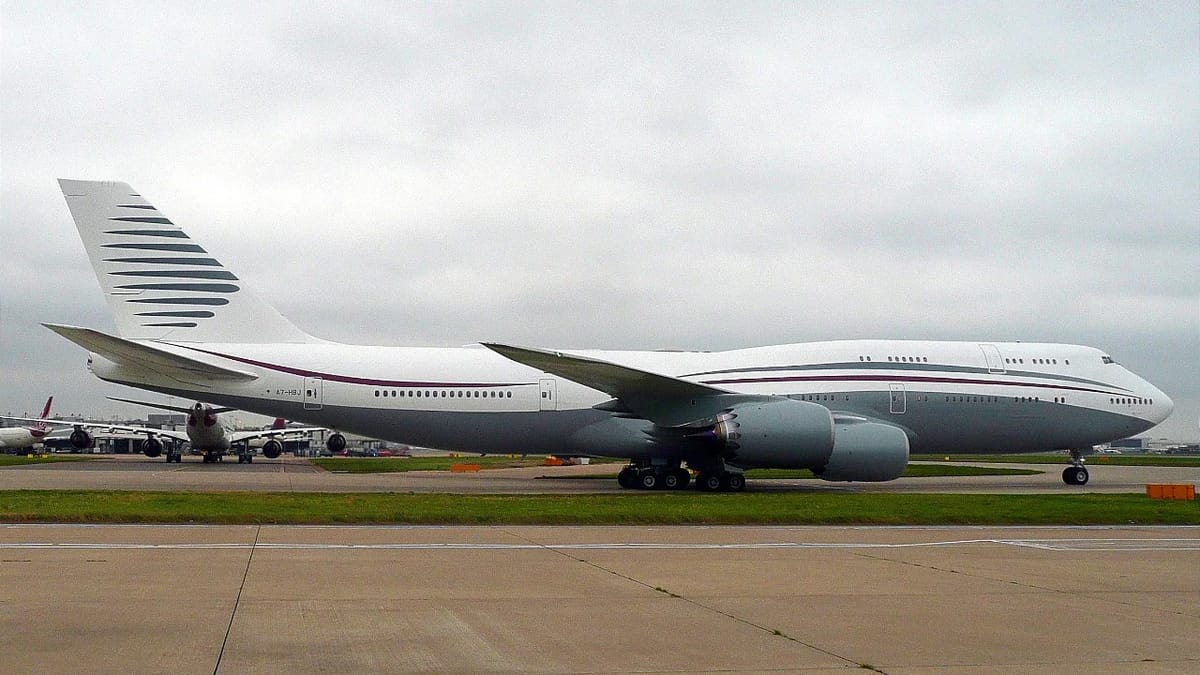
The US Secret Service and the Air Force are swiftly transforming Qatar’s donated Boeing 747 into the interim Air Force One. This major project signifies a significant step in enhancing the security and operational capabilities for presidential travel. However, this rapid transformation comes with a hefty financial implication.
The $400 Million Investment to Begin the Transformation
The staggering cost associated with this project has already reached $400 million. Reports indicate that this amount is primarily allocated for vital security measures and structural integrity assessments. The Air Force and Secret Service have made it their priority to ensure the aircraft meets the rigorous standards essential for transporting the President of the United States.
A thorough examination of the aircraft’s interior has been undertaken, not only to ensure all systems are operational but also to eliminate any potential security threats. General Dale White, the four-star officer overseeing this significant task, emphasized that security protocols were extensive, stating, “We did not take any shortcuts as it relates to making sure security was exactly what it needed to be.” The careful evaluation aims to guarantee that there are no covert surveillance devices or hidden security issues within the aircraft.
Maintaining the Aircraft’s Interior while Enhancing Security
Interestingly, despite the hefty overhaul budget, Air Force officials have indicated that major cosmetic changes to the aircraft’s interior are not planned at this time. General White mentioned, “By and large, the airplane that we’re getting is in the same condition from an interior perspective.” The only notable change will involve replacing Arabic-language exit signs with English ones to cater to its new usage. In contrast, the exterior will be painted in patriotic colors—red, white, and blue—reflecting the United States’ national identity.
The existing interior may be functional and secure, allowing time for a more extensive upgrade down the line. The immediate focus remains on ensuring that the plane meets the necessary security requirements without undergoing significant cosmetic alterations.
The Role of Qatar’s Boeing 747 as an Interim Solution
The decision to use Qatar’s Boeing 747 is largely driven by the need for a reliable and modern aircraft amid delays with the new Boeing VC-25B, the permanent Air Force One replacement, which is taking longer and costing more than initially expected. The current Air Force One jets are nearing 40 years of service, making them costly to operate.
Utilizing the donated 747 serves a dual purpose: it provides a readily available aircraft with upgraded features while helping manage the operational costs of the aging fleet. Furthermore, once security modifications are completed, the aircraft’s engine and other systems will not require extensive work, making it a sensible interim solution.
Indeed, as the anticipation for the new Air Force One continues, the interim 747, sometimes referred to as the ‘VC-25B Bridge Aircraft,’ offers a pragmatic approach for secure executive air travel. While labeled as temporary, it remains uncertain how long this aircraft will be in service, reflecting the often fluid nature of political timelines. In the realm of politics and aviation, the meaning of “temporary” can stretch significantly, leaving the door open for the 747 to serve longer than expected.