
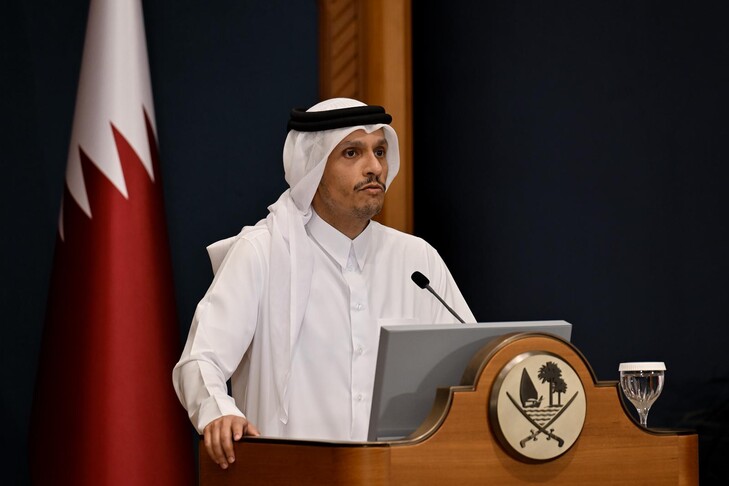
Sheikh Mohammed bin Abdulrahman Al Thani, the Prime Minister and Foreign Minister of Qatar, has openly labeled Israeli Prime Minister Benjamin Netanyahu as a “war criminal.” This assertion comes amid increasing regional instability, yet Sheikh Mohammed reaffirmed Qatar’s ongoing commitment to mediation efforts in the Middle East.
Accusations of War Crimes
In a recent interview with British journalist Piers Morgan, Sheikh Mohammed did not shy away from condemning Netanyahu’s actions in Gaza. He emphatically stated, “What’s been committed in Gaza is war crimes, and whoever is responsible for this is a war criminal.” He underscored the extensive impact of military actions in the area: “Hospitals have been targeted, schools have been targeted.” For Sheikh Mohammed, these attacks cannot be justified, despite any rationale that may be presented.
Political Maneuvering and Mediation
Sheikh Mohammed accused Netanyahu of politically targeting Qatar to divert attention from Israel’s actions. Highlighting a particularly egregious incident, he referred to Israel’s strike on September 9, 2025, which claimed the lives of five Hamas members and a Qatari security officer while Qatar was actively engaged in mediation efforts. Describing this as an “unprecedented attack on a mediator,” he expressed that such actions have crossed significant lines in international diplomacy.
Despite the confrontation, Sheikh Mohammed emphasized Qatar’s ongoing emphasis on diplomatic solutions. He stated that Qatar is committed to providing constructive advice to both the U.S. government and Iran in hopes of fostering a peaceful resolution to the ongoing conflicts in the region.
Addressing Regional Issues
In discussing the broader regional conflict, Sheikh Mohammed outlined three critical issues that need to be resolved to de-escalate the situation: Iran’s nuclear program, freedom of navigation through the Strait of Hormuz, and security arrangements involving both Iran and the Gulf Cooperation Council (GCC) states. He advocates for a regional security framework rooted in dialogue, non-interference, and economic cooperation, arguing that such strategies are essential for lasting peace.
In an earlier statement, Qatari Foreign Ministry spokesman Majed Al-Ansari reiterated Qatar’s dedication to this mediation role, confirming that the nation continues to facilitate communication between the US and Iran. Al-Ansari also acknowledged Qatar’s concerns regarding further military escalation in the region, stressing the need for peaceful solutions to ongoing conflicts.
In summary, the remarks from Sheikh Mohammed highlight the complexities of the Israeli-Palestinian conflict and other regional tensions, eyes focused on diplomacy as the key to unlocking future stability. Qatar remains a pivotal player in these mediation efforts, committed to navigating the intricate political landscape with the hope of achieving lasting peace.