
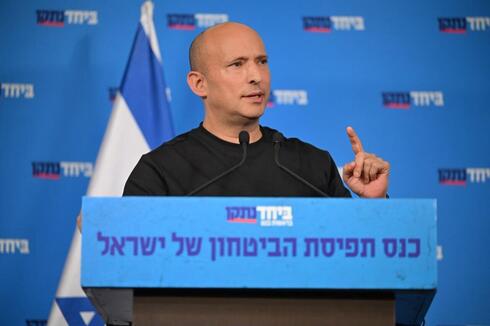
Naftali Bennett has made a significant statement regarding Israel’s security approach in light of recent developments. During a party conference, he asserted that the collapse experienced on October 7 was not merely a failure in military defenses against Gaza, but indicative of a broader breakdown of the security framework that Prime Minister Netanyahu had put in place over many years.
Revising Military Assumptions
Bennett declared his intent to “break four assumptions” if he returns to leadership. The first assumption he challenged relates to the roles of Iran and Hezbollah. Traditionally, the expectation has been that Iranian actions are a response to Israeli military actions in Lebanon. Bennett proposes a shift in this strategy: “Any aggression from Hezbollah will lead to a counterstrike on Iran,” he stated. This reversal could redefine the rules of engagement and signal a more aggressive posture towards Iranian influences in the region.
In his remarks, Bennett also made clear his stance on Qatar. While Netanyahu has portrayed the Gulf nation as a “complex country” in geopolitical terms, Bennett plans to categorize it as an enemy state. He stated, “Anyone who does not understand that after October 7 is unfit to lead Israel,” emphasizing that a reevaluation of foreign relationships is essential for national security.
Restructuring Post-War Arrangements
Bennett also addressed his plans for Gaza’s future. He argued against the roles of Turkey and Qatar in post-war governance, advocating instead for the inclusion of Egypt. He expressed a desire to eliminate Turkish and Qatari influence in Gaza, suggesting that Egypt should take on a more pivotal role without compromising Israel’s operational flexibility in the region. His approach highlights a desire for a more direct solution to geopolitical challenges surrounding Gaza, contrasting with previous administrations’ strategies.
He further touched upon internal security concerns, focusing on the rampant problem of illegal weapons circulating within Israel. Bennett plans to redefine this issue from a criminal matter to a national security threat. This involves utilizing the IDF and Shin Bet in addressing the situation, declaring areas influenced by illegal arms as closed military zones until properly resolved.
Challenges to Current Governance
Throughout his address, Bennett critiqued the existing government’s approach, asserting that the current leadership remains stuck in pre-October 7 mindsets. He compared his previous government’s strategy with more robust tactics against Gaza, arguing that they altered the deterrence dynamics significantly. He claimed, “After countless rocket attacks and arson balloons under Netanyahu’s control, we retaliated even for minor provocations,” highlighting what he described as a period of relative calm for southern communities.
Bennett also emphasized the need for universal military service, asserting that his administration would enforce inclusive drafting policies with no exemptions. He directly criticized methods of selective service that would spare specific groups, stating that past experiences inform the futility of such exemptions.
Security as Central Election Theme
Bennett’s speech underscored the critical nature of national security in the upcoming election. He presented the vote as a pivotal choice not just between political factions, but as a selection between fundamentally different strategies for addressing threats from Iran and Hezbollah, while managing internal security challenges and rebuilding the IDF’s operational capabilities. His focus on military and diplomatic reform reflects a broader concern for Israel’s future security landscape, aiming to resonate with an electorate increasingly aware of these pressing issues.