
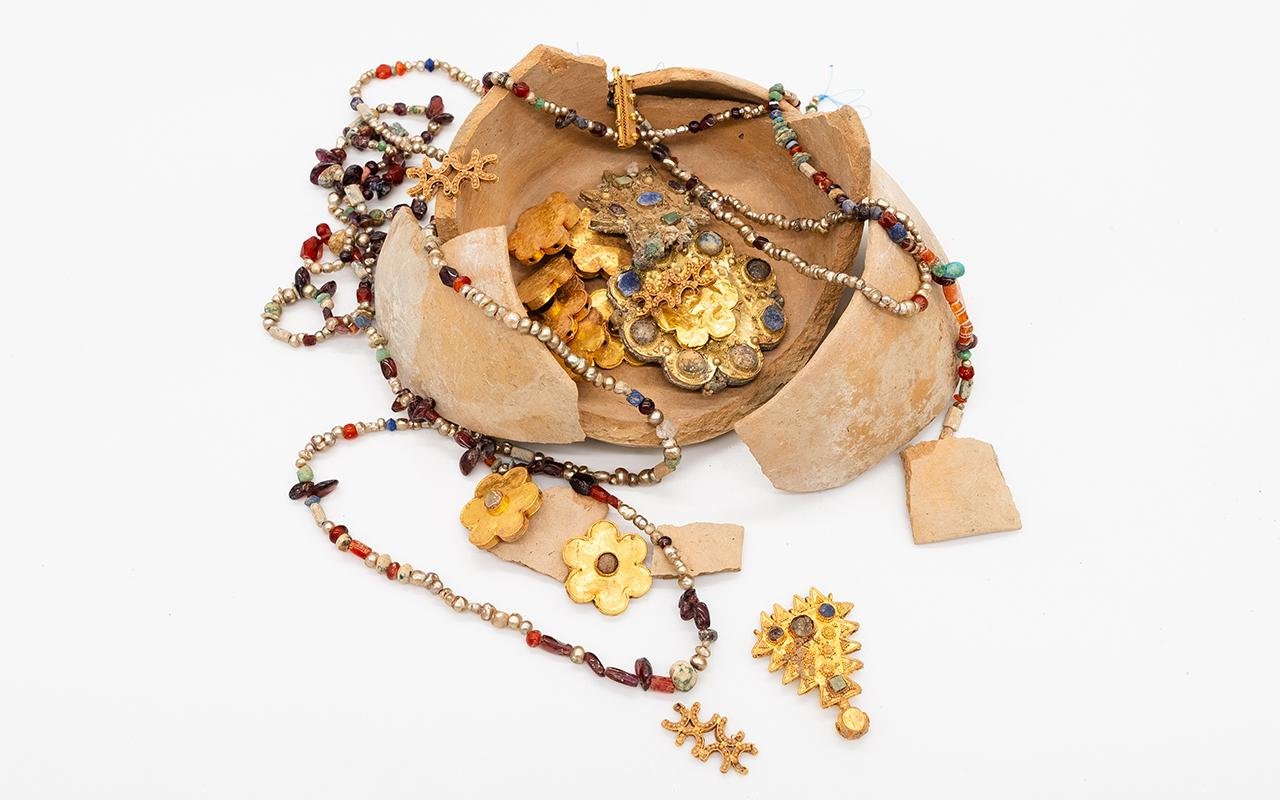
Archaeologists in Saudi Arabia’s Al-Qassim Region have made a remarkable discovery at the Dariyah archaeological site. They have uncovered an extensive collection of gold jewelry dating back over 1,100 years, providing valuable insight into the wealth and trade activities during the early Islamic period. This find highlights the historical significance of the area and its role in ancient commerce.
Significance of the Discovery
The Saudi Heritage Commission announced this extraordinary discovery following the fourth excavation season at the Dariyah site. Researchers have recovered nearly 100 gold artifacts, believed to belong to a single jewelry collection. These pieces, which include pendants, intricate discs, beads, and gold spacers traditionally used in necklaces or ceremonial items, underscore the artistic and cultural richness of the Abbasid era.
Among these artifacts, many showcase floral motifs nestled within geometric patterns, while select pieces feature colored gemstones embedded within gold frames. Notably, one elaborate circular ornament stands out; it is adorned with symmetrically arranged stones surrounding a central design, illustrating the craftsmanship of that time. This discovery not only reflects the aesthetic preferences of the period but also signifies the skilled artistry of the metalworkers who created these intricate adornments.
Craftsmanship and Techniques
The jewelry’s construction speaks volumes about the metalworking techniques employed during the Abbasid period, which spanned from the 8th to the 13th centuries. The artisans hammered thin sheets of gold and impressed decorative patterns into the surface. They expertly set stones into hand-prepared settings, showcasing a high level of craftsmanship. This collection emphasizes not only the artisans’ skills but also the economic prosperity of the era, supporting the notion that goldsmithing was a prominent trade.
In addition to the jewelry, the excavations at Dariyah have revealed stone foundations, mudbrick walls, plastered rooms, hearths, pottery fragments, and metal tools. These findings link the settlement to activities dating back to the late 9th century CE. The varied items unearthed within the site provide a well-rounded view of daily life and commerce during that time.
A Hub of Trade and Cultural Exchange
Dariyah’s location along significant pilgrimage and trade routes across the Arabian Peninsula solidifies its historical relevance. It is connected to the Basran Hajj route, which was frequented by pilgrims traveling from Iraq to Mecca, providing crucial rest stops for traders and travelers alike—facilitating cultural exchanges and commercial activities.
Dr. Jasir Suliman Alherbish, head of the Saudi Heritage Commission, emphasized how this treasure trove of artifacts reflects the deep cultural heritage preserved throughout the Kingdom. He highlighted the area’s long-standing connection to trading and cultural interactions between different regions, which played a pivotal role in shaping the historical narrative of the time.
Expanding the Historical Narrative
Nestled in the mountains and valleys southwest of Al-Qassim, Dariyah holds remnants of human activity dating back to both pre-Islamic and early Islamic eras. Previous archaeological surveys have documented numerous mounds, stone structures, and fragments of pottery and glass scattered throughout the region, enriching the historical context of the area.
The recent discovery of the gold jewelry adds yet another remarkable layer to the complex history of Dariyah, underscoring the settlement’s significance in understanding the cultural and economic dynamics of the early Islamic world. As research continues, these findings will undoubtedly illuminate more aspects of the rich heritage that defines this storied region of Saudi Arabia.