
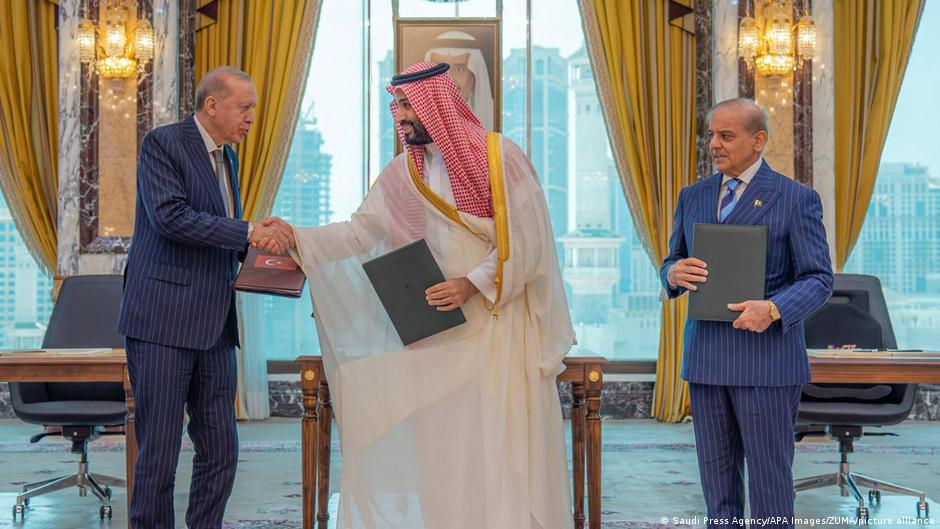
There has been considerable discussion surrounding Bangladesh’s potential involvement in a recent defense agreement involving Saudi Arabia, Turkey, and Pakistan. However, officials from Bangladesh maintain that no formal invitation has been extended for them to join the pact.
Understanding the Mecca Joint Defense Agreement
The Mecca Joint Defense Agreement, which was enacted in early August, aims to fortify mutual defense against any acts of aggression. This framework asserts that an armed attack on any of the three parties will be perceived as an assault on all involved nations. Analysts suggest that this agreement may have already begun to reshape the geopolitical dynamics of both the Middle East and South Asia.
As noted by Navine Murshid, a political science expert from North South University in Dhaka, this defense pact not only serves as a collective security measure but also seeks to advance the strategic interests of the participating countries. The implications of this agreement are significant for Bangladesh, especially considering its geographical and political context.
Bangladesh’s Hesitance and Relations with India
The possibility of Bangladesh joining the pact could complicate its diplomatic ties, particularly with India. The two countries share a lengthy border and have deep cultural and economic connections. Historically, India played a pivotal role in Bangladesh’s independence war against Pakistan in 1971. However, relations have soured in recent years, especially following the 2024 upheaval that removed Prime Minister Sheikh Hasina, who was seen as a strong ally of India.
Currently, Bangladesh’s government, led by the Bangladesh Nationalist Party, has expressed a positive view of the Mecca agreement. Foreign Minister Khalilur Rahman recently stated that while they view the pact favorably, any serious consideration of a membership would hinge on the current members’ intentions. In response to questions from the media, India’s government has expressed concern over the agreement’s potential implications for its national security.
Geopolitical Considerations and Bangladesh’s Stance
Experts suggest that any decision by Bangladesh to join the defense pact should be approached with caution. Although the likelihood of direct military conflicts in South Asia may be low, the presence of such a defense agreement can shift bargaining powers and international relations. Particularly for Pakistan, enhancing ties with Bangladesh through this agreement may serve strategic interests, while India focuses on securing sensitive areas like the Siliguri Corridor.
Analyst Murshid emphasizes that Bangladesh must clarify its position regarding potential military conflicts involving India and Pakistan. Aligning with Pakistan in such a scenario could generate diplomatic challenges that Bangladesh may find challenging to navigate.
Evaluating the Benefits of Joining the Pact
The argument for Bangladesh’s participation in this security framework often hinges on the potential benefits, such as modernization of defense capabilities and improved access to military technology. While the agreement does not explicitly cover economic relations, historical patterns suggest that security arrangements often intertwine with economic interests.
Conversely, former diplomat M. Humayun Kabir argues that Bangladesh should remain neutral, having avoided military alliances for decades. His perspective highlights that joining the pact could limit the nation’s geopolitical flexibility, complicating the existing economic interconnections that benefit Bangladesh.
Ultimately, deciding whether to join the Mecca Joint Defense Agreement requires a balanced assessment of national interests across various sectors, from security to economic stability, ensuring that any move aligns with Bangladesh’s long-term strategic goals.