
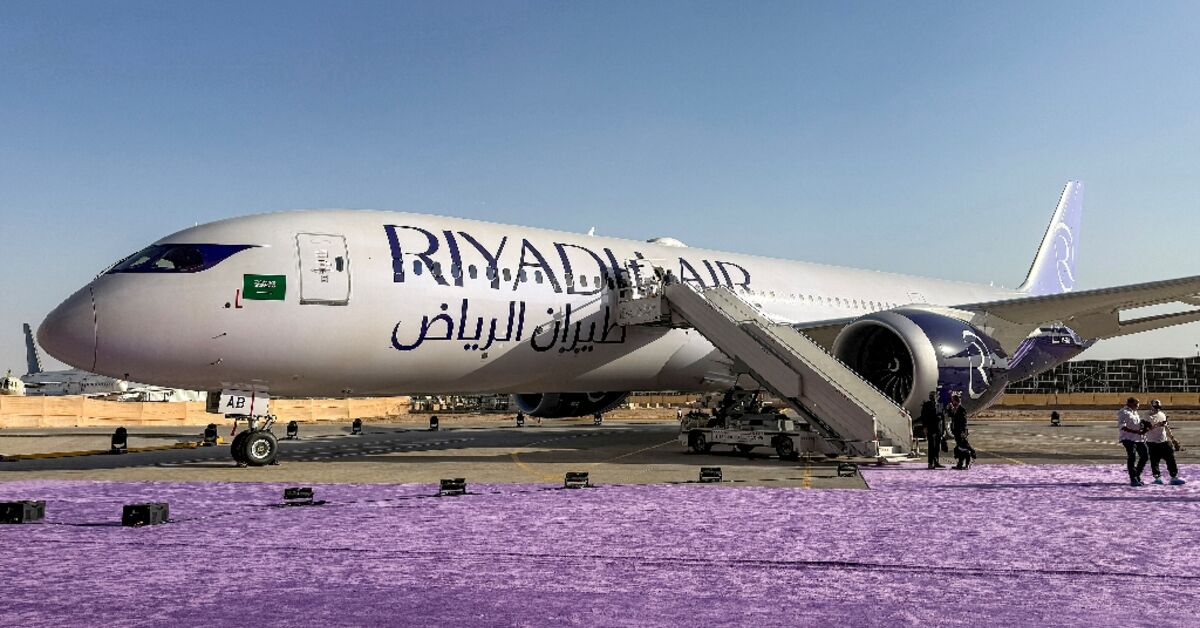
Saudi Arabia has officially launched its second national airline, Riyadh Air, marking a pivotal moment in its efforts to diversify the economy beyond oil. Despite facing economic challenges stemming from regional conflicts and stiff competition from established Gulf carriers, the new airline is poised to transform the Saudi capital into a major global travel hub, rivaling the likes of Dubai.
Launch of Riyadh Air: A Bold Step Forward
The inaugural flight of Riyadh Air took place on a Boeing 787 Dreamliner, emblazoned with the airline’s distinctive white and lavender colors, departing from Riyadh at 2:30 AM local time. This launch is not just a new airline; it represents Saudi Arabia’s strategic vision to reduce its oil dependency and solidify its position in the global aviation market. Riyadh Air is the nation’s second state-owned carrier, following Saudia, which is based in Jeddah.
Tony Douglas, the CEO of Riyadh Air, shared his vision for the airline, expressing a desire to reintroduce elegance and sophistication to air travel. “We want to bring glamour, we want to bring refinement,” he stated, emphasizing the airline’s commitment to excellence. The project was initially slated for a 2025 launch but faced delays partly due to Boeing’s manufacturing setbacks.
Economic Resilience Amid Regional Challenges
The launch of Riyadh Air comes in the context of heightened regional instability, particularly due to attacks from Iran that have targeted Gulf nations and their infrastructures. Nonetheless, Douglas is optimistic, stating that Riyadh has demonstrated resilience in the face of these events, having been less affected than other regions. He acknowledged the challenges encountered in the years leading up to this moment but expressed pride in reaching this significant milestone.
To further its goals, Saudi Arabia is constructing a massive new airport in Riyadh, with aspirations to accommodate 120 million passengers annually by 2030—an impressive boost over the current capacity of 53 million at King Khalid International Airport. Riyadh Air is backed by the Public Investment Fund, which is central to Crown Prince Mohammed bin Salman’s Vision 2030 economic reforms.
Ambitious Future Goals and Market Dynamics
Riyadh Air has set ambitious targets, aiming to connect to over 100 international destinations within the next five years. The airline’s strategy includes a substantial order of aircraft, comprising 132 Boeing 787 Dreamliners and 25 Airbus A350-1000s, with options for more. This strategy aligns with Saudi Arabia’s broader objective of tripling annual air traffic to 330 million passengers by 2030.
Despite these lofty ambitions, market analysts question the feasibility of such goals in a landscape crowded with competitors like Emirates, Qatar Airways, and Etihad. However, Saudi Arabia maintains a crucial advantage: a substantial domestic market of approximately 35 million people, the largest in the region.
The establishment of Riyadh Air and the construction of new airport facilities signal a transformative period for the Kingdom. Major events like the 2030 World Expo and the 2034 World Cup will further enhance the country’s international profile. While challenges remain, Saudi Arabia’s commitment to diversifying its economy and boosting tourism indicates a determined effort to redefine its place on the global stage.