
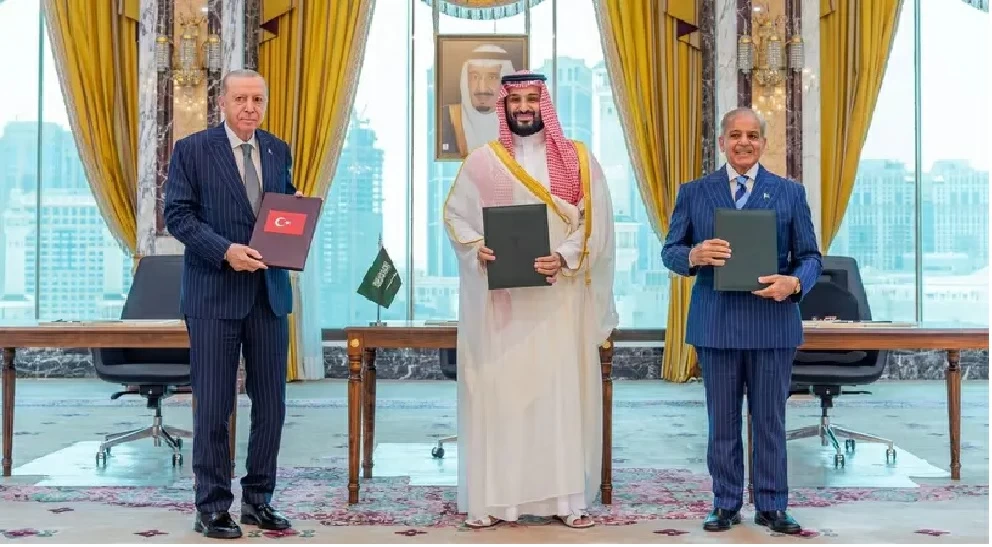
The first session of the Strategic Political and Defense Committee will take place in Istanbul, gathering significant figures from Turkey, Pakistan, and Saudi Arabia. This initiative marks a crucial step towards enhanced cooperation and mutual defense among the three countries. Expected attendees include Turkey’s Foreign Minister Hakan Fidan, Defense Minister Yaşar Güler, and Chief of General Staff Gen. Selçuk Bayraktaroğlu.
Committee Composition and Purpose
The delegation from Pakistan is likely to feature Deputy Prime Minister and Foreign Minister Ishaq Dar, Defense Minister Khawaja Asif, and Field Marshal Asim Munir, the Chief of Defense Forces and Army Chief. Meanwhile, Saudi Arabia will be represented by its own foreign and defense ministers alongside the chief of general staff. The recent pact, signed in Saudi Arabia on August 7 by Turkish President Erdoğan, Saudi Crown Prince Mohammed bin Salman, and Pakistani Prime Minister Shehbaz Sharif, enshrines a collective defense agreement where an assault on one nation equates to an attack on all involved.
Objectives of the Agreement
According to sources from the Turkish foreign ministry, the “Mecca Joint Defense Agreement” is aimed at fortifying collective defense mechanisms, likening its principles to NATO’s Article 5. In essence, any armed aggression towards one signatory will invoke a collective response, thus tightening security bonds among Turkey, Pakistan, and Saudi Arabia.
The first committee meeting in Istanbul, scheduled for Monday, is set to feature a robust agenda. It aims to explore international security dilemmas, enhance defense capabilities, and improve interoperability among the military forces of the three countries. Reports from the Turkish state-run Anadolu Agency indicate that strategic goals tied to the trilateral pact will guide discussions.
Key Discussion Points
Furthermore, the Pakistani Foreign Ministry has outlined that prominent issues regarding defense capabilities and cooperative initiatives in the military industry, such as joint production and research, will dominate the discussions. A Turkish diplomatic report mentions that the agenda will also focus on advancing cooperation in counter-terrorism efforts and ensuring better coordination amongst the military forces.
In addition to concrete military initiatives, discussions will cover broader international security concerns. With Turkey opening the door for expanding the pact, other nations like Egypt could potentially join. This development may not intend to supersede existing alliances but aims to foster a broader coalition for regional stability.
Implications and Regional Reactions
The implications of the Mecca agreement extend beyond mere defense cooperation. Analysts express concern that this alliance could represent a new geopolitical force, described by some as a “Muslim NATO,” which could pose a challenge to Israel and U.S. interests in the region. Prominent figures, including Donald Trump, have praised the pact as a significant and bold step toward regional collaboration.
Nonetheless, tensions could arise given the harsh rhetoric directed towards Israel by some leaders involved in this coalition. The sentiments expressed by Pakistan’s Defense Minister, who labeled Israel as an “evil,” alongside Turkey’s President Erdoğan’s calls for Islamic nations to unite against Israel, raise alarms regarding the potential consequences of this alliance.
In summary, the upcoming Istanbul meeting signifies an essential step in reshaping the geopolitical landscape in the Middle East, with far-reaching effects on diplomacy and defense initiatives within and outside the region.