
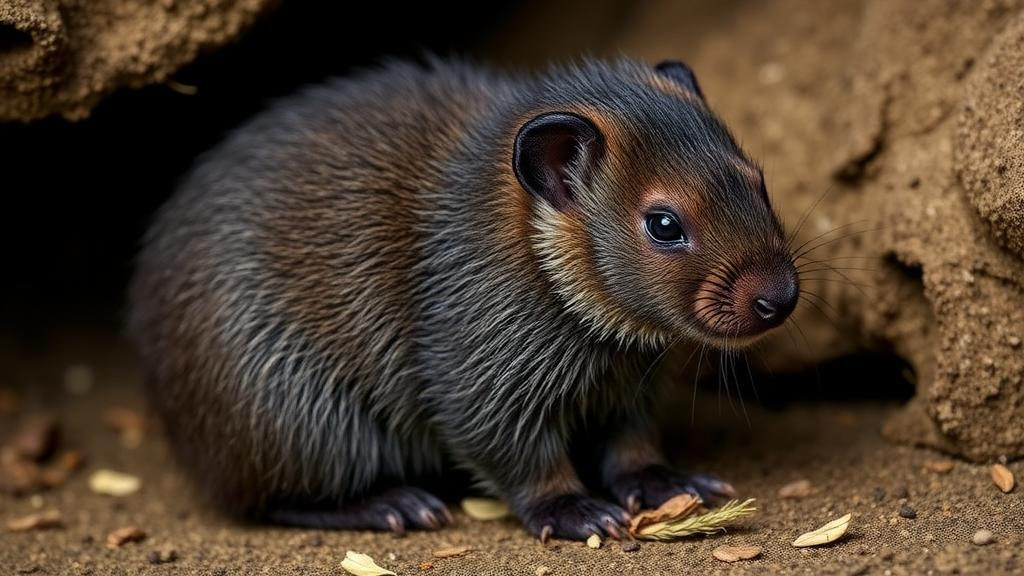
Deep beneath the grasslands and semi-arid regions of Eastern Anatolia resides a remarkable rodent that has captivated cytogeneticists for decades. The Transcaucasian mole vole, known scientifically as Ellobius lutescens, lives almost entirely underground, creating elaborate tunnel networks in the soil of the Van and Hakkâri provinces. Recent research has delved into the chromosomal structure of this unique mammal within Turkish populations, revealing that its cellular organization is just as extraordinary as its subterranean way of life.
Uncovering a Unique Chromosome Structure
Published in the journal Subterranean Biology, this study is a pioneering exploration of nucleolar organizer regions (NORs) and C-heterochromatin in Turkish specimens of E. lutescens. Researchers collected nine individuals—five females and four males—across four locations within the Van and Hakkâri provinces. Through classic cytogenetic staining methods applied to bone marrow cells, they unveiled a chromosome configuration that is remarkably rare among mammals: a diploid number of 2n = 17. Additionally, this species exhibits an XO sex chromosome system, with both males and females carrying a single X chromosome and lacking a Y chromosome altogether.
This chromosomal arrangement sets E. lutescens apart from most mammals, including humans, which typically follow a dimorphic XX/XY system for sex determination. The XO system indicates that these voles employ a fundamentally different molecular mechanism for determining sex, one that remains largely enigmatic. Among the five recognized species within the genus Ellobius—spanning regions from Ukraine to Central Asia and into Iran—E. lutescens is unique in its unusual diploid number combined with an atypical sex chromosome arrangement.
The Evolutionary Significance of Subterranean Life
Described for the first time by Thomas in 1897, E. lutescens has endured taxonomic uncertainty, with some researchers previously classifying it alongside E. fuscocapillus. However, current consensus acknowledges it as the only representative of its genus in Turkey, primarily found in the country’s eastern regions, as well as extending into northwestern Georgia, Iran, Azerbaijan, and Armenia.
Life underground has profoundly influenced this species’ biology. Its burrow systems are constructed 16 to 48 centimeters below the surface, marked by numerous interconnections and a living area approximately 12 by 9 meters in size. Morphologically, these voles exhibit typical subterranean traits such as a cylindrical body, reduced limbs, and small eyes, while physiologically, they adapt to low oxygen and elevated carbon dioxide levels within their tunnels. These features not only highlight their evolutionary significance but also align with the emerging research on their unique chromosomal characteristics.
New Insights from Cytogenetic Analysis
In the current study, chromosome preparations from colchicine-treated cells were meticulously examined, revealing significant NOR patterns. The research uncovered distinct interstitial NORs on the long arm of chromosome pair one and additional NOR signals on the short arms of pairs two and three, as well as both homologues of pair four. Interestingly, no NOR signals were detected on the X chromosome. This finding underscores the differences when compared to a 1986 study on a population in Tehran, Iran, which identified NOR signals on two biarmed chromosomes and four chromosomes in total.
Furthermore, C-banding analysis showed a surprising absence of C-band heterochromatin, including on the X chromosome. This lack of constitutive heterochromatin aligns with findings from previous research, suggesting that this C-negative trait is consistent across the species’ range. The stable karyotype, alongside newfound NOR variations, offers compelling cytogenetic evidence supporting evolutionary divergence between Turkish and Iranian populations, particularly in light of geographical barriers such as the Zagros and Tendürek mountain ranges.
Updating the Distribution of E. lutescens in Turkey
The study also sheds light on the known distribution of E. lutescens within Turkey, extending the southernmost record to Karabey village in the Yüksekova district of Hakkâri province at an elevation of 1,870 meters. Surveys further south yielded no burrow systems, solidifying Karabey as the southern limit for this elusive species. Despite their reclusive nature, the cytogenetic insights gained from this research confirm not only an ancient and stable chromosomal pattern but also illustrate the nuanced genetic isolation shaped by geographical barriers over time.