
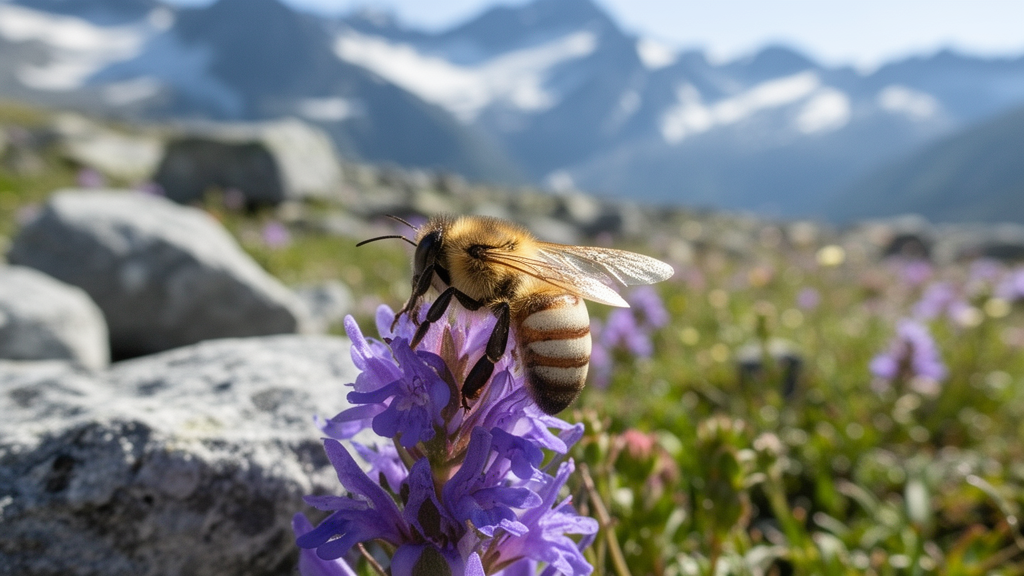
A newly identified bee species, Hoplitis (Hoplitis) onosmaevae, has been discovered across a vast geographical range, including the French Alps, Turkey, and northern Iraq. This osmiine bee features a remarkably long proboscis that is nearly the same length as its body. Notably, the findings stem from explorations in the Tinée Valley of southern France, where the presence of this bee species is separated from its eastern counterparts by a significant distance of at least 2000 kilometers. The species’ identification involved a combination of morphological comparisons, DNA sequencing, and meticulous examination of pollen samples.
Discovery in the French Alps
The original encounter with Hoplitis onosmaevae occurred during faunal inventories conducted in Mercantour National Park in 2018. Several specimens were collected from Onosma tricerosperma subsp. fastigiata in the French southern Alps. The unique length of their mouthparts set these bees apart from previously known species within the French and Central European regions. Further comparisons revealed that the French samples closely matched an undescribed species collected in Turkey, leading to the formal identification of H. onosmaevae.
The formal documentation of this species included both male and female specimens from its geographical range. The examination focused on various anatomical aspects, such as the head, antennae, and other structural features. Key distinguishing characteristics include the bee’s elongated proboscis, a pronouncedly elevated vertex, and specific traits found in females, like thickened lateral margins and a distinctive central spine on the sixth metasomal sternum. Furthermore, the yellowish-brown hind tibial spurs serve to differentiate it from similar species like H. adunca, which possesses black spurs.
Genetic Analysis and Morphological Similarities
A phylogenetic study, which included genetic analyses of two French specimens and four gene fragments, positioned H. onosmaevae within a well-supported clade of H. adunca, H. benoisti, and H. manicata. While the sister relationship among these species received less decisive support, the data did not suggest a close association with other long-tongued species like H. holmboei and H. homalocera. Although no genetic data for eastern populations were available, the morphological comparisons between European and Asian specimens indicated strong similarities, leading researchers to classify these disjunct populations under one species.
Field observations in southern France revealed female bees actively collecting nectar and pollen from Onosma. Behaviors included entering flower heads, gripping the style, and vibrating the flowers to stimulate nectar release. Detailed microscopic analyses confirmed that pollen collected from French specimens matched reference Onosma pollen, although similar pollen types from related plant genera complicated identifications in Turkish samples. As a whole, these observations suggest a notable specialization on Onosma, even if not conclusively proven.
Conservation Considerations
The nesting behavior of Hoplitis onosmaevae was documented in natural habitats approximately 35 to 40 meters from patches of Onosma. The species preferred pre-existing insect burrows in dead larch trunks for nesting, distinguished from the rock cavities often used by its relatives. While phylogenetic analysis hints at a shared ancestry of wood-burrow nesting among related species, there remains uncertainty regarding the precise relationships.
In France, the species appears to be exceptionally rare, recorded at only two sites less than five kilometers apart, with an estimated population of just 10 to 20 individuals. The search for additional populations in southern Alpine regions with flowering Onosma has not yielded results, raising concerns about the bee’s rarity. Potential factors contributing to this rarity may include a restricted climatic niche, limited nesting sites, or both. The authors underline the necessity of a conservation strategy in the southwestern Alps, suggesting further field studies, protecting current populations, maintaining the availability of dead wood, and adapting land management strategies to promote the host plant’s abundance. These recommendations emphasize proactive measures necessary to safeguard the future of this unique species.