
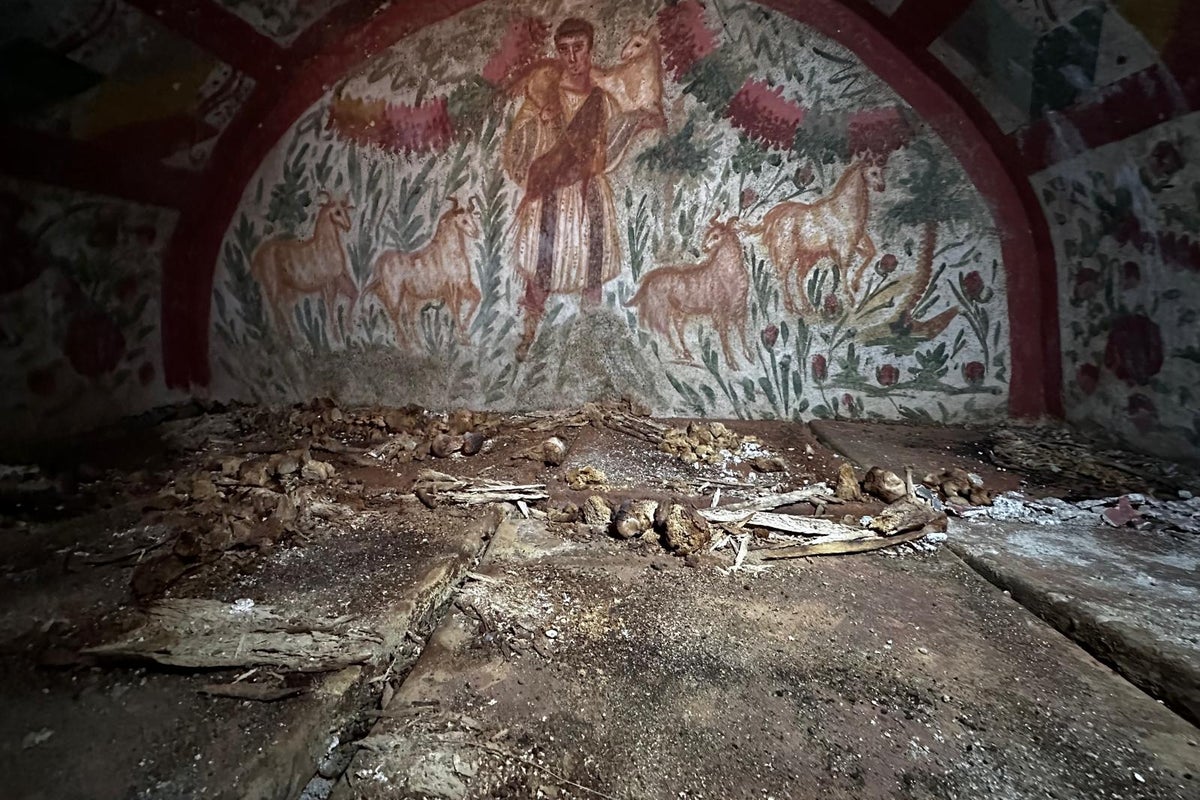
Significant archaeological findings in Turkey are shedding new light on the early development of Christianity, highlighting the region’s critical role in the faith’s initial spread. Recent discoveries include the earliest known images of Christ and numerous ancient Christian tombs and inscriptions, all of which reveal how Anatolia evolved into a key center for Christianity during the fourth and fifth centuries AD.
Remarkable Discoveries in Iznik
Among the most impressive finds is a fresco depicting Christ as the Good Shepherd, uncovered in Iznik. This image, dating to the early-to-mid-third century AD, is one of the oldest and best-preserved representations of Jesus discovered to date. Found in a sealed tomb, the fresco remains remarkably vibrant, with intricate details like Christ’s facial features and the folds of his clothing still visible. This portrayal offers valuable insights into early Christian perceptions of Jesus, revealing him with short hair, dressed in elegant Roman attire, thus painting a vivid picture of the cultural context during that era.
The Rise of Early Christianity
These discoveries affirm the pivotal role of Anatolia in the expansion of Christianity shortly after Christ’s crucifixion. New churches and various inscriptions indicate that the region rapidly adopted the faith, transitioning from a persecuted sect to gaining acceptance as the Roman Empire’s official religion within just a few centuries. Extensive research from universities around the globe has begun to highlight how early Christians’ community support contributed to their growth, opposing societal norms, and reinforcing their resolve despite periods of persecution.
Insights into the Imperial Cult
Recent excavations have revealed much about the spread of emperor worship, an imperial cult that inadvertently provided early Christianity with the opportunity to grow. For instance, findings of statues of emperors like Marcus Aurelius and Hadrian illustrate the popularity and political influence of such worship in ancient Turkish cities. As Christians opposed emperor veneration, they gained support from those disillusioned with the imperial regime, furthering the appeal of Christianity amid societal upheaval.
A Rich Tapestry of Early Christian Life
Further excavations have uncovered additional evidence of early Christian practices, including a recently discovered house church in Laodicea, one of only a few such sites identified worldwide. Other recent studies in cities like Smyrna and Pergamon have unearthed extraordinary artifacts, including early Christian graffiti and ceramic pilgrim flasks, suggesting a thriving community engaging in religious practices long before the construction of dedicated churches. These findings not only illuminate daily life for early Christians but also how their beliefs intertwined with the political and cultural fabric of the time.
In summary, the ongoing archaeological work in Turkey is radically transforming our understanding of early Christianity. Key figures like Professor Candida Moss emphasize the importance of this region, noting that it served as a cradle for the faith, visited by prominent apostles like Peter and Paul. As the Romans shifted their capital from Rome to what is now Istanbul, the early foundations of Christianity continued to flourish, leaving an indelible mark on the religious landscape that endures today.