
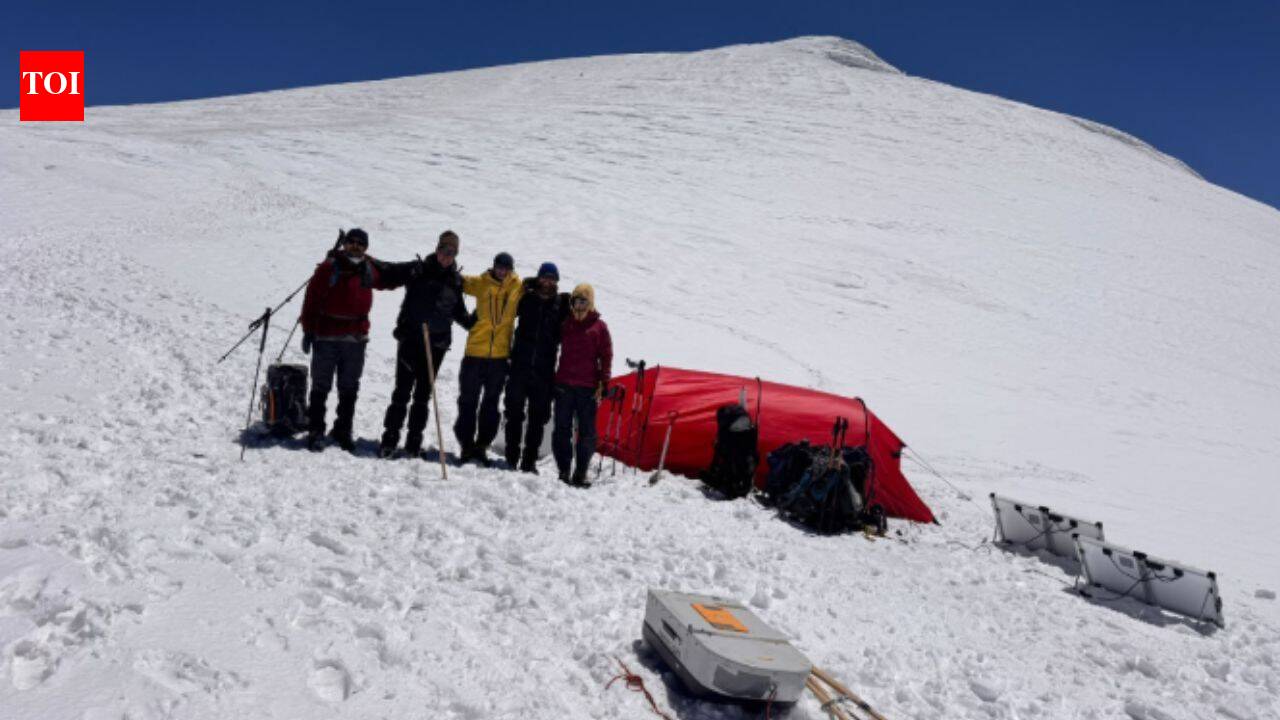
The glaciers of Mount Ararat, Turkey’s tallest peak, have been surveyed for the first time by scientists eager to capture insights before the ice further diminishes. This pioneering research aims to unlock critical information regarding both climate change and human history. Unlike typical archaeological studies that rely on artifacts buried in the earth, glaciers consist of layered ice that records environmental conditions over thousands of years. Unfortunately, as global warming accelerates, these valuable ice layers continue to melt at an alarming rate.
Surveying the Glacial Landscape
In July, a team of German and Turkish researchers embarked on an extensive survey at elevations surpassing 5,000 meters. Over two weeks, they navigated harsh conditions to gather essential data about the glacier. Prior to extracting ice cores, scientists employed advanced techniques such as ground-based radar echo sounding and active seismic surveys to map the glacier’s thickness and the underlying landscape. This mapping is crucial for determining optimal drilling sites for future ice core collection during subsequent expeditions.
Ice cores serve as cylindrical repositories of information, encapsulating winter snowfall over distinct time periods. Individual layers reflect historical meteorological conditions, similar to how tree rings divulge age and growth conditions. Dr. Coen Hofstede from the Alfred Wegener Institute, who led the measurements, expressed satisfaction with their data collection despite the challenging weather. With their comprehensive mapping, the team is now poised to identify locations for the longest uninterrupted ice core extraction.
Ice as a Historical Record
The potential findings from Mount Ararat’s glacier may be transformative, particularly for archaeologists. Project leader Prof. Dr. Achim Lichtenberger from the University of Munster emphasizes that this glacial study represents an unprecedented source of archaeological data. Unlike conventional digs that rely on soil records, the ice itself may offer a continuous historical narrative regarding human activities, layer by layer, over millennia.
Beyond human history, glaciers also hold secrets about the Earth’s climatic past. Layers of ice can reveal changes in atmospheric composition, airborne dust particles, and volcanic activity over time. By examining this scientific treasure trove, researchers hope to glean insights into how varying climate epochs have influenced the environment surrounding Mount Ararat.
The Significance of Mount Ararat
Mount Ararat holds a unique position for scientific investigation due to its geographical significance. Located at the crossroads of ancient civilizations, it has been a cradle for early agricultural and metallurgical societies. Professor Dr. Unsal Yalcin of Isparta University highlights that the glacier may offer more than just climate data. The team anticipates discovering traces of ancient smelting activities and remnants of early agricultural practices embedded within the ice.
As such, Mount Ararat could evolve into an environmental archive, reflecting broader historical contexts in regions like Anatolia, Mesopotamia, and the Caucasus.
Urgency in Action
The need for prompt action is paramount as the glacier continues to recede. Global warming is causing significant ice loss each summer, leading to the irreversible loss of older ice layers and their valuable data. This underlines the urgency for scientists to gather ice cores before further portions of the glacier vanish. The recent survey marks a crucial initial phase in this ongoing research effort. With their comprehensive map in hand, the team is positioned to execute future drilling expeditions effectively.
The initiative is spearheaded by the Institute of Classical Archaeology and Christian Archaeology at the University of Munster, in collaboration with Isparta University, marking a significant stride in understanding how glacial studies can inform us about our planet’s history.