
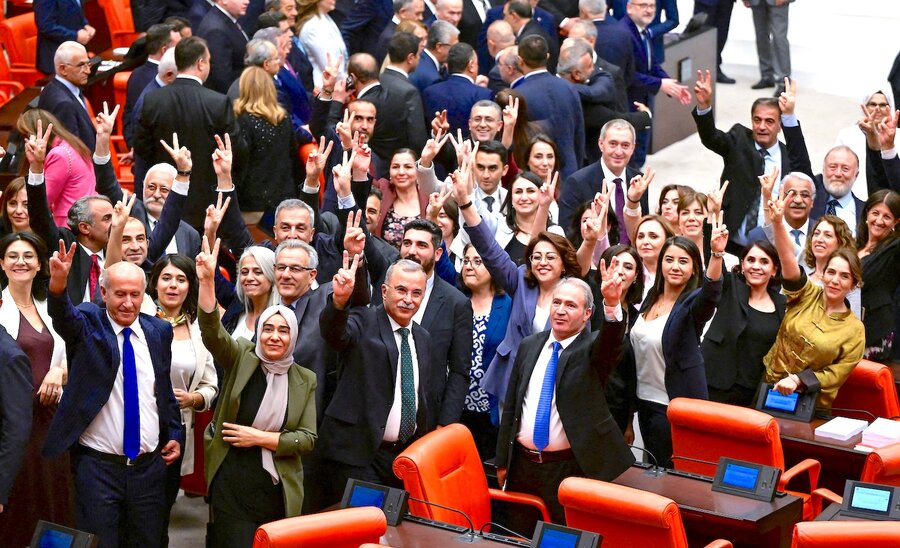
In a volatile region, Turkey is taking significant strides to address both internal and external conflicts, aiming to reshape national identity beyond ethnic and linguistic divides. Recently, the Turkish parliament passed a pivotal bill designed to end over four decades of strife with its considerable Kurdish population, thus laying the groundwork for a potential reconciliation.
Progress Towards Reconciliation
The newly approved legislation establishes a framework for conditional amnesty and the reintegration of thousands of Kurds, including former combatants. Many of these individuals have been based in neighboring countries such as Iran, Iraq, and Syria, where various factions have sought greater autonomy or full independence for the Kurdish people. Estimates suggest that around 31 million Kurds inhabit Turkey, Iraq, Iran, and Syria. The Kurdistan Workers’ Party (PKK), labeled a terrorist organization by Turkey, the United States, and the European Union, has shifted its focus in recent years, abandoning ambitions for full independence. In May 2025, the PKK announced plans to disband and disarm, putting the responsibility on the Turkish government to advance the reconciliation process.
Kurdish Perspectives on the Legislation
Many Kurds view this legislative move positively, seeing it as an opportunity to pursue democratic avenues for their rights. Garo Paylan, a visiting scholar at the Carnegie Endowment for International Peace, anticipates that tangible commitments related to political representation, cultural rights, and the inclusion of Kurdish voices in public dialogue will be essential for the legislation’s success. Furthermore, Abdullah Öcalan, the long-imprisoned leader of the PKK, has characterized the legislation as the start of a significant democratization process, comparable to the establishment of the Republic of Turkey in 1920.
Geopolitical Implications
This act of reconciliation presents Turkey, a vital NATO ally, with the opportunity to play a stabilizing role in a tumultuous region. Historically at odds with Syria due to its support for PKK factions, Turkey has significantly reduced its military operations in Iraqi territory, marking a 97% decline in such actions since the PKK’s latest announcement. Currently, Turkey is facilitating trade for Iraq and other oil-rich Gulf nations, aiding them in transporting goods across its roads, especially as routes through the Strait of Hormuz remain constrained. The potential stabilization of relations with Syria also looms as a possibility if Turkey maintains its peaceful trajectory.
Challenges Ahead
Despite these hopeful developments, the primary challenge lies within Turkey itself. Citizens are looking for genuine evidence of a more inclusive and responsive political landscape, especially as President Recep Tayyip Erdoğan has fortified his power in recent years and stifled dissenting voices. Critics often view his overtures toward Kurds as mere tactical moves aimed at bolstering his popularity and extending his tenure.
Yet, some experts, including Zakir Avşar from Ankara’s Hacı Bayram Veli University, call for a broader perspective on these developments. Avşar emphasizes the need for balance among security, freedom, public order, and democratic governance, along with fostering a sense of belonging among citizens. He posits that the true success of this reconciliation process should be gauged not by political gains for one group but by its overall contributions to Turkey’s collective future.
As Turkey embarks on this transformative journey, the world watches closely, hoping for a lasting peace that honors the diverse identities within its borders.