
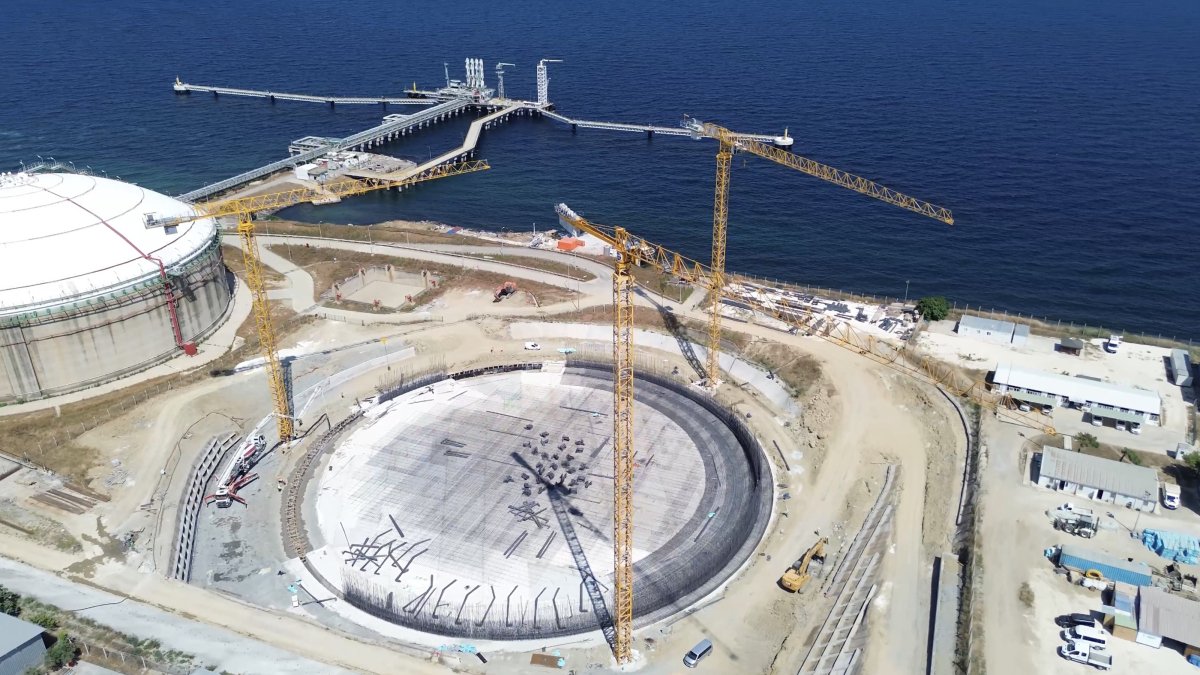
State energy firm BOTAŞ has initiated the construction of a fourth storage tank at the Marmaraereğlisi LNG Terminal located in northwestern Türkiye. This significant development aims to enhance the terminal’s liquefied natural gas (LNG) storage capacity by nearly 60%.
Expansion of Storage Capacity
The newly constructed storage tank will have a capacity of 160,000 cubic meters, raising the terminal’s total storage from 255,000 cubic meters to 415,000 cubic meters. Energy and Natural Resources Minister Alparslan Bayraktar highlighted that this expansion is crucial for optimizing Türkiye’s management of natural gas supplies. With improved storage capabilities, the country will be better equipped to handle LNG delivered by sea, regasify it when necessary, and transport the gas using road tankers while preserving its liquid state.
The Marmaraereğlisi LNG Terminal is strategically positioned in Tekirdağ province and plays a vital role during peak natural gas demand periods, especially in the winter. It features a daily regasification capacity of 37 million cubic meters. The terminal is designed to accommodate various types of LNG carriers, including large Q-Flex and Q-Max vessels, which rank among the world’s largest in terms of capacity.
Meeting Energy Demands
Every year, the facility services approximately 65 LNG vessels, fulfilling around 15% of Türkiye’s overall natural gas requirements. Beyond just storage and regasification, the terminal also manages road tanker loading, fuel supply, and reload operations, making it a comprehensive natural gas facility.
Minister Bayraktar underscored that the Marmaraereğlisi LNG Terminal’s ability to source gas from diverse markets, combined with its robust storage and regasification systems, is essential for Turkey’s energy security. He emphasized that global energy market fluctuations have underscored the need for resilient infrastructure.
Increasing Energy Security
The government aims to fortify Türkiye’s natural gas infrastructure through this latest investment, enhancing the nation’s resilience during energy crises. Currently, Türkiye has five LNG entry points, which include two terminals and three floating storage and regasification units (FSRUs). In addition to the Marmaraereğlisi LNG Terminal, BOTAŞ also supervises the Dörtyol and Saros FSRU facilities.
Under Türkiye’s National Energy and Mining Policy, the country’s LNG regasification capacity has expanded nearly fivefold since 2016, climbing from 34 million cubic meters per day to about 161 million cubic meters per day. The government has set its sights on increasing total LNG regasification capacity to 200 million cubic meters per day by the addition of two more FSRU facilities. This strategic expansion not only enhances storage capabilities but also fortifies Türkiye’s energy independence in a volatile global market.