
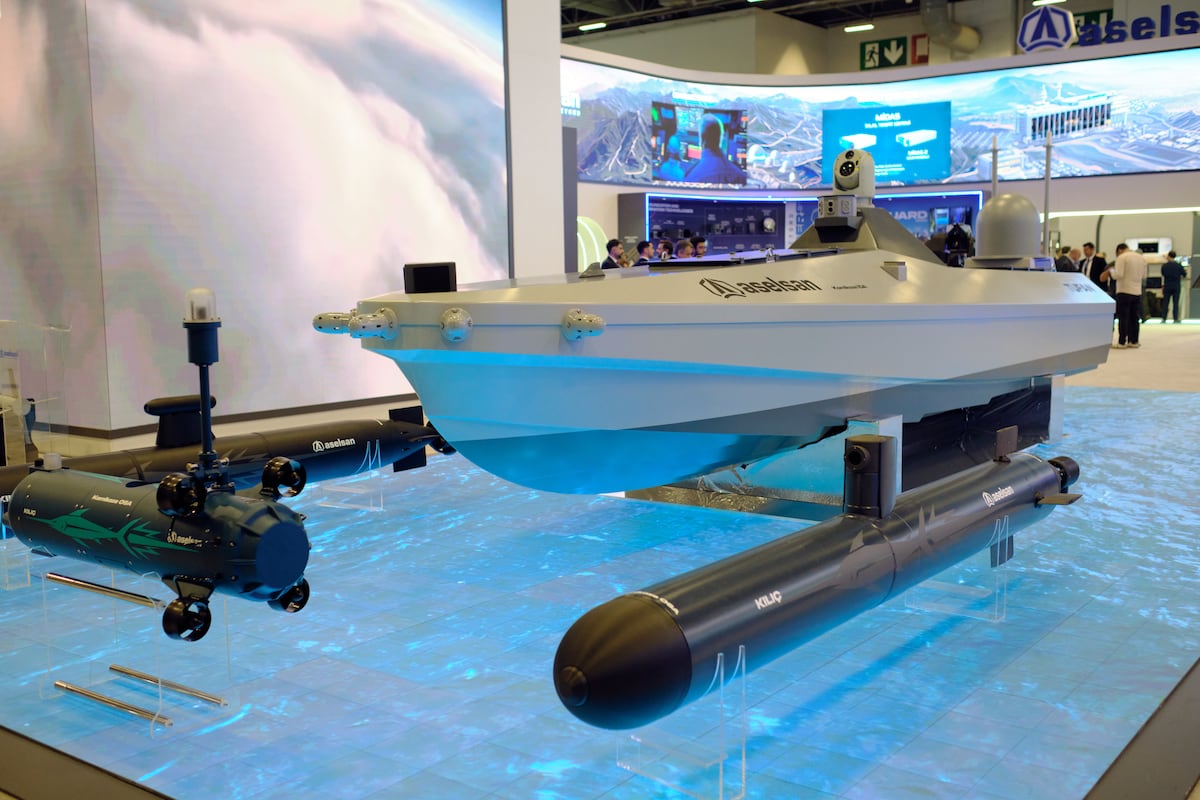
Turkey is set to significantly enhance its naval capabilities with a new procurement initiative. The country plans to acquire 100 expendable unmanned surface vessels (USVs), a strategic move announced during the SAHA Expo 2026 defense exhibition. This decision underscores Turkey’s commitment to modernizing its military assets in response to evolving maritime security challenges.
Decision-Making Process and Project Oversight
The decision to purchase these unmanned vessels was finalized during the February meeting of the Defense Industry Executive Committee, Turkey’s top governing body for defense procurement. The Secretariat of Defense Industries (SSB) is responsible for managing the project, indicating a structured approach to integrating advanced technologies into Turkey’s naval operations. The procurement will involve three different companies tasked with producing these innovative systems.
Unmanned Surface Vessel Providers
Aselsan, a prominent defense technology firm, is collaborating with Ares Shipyard to develop one of the expendable USVs, dubbed Tufan. This partnership resulted in a significant showcase at the SAHA Expo 2026, where the vessel’s capabilities were revealed. Additionally, STM is working with Yonca Shipyard to create another USV, named Yaktu. This vessel also made an appearance at the expo. The third participant in this endeavor is Havelsan, in collaboration with Sefine Shipyard.
The allocation of the 100 units includes 40 for Aselsan, 32 for STM, and 32 for Havelsan. This distribution may require minor adjustments to align with operational plans that anticipate deploying four-drone swarms. Such units are designed not only for standalone missions but also for cooperative operations that enhance their effectiveness.
Specifications and Operational Roles
Aselsan’s Tufan is a robust vessel measuring 8 meters in length and 1.8 meters in width, specifically engineered for strike missions targeting maritime and coastal objectives. It can carry a substantial high-explosive payload that is equivalent to one Mk 82 bomb. On the other hand, STM’s Yaktu USV is designed to fulfill diverse naval roles, addressing asymmetric threats from port security to open-sea strike operations. It has a length of 5.8 meters and a displacement of 1.7 tons.
Both Tufan and Yaktu are built for precision strikes and are configured as expendable platforms targeting surface assets. They feature low-profile hulls designed to minimize radar signature and visual detection, enhancing their stealth capabilities. Furthermore, these USVs support both line-of-sight (LOS) and satellite communications, making them suitable for integration into Turkey’s network-centric operations.
Incorporating swarm technology into their design allows these vessels to work collaboratively, sharing real-time data and autonomously managing tasks during missions. This capability not only increases operational flexibility but also enhances the overall effectiveness of Turkey’s maritime defense strategies.
Turkey’s investment in unmanned surface vessels reflects a significant step toward modernizing its naval forces, ensuring readiness to meet contemporary security challenges in an increasingly complex global environment. As military technology continues to evolve, these advancements will play an essential role in bolstering Turkey’s defensive posture.