
Thank you for your support and interest in my posts! Currently, I’m offering a special rate for early subscribers. If you enjoy this content and wish to engage with me directly, consider subscribing. Your input helps shape future discussions, and securing a subscription now will lock in a lower rate before I transition to a paywall.
Turkey’s Political Turmoil
The recent political landscape in Turkey has created an environment of uncertainty, mirroring the chaos often seen in football. Just as Gary Lineker famously noted that the outcome of a match can feel predictable, it’s becoming increasingly evident that Turkey faces its own repetitive cycle of crisis. A Turkish court’s recent decision to remove the leader of the main opposition party is the latest chapter in President Erdogan’s efforts to consolidate power, sending financial markets into a frenzy. This incident, while alarming, is merely a symptom of deeper, ongoing issues within the nation.
Turkey’s political environment is deeply polarized, with Erdogan vigorously promoting economic growth as a way to maintain his grip on power. However, this growth comes at a price, manifesting in a troubling current account deficit that exacerbates the country’s vulnerabilities. As Turkey’s growth outpaces its sustainable limits, every upheaval—whether economic or political—threatens to plunge the nation deeper into crisis. The court’s ruling may be the latest spark, but the precarious state of the economy hangs in the balance, revealing a pattern of instability that has plagued the nation for years.
The Current Account Deficit Challenge
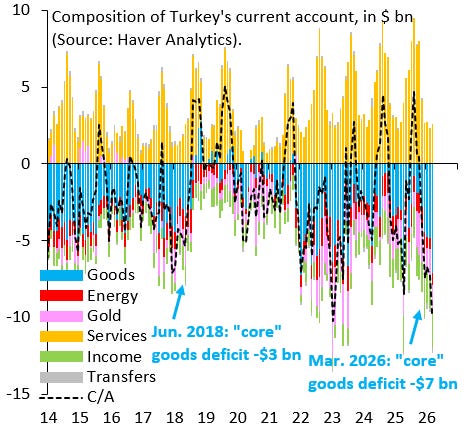
Recent data illustrate the severity of Turkey’s situation. The country’s current account deficit, which notably excludes energy and gold imports, is reaching unprecedented levels. For instance, in March 2026, this core deficit escalated to a staggering -$7 billion. Comparatively, it was only about -$3 billion back in early 2018, a period that also saw significant economic turbulence following external sanctions. The alarming truth is that Turkey’s short-term growth strategies, while politically expedient, are unsustainable. The nation finds itself in a vicious cycle, where rapid growth pulls in massive imports without the necessary export growth to balance the books.
Looking ahead, the core goods deficit is a pressing concern. As imports soar to near historical highs, exports have begun to weaken, particularly due to disruptions from the ongoing conflict with Iran. This increased import dependency leaves Turkey’s economy precariously exposed. If global economic conditions decline, the direct consequence could be a fall in exports, leaving the nation with insufficient funds to cover its considerable import bills.
The Road to Devaluation
Compounding these economic challenges is the Turkish central bank’s ongoing struggle to prevent currency devaluation. Since the onset of the conflict with Iran, the institution has resorted to record sales of foreign exchange reserves, including gold, in a desperate attempt to stabilize the lira. As this tactic depletes available resources, the central bank finds itself with diminishing options to counter the next economic shock.
As the situation evolves, one conclusion seems inevitable: Turkey is on a path towards devaluation. Despite the government’s best efforts to maintain financial stability, the underlying issues tied to aggressive growth strategies and political unrest create a recipe for disaster. The country’s economy, vulnerable and unpredictable, will require significant reforms to avoid further turbulence and potential collapse in the coming years.