
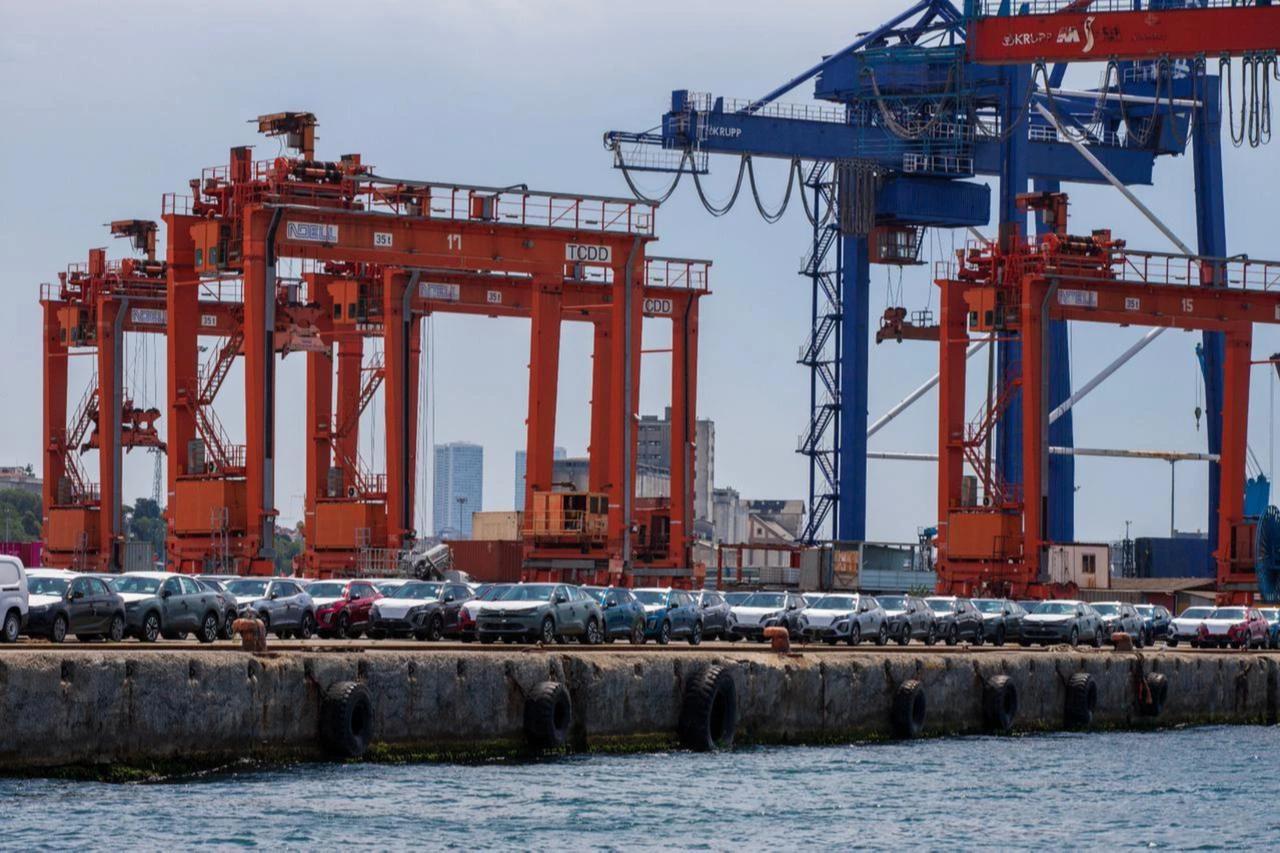
Türkiye’s exports to the European Union saw a notable uptick in the first eight months of 2026, reflecting a robust trade relationship. The latest figures provided by the Turkish Exporters Assembly (TIM) illustrate a year-on-year increase of 3.6%, with exports rising to approximately $71.79 billion. This growth aligns with the overall upward trend in Türkiye’s exports, which saw a 4% increase, bringing total exports from $177.9 billion to $185 billion during the same timeframe.
Germany Remains Türkiye’s Top EU Market
Germany continues to be Türkiye’s largest trading partner within the EU, importing goods worth $13.58 billion—a 3.8% increase compared to the previous year. Following Germany, Italy and Spain also represent significant markets, with exports totaling $8.56 billion and $7.24 billion, respectively. France contributed $6.93 billion, while Romania’s imports from Türkiye reached $4.89 billion. Notably, exports to Italy rose 4.3%, Spain experienced a 7.4% increase, and France saw a 5.2% growth. In contrast, shipments to Romania decreased by 5.5%.
Malta Shows Remarkable Growth
Among EU nations, Malta recorded the most significant proportional surge in exports from Türkiye, skyrocketing by 107% to reach $671.6 million. Slovakia also showcased impressive growth of 32.8%, while Finland and Bulgaria grew by 25.3% and 17%, respectively. Austria saw exports climbing by 14.4%. In total, shipments to Slovakia amounted to $1.46 billion, $408.7 million to Finland, $3.44 billion to Bulgaria, and $1.41 billion to Austria. Overall, Türkiye experienced increased exports to 17 EU member states, while experiencing declines to 10.
Key Sectors Driving Exports
The automotive sector emerges as Türkiye’s leading industry regarding EU exports, witnessing a 4.5% growth that took total shipments to $20.06 billion. Following this sector, chemicals and chemical products contributed $9.06 billion, while ready-to-wear clothing accounted for $6.54 billion. Noteworthy was the substantial rise in iron and non-ferrous metals exports, which jumped 18.6% from $4.87 billion to $5.77 billion—an increase of about $904.5 million. The automotive sector contributed an additional $872.1 million in export growth, with electrical and electronics exports gaining $269.5 million.
Istanbul: The Export Powerhouse
Istanbul stands out as the dominant city for Türkiye’s exports to the EU, accounting for nearly $25.44 billion of the total. The cities of Kocaeli, Bursa, Ankara, and Izmir collectively contributed approximately $53.6 billion in exports over the January to August period. Kocaeli followed Istanbul with $10.11 billion, while Bursa, Ankara, and Izmir recorded $8.31 billion, $4.91 billion, and $4.79 billion, respectively. This geographic distribution highlights the pivotal role of these cities in driving Türkiye’s export performance.
In conclusion, Türkiye’s export growth to the European Union in 2026 underscores a strengthening economic partnership. With significant increases across various sectors and notable achievements in key markets, Türkiye is poised for continued growth in its international trade endeavors.