
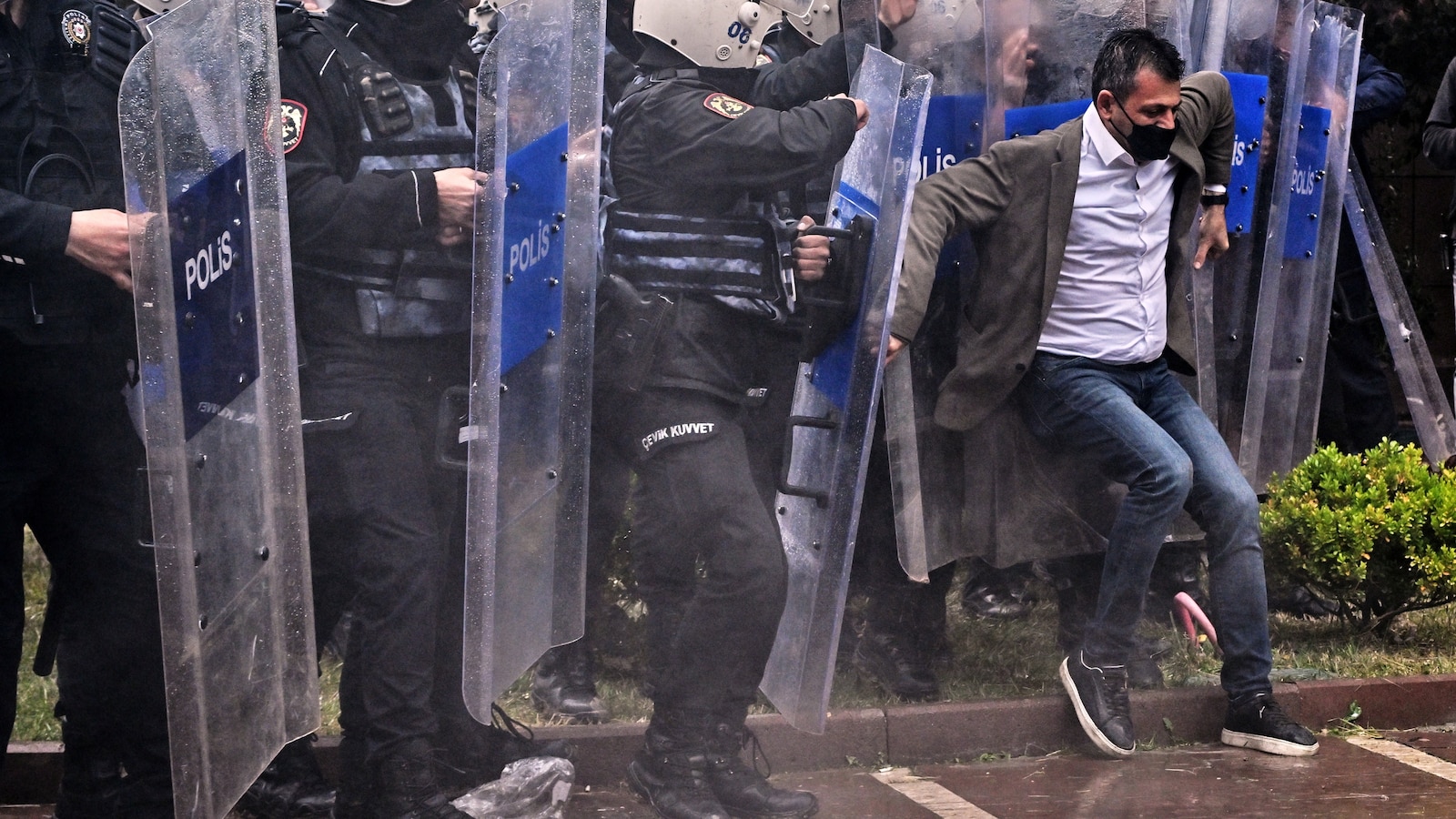
Police clashed with supporters and officials from Turkey’s main opposition party, the Republican People’s Party (CHP), during a recent raid in Ankara. For three days, party members had occupied their headquarters in an effort to block a leadership team imposed by a recent court decision. The situation escalated when law enforcement used tear gas and rubber bullets to disperse protesters, marking a significant moment of tension between the CHP and President Recep Tayyip Erdogan’s government.
The Tensions Escalate
The confrontation began as CHP supporters barricaded entrances, using buses and furniture to block access. As riot police entered the premises, footage captured the chaos: clouds of tear gas filled the air while officers moved through the building. In response, supporters attempted to fend off the police by spraying them with fire extinguishers, but their efforts were quickly thwarted, resulting in shattered doors and broken windows.
Among those within the headquarters was Ozgur Ozel, who had recently been elected as the party’s chairperson but was removed by the court’s ruling. A shocking video of the raid shows Ozel being handed the court order to vacate, which he defiantly ripped apart. Despite being ousted, he left the building to booming cheers from his supporters. “We will reclaim our space so no one can interfere again,” he declared to reporters before marching towards Parliament with hundreds of followers.
The Historical Context
The CHP, founded in 1923 by Mustafa Kemal Ataturk, has faced numerous challenges throughout its history, including periods of being disbanded, particularly following a military coup in 1980. The current legal challenges faced by the party—including the nullification of Ozel’s election—are viewed by many as political maneuvers to undermine the CHP as they prepare for future elections. While the next presidential election is not scheduled until 2028, Erdogan has the authority to call for an early vote, an action that many anticipate.
Ozel’s removal is perceived by opposition factions as part of a broader strategy to weaken the party leading up to the election cycle. The CHP has faced a barrage of legal cases targeting its members, with allegations often centered around corruption. The government maintains that the judiciary operates independently, countering claims of politically motivated prosecutions.
A Broader Political Landscape
Ozel, despite losing his chairperson role, remains an elected lawmaker from Manisa and the party’s spokesperson. He previously delivered a strong performance against Erdogan’s Justice and Development Party in the recent municipal elections, underscoring his potential as a formidable political figure.
In spite of his removal, Ozel rallied his supporters outside the Parliament, declaring that the CHP would be rebuilt and strengthened. “The CHP is effectively shuttered but it will be revived,” he affirmed to the assembled crowd. His determination seems to resonate with many within the party, evidenced by the united front displayed during the recent turmoil at their headquarters.
Many political analysts suggest that the government is leveraging legal mechanisms to undermine the CHP as a competitor. The situation continues to evolve, and the implications for Turkey’s political landscape are significant as the opposition gears up for future battles against Erdogan’s administration. As tensions rise, the outcome could shape the future of Turkish politics for years to come.