
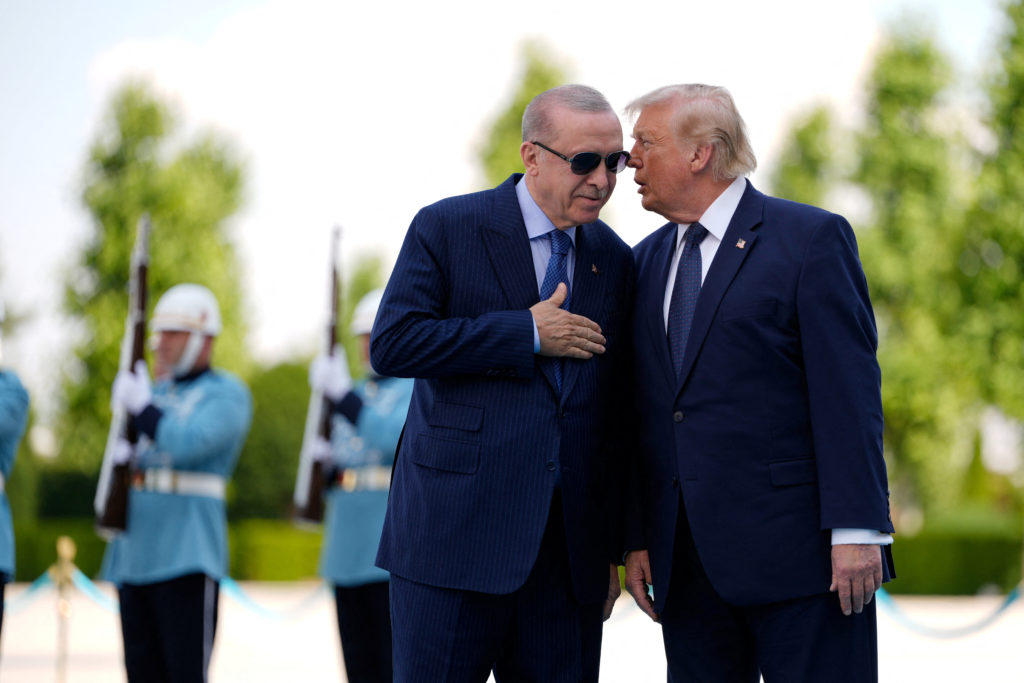
President Donald Trump made his arrival in Turkey on Tuesday for a NATO summit, greeted by Turkish President Recep Tayyip Erdoğan at a ceremonial event. This meeting holds significance not only for NATO but also for the interactions between the United States and Turkey.
Ceremonial Welcome and Key Exchanges
Upon landing, President Erdoğan awaited Trump on a blue carpet as he exited Air Force One. The two leaders exchanged handshakes and smiled for the cameras, with Erdoğan playfully squeezing Trump’s shoulder, signifying a cordial relationship despite past tensions. With sunglasses shielding his eyes from the bright Turkish sun, Erdoğan led the way as they posed for photos together.
The ceremony took place at the July 15 Martyrs’ Memorial, an important site symbolizing Turkey’s historical resilience. Here, both leaders stood solemnly as national anthems filled the air, marking the significance of their meeting. Following the anthems, they observed a guard of honor, followed by a military flyover, illustrating a sense of unity between the two nations.
Implications for US-Turkey Relations
During their interactions, Trump and Erdoğan maintained a light-hearted demeanor. Although they did not make formal statements to the media at the ceremony, conversations were overheard. Intrigued by the occasion, Trump shared details about the new Air Force One aircraft with Erdoğan and his wife, hinting at a mutual interest in strengthening diplomatic ties.
This visit comes amid discussions surrounding U.S. sanctions on Turkey and possible military sales, including the advanced F-35 fighter jets. Such topics have been contentious recently, as both countries navigate complex regional interests and alignments. The willingness of the U.S. to revisit sanctions and export possibilities could signify a thaw in relations that have seen their share of ups and downs over the years.
Importance of the NATO Summit
The NATO summit serves as a crucial platform for member countries to discuss collective security, defense strategies, and international relations. For Trump, this summit represents an opportunity to reinforce the U.S.’s commitment to its allies while addressing pressing global issues. Erdoğan’s warm reception could be viewed as an effort to bolster Turkey’s standing within NATO and regain influence in regional matters.
As the leaders engaged in their ceremonial duties, the world watched closely to see how their relationship would evolve in these challenging times. The implications of this summit extend beyond the immediate interactions of the two leaders, potentially affecting NATO strategies and alliances in the region.
In conclusion, Trump’s trip to Turkey symbolizes more than just a meeting; it reflects ongoing dialogues and the future of U.S.-Turkey relations. As both leaders embrace this opportunity to strengthen ties, the outcomes of discussions at the NATO summit could have ripple effects across global politics.