
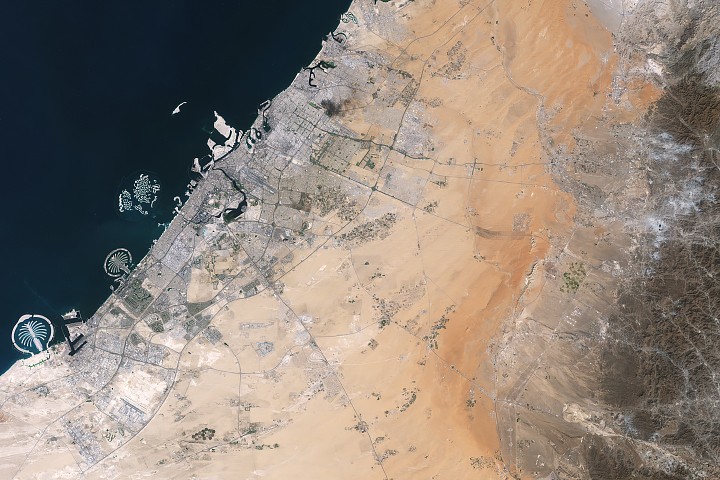
Nestled about an hour’s drive from the dazzling skyline of Dubai lies a captivating natural landscape. The northern region of the Rub’ al Khali, characterized by its undulating orange sand dunes, meets the Al-Hajar Mountains, where notable geological formations rise prominently. The site, showcasing Jabal al Fāyah, presents an intricate tapestry of natural history, where time unfolds tales of both ancient marine life and the resilience of early human societies.
The Geological Significance of Jabal al Fāyah
Captured by the Landsat 8 satellite, the ridges of Jabal al Fāyah form a striking barrier that mitigates wind across the desert. This stunning rock formation is primarily composed of limestone, which serves as a testament to the region’s aquatic past. Millions of years ago, this landscape was submerged beneath a vast sea, allowing sedimentary rock layers to develop. Today, geologists study these limestone ridges to piece together Earth’s history, marking a period when the area’s geology was fundamentally reshaped.
This limestone not only shapes the physical geography but also provides clues about climatic and environmental changes over eons. The dunes to the west, adorned in bright orange hues, are a result of weathering iron-bearing minerals, while the eastern terrain features alluvial fans carrying sediments from the Al-Hajar Mountains. This interplay of erosion and sedimentation underscores the rich geological narrative of the region, compelling for scientists and enthusiasts alike.
Insights into Ancient Oceans and Subduction
To the east of Jabal al Fāyah lies the remarkable Samail Ophiolite, highly regarded by geologists for its well-preserved samples of ancient oceanic lithosphere. Unlike typical oceanic crust, which finds itself subducted during tectonic collisions, sections of this lithosphere were thrust onto the Arabian plate in a process known as obduction. As a result, researchers have access to clues about the Earth’s historical trajectory through geological examination, rendering this site both rare and invaluable in ongoing geological studies.
The limestone ridges encapsulate marine deposits that took shape over millions of years, predominantly from the late Cretaceous to the mid-Paleocene eras. The coral fragments and fossils embedded in these rocks further illuminate a time when vibrant marine ecosystems thrived in the region’s waters, enhancing our understanding of life during this period.
Archaeological Discoveries and Human Adaptation
Beyond its geological interest, the Jabal al Fāyah ridges also serve as a critical archaeological site, highlighting human adaptation in an exposed desert milieu. Recognized as a UNESCO World Heritage site in 2025, the area is speckled with archaeological sites that date back to between 210,000 and 120,000 years ago. These sites offer insight into the Middle Paleolithic era, revealing signs of early human habitation and resilience in a challenging environment.
Archaeological findings, including stone tools and other artifacts, document early humans’ survival strategies and raise intriguing questions regarding migration patterns from Africa. Notably, these objects showcase the adaptive ingenuity of Homo sapiens amidst the harshness of their surroundings and challenge established narratives about early human movement.
The Importance of Water Sources in the Desert
The geological evidence points to periods when lakes formed on the eastern side of the ridges, providing vital resources of food and water that supported early occupants thriving in an unforgiving desert. Rocky outcroppings along the ridge would have offered necessary shelter from the relentless desert heat and wind, further enhancing the site’s appeal for habitation. Such findings not only highlight the adaptive capabilities of early humans but also mark the region as one of the earliest known locations of human settlement on the Arabian Peninsula.
As we delve deeper into the history of the Jabal al Fāyah ridges, we uncover a rich narrative that intertwines human resilience and geological evolution, solidifying the area’s importance as an intriguing hub for both scientists and historians. This hidden gem continues to unfold its secrets, reminding us of our planet’s dynamic past and the tenacity of life within it.