
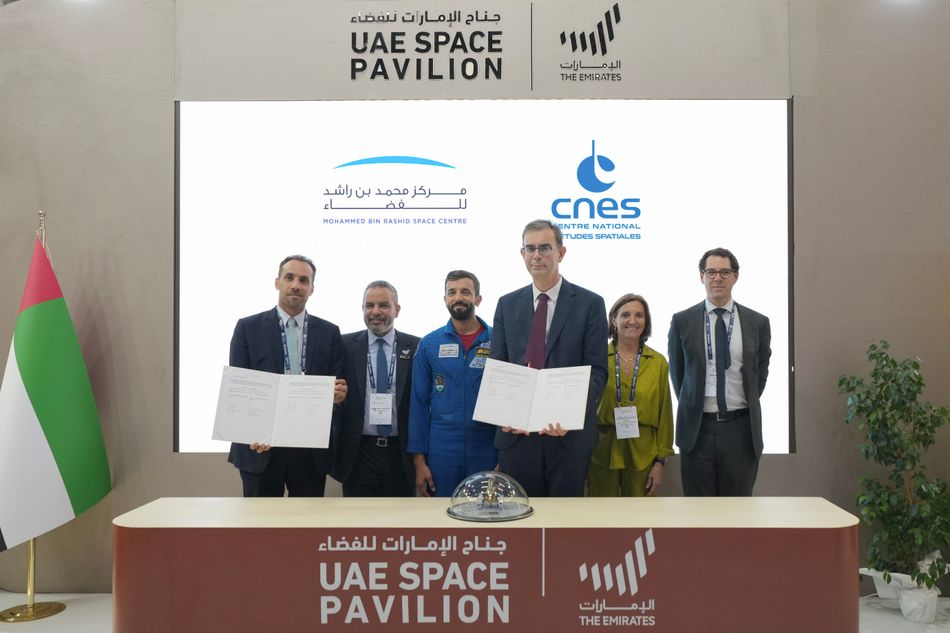
The Mohammed Bin Rashid Space Centre (MBRSC) and the French space agency, CNES, have solidified their partnership by signing a Memorandum of Understanding (MoU) aimed at bolstering future lunar missions. This agreement marks a significant step in their ongoing collaboration in lunar exploration and was officially inked during the 77th International Astronautical Congress held in Antalya, Türkiye.
Key Components of the Agreement
The MoU was signed by H.E. Salem Humaid AlMarri, Director General of MBRSC, and François Jacq, President Director General of CNES, in the presence of notable UAE officials, including H.E. Sultan AlNeyadi, UAE Minister of State for Youth Affairs. This renewed partnership enhances the existing technical and scientific cooperation that has been established during earlier phases of the Emirates Lunar Mission. The agreement sets the foundation for future joint endeavors as MBRSC continues to develop its lunar exploration capabilities.
As part of this collaboration, CNES is set to contribute advanced imaging technologies for upcoming missions. This includes the deployment of CASPEX cameras, micro-camera modules, and enhanced lighting systems. Moreover, CNES will provide expertise in areas like camera calibration and image processing, ensuring operational efficiency throughout these missions.
Building on Previous Successes
The renewed partnership not only promises the expansion of technological resources but also focuses on leveraging the knowledge and expertise already acquired through earlier projects. By joining forces, MBRSC and CNES aim to meet the scientific objectives for upcoming missions while continuing to foster MBRSC’s lunar exploration capabilities.
H.E. Salem Humaid AlMarri highlighted the evolving nature of the Emirates Lunar Mission, emphasizing its long-term ambitions and the UAE’s growing experience in lunar research. He reiterated that this collaboration with CNES is pivotal for advancing national capabilities and deepening scientific understanding, ensuring the UAE remains a key player in lunar exploration.
François Jacq echoed this sentiment, reinforcing that the MoU fortifies the cooperation between France and the UAE in conducting ambitious lunar missions. By uniting their respective areas of expertise, both organizations hope to facilitate scientific research and deepen their understanding of the Moon’s far side, setting the stage for future explorations.
The Vision of the Emirates Lunar Mission
The Emirates Lunar Mission strives to deploy a series of rovers tailored for exploring diverse lunar sites with distinct scientific goals. Each rover is named after Sheikh Rashid Bin Saeed Al Maktoum, who played a critical role in the establishment of modern Dubai. This mission is aligned with the UAE’s overarching vision for space exploration, using incremental advances to build on scientific knowledge, develop innovative technologies, and cultivate national expertise necessary for future space initiatives.
The Emirates Lunar Mission receives funding from the ICT Fund, operated under the Telecommunications and Digital Government Regulatory Authority (TDRA). This initiative is dedicated to bolstering research and development in the UAE’s ICT sector, thereby expanding the nation’s scientific and exploratory capabilities.
In conclusion, the collaboration between MBRSC and CNES not only strengthens ties in lunar exploration but actively contributes to the UAE’s broader aims in the field of space science. As governments and organizations worldwide focus on space exploration, this partnership exemplifies the potential for collaborative growth and innovation in the pursuit of scientific advancement.