
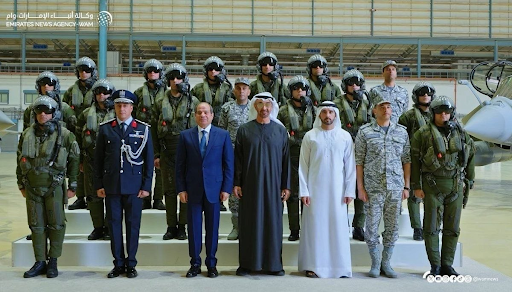
A recent unannounced visit by Egyptian President Abdel Fattah el-Sisi to the United Arab Emirates (UAE) sparked significant attention, raising questions about the nature of Egypt’s regional engagements. During his surprise trip on May 7, Sisi was spotted touring a shopping mall in Abu Dhabi alongside UAE President Mohammed bin Zayed. However, what truly captured the public’s interest were the images of Egyptian military officers and fighter jets. These developments have fueled discussions across Arabic-language social media, raising concerns about Egypt’s role in the evolving geopolitical landscape.
Repercussions of Military Alignment
The initial reactions on social media highlighted a growing unease regarding Egypt’s military cooperation with the UAE. Some commentators suggested that Egypt might be becoming enmeshed in wider regional confrontations, particularly as tensions escalate between Iran and Israel. Only a few months prior, Sisi had prominently stated that “no one dares touch this country,” underlining Egypt’s desire to maintain neutrality in an unstable region. Yet, the visit to the UAE ignited fears that Egypt could be stepping into a strategic trap, influenced by Emirati interests. Critics argue that the UAE has exploited Egypt’s reliance on Gulf financial support, compelling Cairo to provide military backing amid a shifting power balance in the region.
Public Sentiment and Controversial Voices
The backdrop of the ongoing Gaza conflict added another layer to public sentiments regarding Egypt’s military posture. Many observers criticized Egypt’s perceived reluctance to intervene in the conflict, describing it as a moral and political contradiction in light of its cooperation with Western and Israeli security agendas. Prominent Egyptian actor and political exile Amr Waked took to social media to condemn Egyptian pilots involved in military operations tied to the UAE, expressing outrage over perceived betrayals of national honor and dignity.
As discontent simmered, conspiracy theories began to circulate. The unexpected visit from Sisi reopened discussions about the alleged Emirati military presence in Egypt, suggesting that secret security deals could be at play even as internal political dynamics remained murky. Speculation surrounding the visit hinted at its possible link to succession politics in Egypt, further complicating the narrative of the trip.
Wider Context of Gulf Relations
Sisi’s visit cannot be divorced from the broader geopolitical environment emerging from the Gulf region. Emirati officials have openly criticized regional institutions, such as the Arab League and Gulf Cooperation Council, citing ineffective responses to Iranian provocations. Recently, the UAE even declared its withdrawal from OPEC, signaling deeper frustrations with regional alliances. Meanwhile, senior UAE diplomat Anwar Gargash acknowledged the positive stances taken by several Arab nations, including Egypt, during recent crises, yet lamented that cooperation among Gulf states was historically weak.
Egypt has also taken steps to assert its sovereignty amid the ongoing turmoil, issuing statements condemning Iranian aggression against UAE territory. The Egyptian foreign ministry’s declaration of solidarity with the UAE underscores the intricate balance Cairo seeks to maintain in a volatile environment. Further, Al-Azhar University released a public condemnation coinciding with Sisi’s visit, signaling a unified official stance.
Economic Dependency and Military Engagement
The developments observed during Sisi’s UAE visit must be viewed against the longstanding economic ties between Egypt and the Gulf states. Egypt has heavily relied on Gulf investments, particularly from the UAE and Saudi Arabia, which have poured billions into various sectors like real estate and infrastructure. This financial dependency exacerbates Egypt’s precarious economic crisis, making it challenging for the regime to assert its autonomy in decision-making while balancing the interests of competing Gulf powers.
In this context, the images of Egyptian officers and fighter jets in the UAE have taken on profound symbolic significance. For many, they epitomize the growing military coordination between Egypt and the UAE. Others perceive them as a troubling indication that Egypt’s relationships in the Gulf are leaning more towards security cooperation rather than purely diplomatic engagements. As the geopolitical landscape continues to shift, the implications of such developments for Egypt’s national interests will be closely scrutinized.