
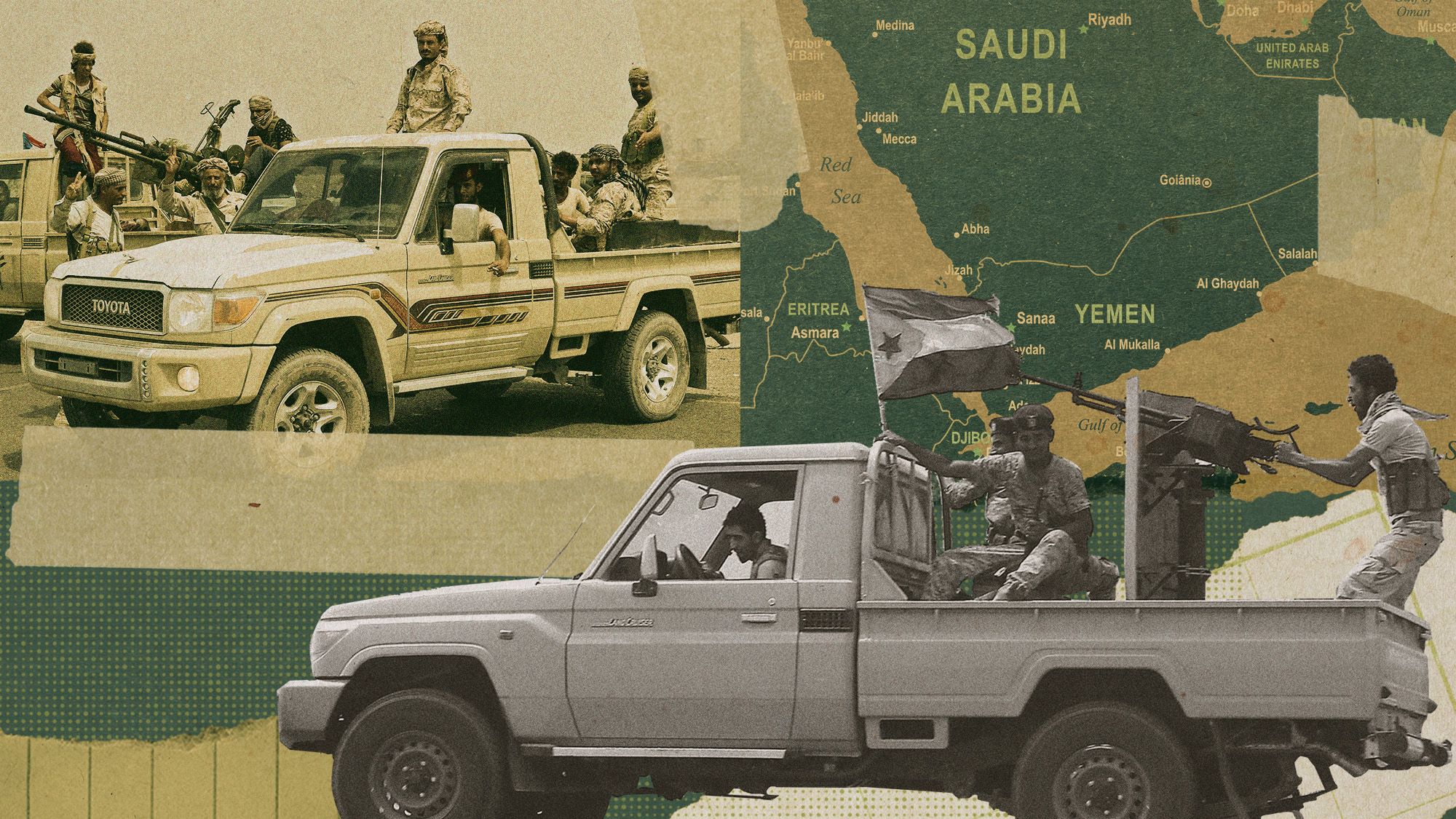
A new militia, spearheaded by a former trader of honey and herbs, is significantly altering the dynamics of the Saudi-Houthi conflict in Yemen. The Southern Giants, recognized as one of the most formidable militias in the region, are reshaping the power landscape between Saudi Arabia and the United Arab Emirates (UAE). Reports suggest that their growing influence has created a notable fault-line within the coalition supporting the Yemeni government.
Emergence of the Southern Giants
Established in 2015 amidst the Yemeni civil war, the Southern Giants, or Alwiya al-Amaliqa in Arabic, are noted for their Salafist ideology—an ultra-conservative interpretation of Sunni Islam. This group views Shia factions like the Iran-aligned Houthis as adversaries. Under the leadership of Abdulrahman al-Mahrami, known to his followers as Abu Zara’a, the militia’s numbers are estimated to have surged to between 20,000 and 70,000 fighters. This rapid expansion has established them as a critical military force capable of executing strategic operations to reclaim territory from Houthi control.
Recently, the Southern Giants played a pivotal role in an offensive to retake the strategically important port of Mocha, a site recaptured by the Houthis less than a month earlier. The Yemeni government has hailed this victory, citing Mocha and the surrounding coastal routes as vital to maintaining control over the Bab el-Mandeb strait, a significant maritime passage. This successful operation marks one of the few significant military attainments for the coalition in recent years, emphasizing the escalating effectiveness of the Southern Giants.
Complex Alliances and Motivations
Though the Southern Giants nominally operate under the auspices of the internationally recognized Yemeni government, their alliance has deeper roots with the UAE. Observers note that the militia largely functions as an extension of Emirati ambitions in the region, receiving robust training, financial backing, and advanced military equipment from their UAE sponsors. This relationship positions the Southern Giants as a strategic asset, enabling the UAE to exert influence over the trajectory of southern Yemen.
While the Southern Giants have largely refrained from engaging in internal conflicts among the various anti-Houthi factions within the Yemeni coalition, their motivations appear predominantly separatist. Analysts speculate that their primary goal remains the liberation of southern Yemen from Houthi control, rather than fostering national unity. This perspective has led to apprehension about the potential implications for the country’s future stability.
Current and Future Implications
The Southern Giants currently represent the spearhead of the Saudi-led coalition’s attempts to regain territory lost to the Houthis, potentially reshaping control over crucial shipping routes in the region. For the time being, the interests of Saudi Arabia and the UAE seem to align, allowing them to jointly counter the Houthi advances. However, analysts caution that this partnership remains tactical and may not endure in the long term. The future actions of the Southern Giants will likely influence not just the immediate struggle over the Bab el-Mandeb strait but also the overarching control of southern Yemen.
In conclusion, the emergence of the Southern Giants illustrates how shifting alliances and motivations can alter the dynamics of long-standing conflicts. With their growing military capability and strategic partnerships, the militia is positioned to play a significant role in Yemen’s turbulent landscape, impacting the regional balance of power for years to come.