
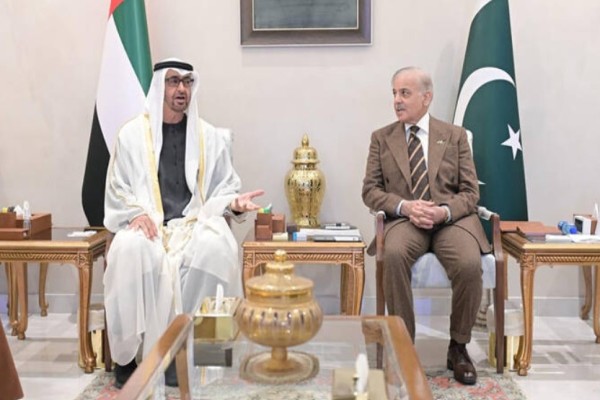
The dynamic of international relationships in West Asia is undergoing significant transformation. One of the most notable shifts is the evolving ties between the United Arab Emirates (UAE) and Pakistan, as the regional landscape grows increasingly complex. Once viewed as reliable partners, both nations now find themselves on opposite sides of a growing strategic divide, influenced by deeper partnerships the UAE is forging with countries like India and Israel.
Shifting Alliances: UAE’s Transformation
UAE has transformed itself into a formidable force in the Gulf region, often referred to by some as “Little Sparta.” The moniker emphasizes its military ambitions and strategic aspirations that rival those of much larger states. Recent statements by Israeli Prime Minister Benjamin Netanyahu, who dubbed Israel as the “super Sparta” of West Asia, underscore this evolving narrative. Both countries now share a strategic alignment, leaving Pakistan to reconsider its position in this rearranging geopolitical matrix. Historically, the UAE provided vital economic support to Pakistan, a relationship that has recently begun to fray due to these shifting allegiances.
Economic support from the UAE has been crucial for Pakistan, particularly during financial crises. In past years, the UAE extended aid in the form of multi-billion dollar deposits to stabilize Pakistan’s economy. However, as the security landscape shifts, UAE’s financial assistance has become conditional, highlighting a changing relationship that hinges on their respective geopolitical interests. After a prolonged period of comfortable partnership, tensions escalated sharply in early 2026 when Abu Dhabi hesitated to outright support Pakistan amid the onset of military actions directed at Iran. This marked a watershed moment, clearly demonstrating how financial resources can become instruments of leverage in the context of broader strategic divergences.
Tensions Rise: Conflicting Priorities
The escalation of hostilities in the region, particularly over Iran, has exacerbated existing frictions. The UAE has shown a willingness to distance itself from Pakistan, resulting in significant actions such as the arrest and deportation of Pakistani nationals perceived to have affiliations with Iran. These tensions are compounded further by Pakistan’s failure to align entirely against Tehran. Such diplomatic unease has left Pakistan in a precarious situation, where its economic reliance on the UAE is challenged by the latter’s growing closeness with Pakistan’s historical adversaries, India and Israel.
The UAE’s pivot towards India, especially following the establishment of the I2U2 group and the notable increase in bilateral trade, adds another layer of complexity. With trade volume reaching substantial figures, and defense collaborations intensifying, Pakistan fears that it is consistently being sidelined. The recent signing of a strategic defense agreement between Pakistan and Saudi Arabia further raises concerns in Abu Dhabi, amplifying mutual suspicions.
Broader Implications for Regional Stability
The shifting dynamics extend beyond just bilateral relationships. The UAE’s military and economic maneuvers have prompted a new paradigm within the region, especially amid the ongoing conflict in Yemen and the UAE’s burgeoning interests in the Horn of Africa. Not only is the UAE arming itself with strategic alliances, but its actions are also creating ripples that affect its historical relationship with Saudi Arabia, particularly as both nations find themselves on opposite sides of the Yemen conflict.
As the UAE continues to assert itself by engaging with countries that Pakistan traditionally views as rivals, Islamabad’s strategic choices become increasingly limited. With a high number of Pakistani expatriates working in the Gulf, a total rupture with the UAE would have dire financial consequences. Yet Pakistan’s commitments to its strategic partners, particularly Saudi Arabia, constrain its ability to cater to the UAE’s shifting preferences.
In conclusion, the unraveling of UAE-Pakistan ties is emblematic of broader regional changes. As the UAE embraces its role as a key player in West Asia, Islamabad must navigate a delicate balance of economic dependence and strategic autonomy. This scenario serves as a reminder of the evolving geopolitical landscape, where old alliances may not hold firm amid new realities.