
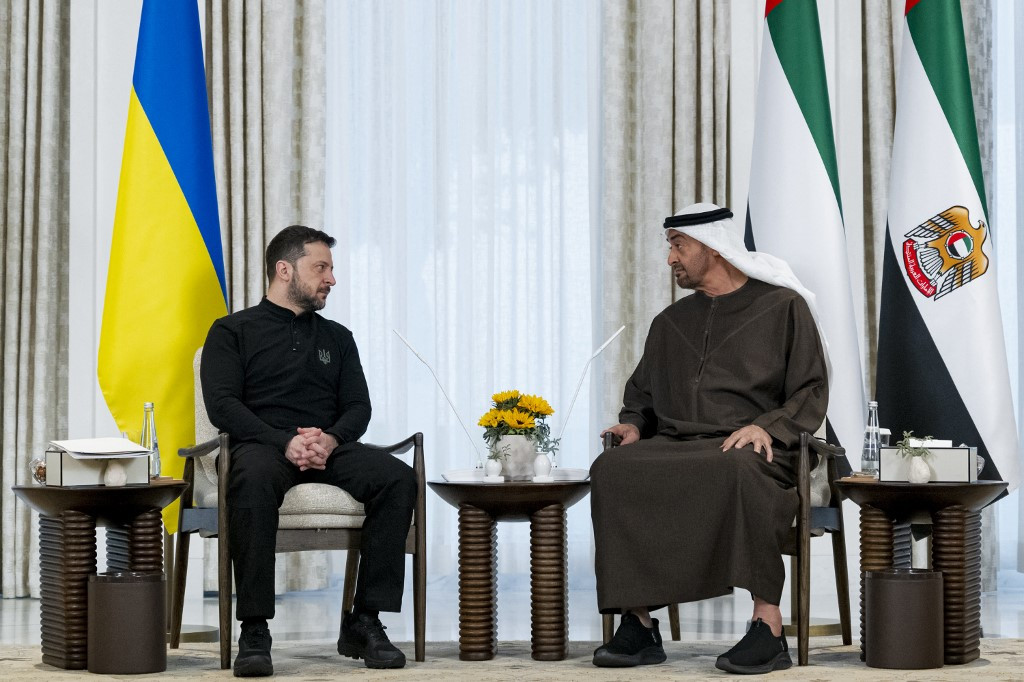
President Volodymyr Zelensky recently engaged in discussions with UAE President Mohamed bin Zayed Al Nahyan, focusing on enhancing the safety of maritime routes in the Black Sea and addressing global food security concerns. This dialogue comes in response to increasing threats to Ukrainian shipping posed by both Russia and Iran.
### Importance of UAE Support for Ukraine
In a video address on August 1, Zelensky underlined Ukraine’s past contributions to the security of its Gulf allies, particularly regarding defense against aggressions from Iran. He expressed a desire for mutual aid to bolster security in the Black Sea area. Zelensky highlighted that the conversations centered around how the UAE can assist Ukraine amid rising threats, specifically regarding food stability and maritime security.
The backdrop to these diplomatic efforts is a notable decline in relations between Kyiv and Tehran, underlined by a recent near-military conflict. Iranian Foreign Minister Abbas Araghchi accused Ukraine of attacking an Iranian commercial vessel in the Caspian Sea, a claim that allegedly resulted in the death of a sailor. He condemned the incident as a breach of the UN Charter, asserting that Ukraine acted under directives from Israel. In retaliation, Tehran considered targeting a Ukrainian seaport, but diplomatic channels have since worked to mitigate tensions.
### Rising Dangers in the Black Sea Region
The threat posed by Iran adds to the ongoing risks in the Black Sea. Throughout the summer, Russian forces have ramped up attacks on civilian vessels, a strategy that Zelensky asserts aims to completely disrupt Ukraine’s crucial “grain corridor” and impede global food supplies. The implications of these aggressive maneuvers are significant, threatening not only Ukraine’s economic stability but also global food security.
The recent incident in the Caspian Sea has drawn attention to the strained relations between Ukraine and Iran, which had already been deteriorating due to Iran’s support of Russia in the ongoing conflict. This included the provision of Shahed drones and military technology, further straining bilateral ties. The relationship hit a new low when Ukraine openly supported Israeli airstrikes against Iranian interests and classified Iran’s Islamic Revolutionary Guard Corps (IRGC) as a terrorist entity.
### Strengthening Alliances Amidst Tensions
Zelensky’s outreach to UAE showcases Ukraine’s strategic efforts to forge alliances in the Middle East, especially given the rising threats from Tehran. Earlier interactions, such as Zelensky’s meetings with exiled Iranian Crown Prince Reza Pahlavi, have framed the Moscow-Tehran partnership as an “Axis of Chaos.” This characterization has not only exacerbated tensions but has also reinforced the need for Ukraine to seek broader international support.
In light of increasing hostility, Israeli Foreign Minister Gideon Sa’ar has extended an invitation to Ukrainian Foreign Minister Andrii Sybiha for a visit to Israel. This invitation underlines the collaborative efforts between Ukraine and Israel to address common security challenges posed by Iran.
As geopolitical tensions continue to rise, the need for robust maritime security and food security frameworks becomes ever more critical. Ukraine’s engagement with the UAE is a testament to its proactive approach in securing both its own interests and contributing to global stability.
By connecting with allies in the Gulf and reinforcing strategic partnerships, Ukraine aims to safeguard its maritime routes and ensure the uninterrupted flow of essential goods. The developments indicate a critical junction in not only regional politics but also in the landscape of global food security, emphasizing the interconnectedness of international relations amidst growing threats.