
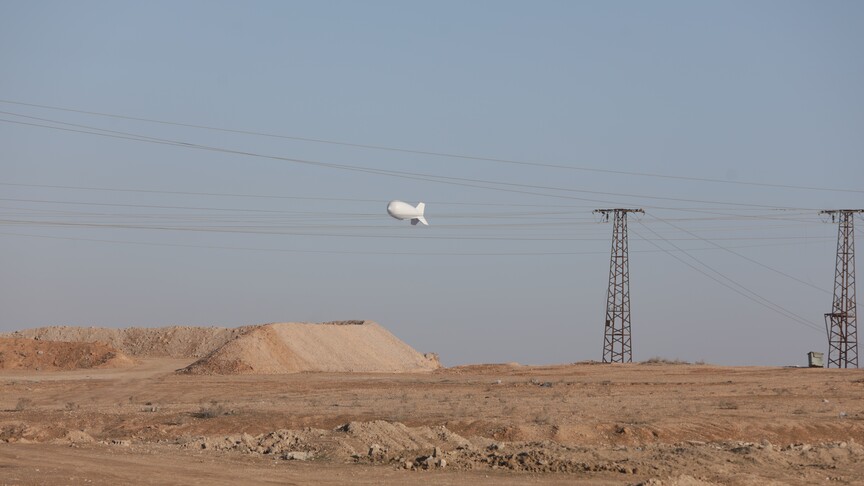
Iran’s Islamic Revolutionary Guard Corps (IRGC) recently announced that it successfully executed a drone strike on a US military tethered surveillance aerostat near Erbil airport in northern Iraq. This incident highlights the increasing tensions between Iran and the United States in the region.
Details of the Attack
On Sunday, the IRGC reported that the US military’s Persistent Surveillance Systems-Tethered (PSS-T) aerostat was “completely destroyed” during a drone strike conducted by its Aerospace Force. According to a statement released through Iran’s Tasnim news agency, the attack took place amidst ongoing clashes between Iranian and US forces in the area. The IRGC also shared footage purportedly showing the moment the surveillance system was targeted, emphasizing the precision of their operation.
The PSS-T aerostat is distinct from traditional balloons, as it remains tethered to a fixed location, functioning similarly to a surveillance tower. This makes it an effective tool for continuous monitoring, and its destruction could potentially impact US military operations in the region. However, there has been no immediate response from US officials regarding this claim from Iran.
Escalating Regional Tensions
The military confrontation marks a significant escalation in regional hostilities, particularly since the onset of US-Israeli attacks on Iran which began on February 28. In a marked response, Tehran has carried out missile and drone strikes targeting US interests and Israeli assets in the vicinity. These actions demonstrate Iran’s commitment to countering perceived threats to its sovereignty and regional influence.
Compounding the situation, military tensions have remained high following a memorandum of understanding between Iran and the US in June. Mediated by Pakistan and Qatar, this agreement aimed to reduce hostilities, facilitate the reopening of the strategic Strait of Hormuz, and address economic sanctions affecting both nations. However, both parties have since leveled accusations against one another for failing to fulfill their obligations, undermining the potential for dialogue and reconciliation.
The Path Forward
As Iran and the US continue to engage in a tit-for-tat military engagement, the risk of escalation remains substantial. The clashes underline a fraught geopolitical landscape characterized by distrust and antagonism. Without significant diplomatic efforts, the chances of a broader conflict could increase, threatening both regional stability and global interests.
The ongoing situation in Iraq and surrounding areas remains fluid, and experts suggest that without a commitment to constructive dialogue, opportunities for peace may continue to evaporate. As both sides navigate these challenges, the international community watches closely, aware that the implications of this conflict could ripple far beyond the immediate region.
In summary, this recent drone strike serves as a stark reminder of the volatility present in the relationship between Iran and the US, as well as the potential consequences of their escalating military engagements. With stakes this high, the call for diplomatic resolution has never been more urgent.