
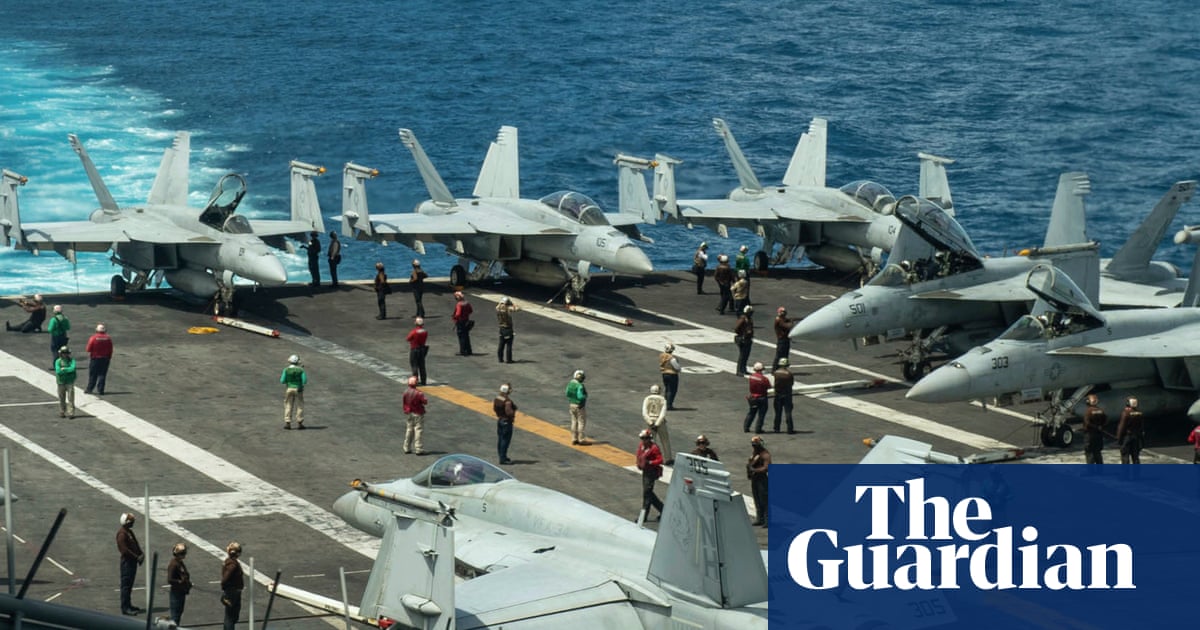
The recent announcement of a third US aircraft carrier strike group being dispatched to the Middle East marks a significant escalation in military readiness. Amid growing tensions and looming midterm elections, President Donald Trump hinted that fresh military action against Iran could be on the table, raising concerns in both domestic and international spheres.
Heightened Military Presence in the Region
The newly deployed naval force includes the USS Theodore Roosevelt carrier strike group and the USS Makin Island amphibious readiness group, bringing together over 7,000 sailors and 2,000 Marines. US officials indicated that this deployment could see three aircraft carriers in the region by the end of October, which is an uncommon number for the area. In total, the US naval presence may exceed 20,000 sailors and Marines, along with hundreds of aircraft already stationed in the Middle East. This represents a strategic military buildup reminiscent of the last time there were three carrier strike groups in the region, which occurred in April 2003.
Adding to the tension, the carriers USS George HW Bush and USS George Washington are already operating in the Middle East, alongside the USS Boxer amphibious readiness group. The USS Washington, typically designated for the Pacific Ocean, has been redirected to the Middle East to take over from the USS Abraham Lincoln, which recently completed a grueling deployment of more than 260 days.
Potential for Escalation
In a recent interview with Time magazine, President Trump discussed the possibility of intensifying military actions in Iran following the upcoming midterm elections. While he declined to provide specific details regarding future operations, he did confirm the potential for increased bombing campaigns. Trump’s rationale behind this strategy seems intertwined with both military objectives and political calculus. He firmly rejected a ceasefire proposal presented by Iran, stating that offers which once might have seemed adequate no longer met his approval standards.
The president also cited concerns about Iran’s nuclear capabilities, emphasizing that a significant majority of the global community opposes any nuclear armament for Iran. He confidently stated, “100% of the people” reject the notion of Iran having nuclear attack capabilities. This sentiment is expected to resonate with his base as the elections approach, suggesting that a tough stance against Iran could strategically benefit his party.
Political Implications of Military Strategy
Trump’s approach to the situation in Iran raises questions about the intersection of foreign policy and domestic politics. While some might argue that an unpopular war could hamper Republican electoral prospects in November, Trump seemed optimistic that a decisive military strategy would actually bolster support for his administration. He argued that the prevention of nuclear proliferation in Iran should positively play into his favor come election time.
This deployment of military resources and the rhetoric surrounding it highlights a broader strategy, aligning military readiness with political survival. As the midterms draw closer, the potential for military strikes not only serves as a warning to adversaries but also aims to consolidate Trump’s image as a strong leader.
In conclusion, with military assets increasingly concentrated in the Middle East and a rhetoric that suggests imminent escalation, the geopolitical landscape is poised for significant shifts. The upcoming elections will likely serve as a crucial backdrop against which military actions and political fortunes are carefully navigated.